Friday, August 3, 2012

CPI(M) PARLIAMENTARY DELEGATION VISITS AFFECTED AREAS IN ASSAM


Isfaqur Rahman

ASSAM continues to burn. The multi-ethnic, multi-religious and multi-national state, once again, witnessed horrible incidents of ethnic-communal violence in the Bodoland Territorial Area Districts (BTAD) since the eruption of hostilities among different communities – mainly between the Bodos and Muslim minorities – from the first week of July. Since July 19, lower Assam’s Kokrajhar and Chirang districts under BTAD administration and adjoining Dhubri district have been experiencing the worst form of frenzied violence. At least 60 persons, including children and women, have been killed. Several others  remained untraced till the filing of this report (August 1, 2012). Moreover, nearly 4 lakh people have taken shelter in 274 relief camps. In the four districts – Kokrajhar, Chirang, Dhubri and Bongaigaon in western Assam  – a total of 244 villages and 45,000 families were affected and five thousand houses were burnt to ashes.

For quite a long time, there were simmering tensions between different ethnic groups residing in the BTAD areas. The politics of identity have also been playing havoc. There were demands for further vivisection of Assam and creation of a separate ‘Bodoland state’. There were also demands for a ‘Kamatapur state’ raised by a section of Rajbongshi people. Communal and fundamentalist forces were also at work. Various non-Bodo organisations oppose “Bodoland” and demand redrawing of the BTAD areas by excluding certain villages where non-Bodos are overwhelming majority. The security and safety of the people was also a cause for concern. Mutual distrust, ill-faith and ill-feelings among different groups and communities prevailed for quite some time now.

TRIGGER FOR
THE VIOLENCE
On July 6,  two poor Muslim peasants were killed by unidentified gunmen at Mussalmanpara near Bhowraguri under Dotoma police station in Kokrajhar district. When tension was brewing after this incident, two student leaders of the Minority Students’ Union were attacked in Magurmari near Kokrajhar on July 19. This was followed by the killing of four former Bodo Liberation Tiger workers on July 20 at Jaypur-Namapara near Kokrajhar town – the headquarters of BTAD administration. The eruption of violence and counter-violence started soon after and spread to the interior areas. Ironically, both Bodo and Muslim leaders see a design in the orchestrated violence which spread like wild fire. Now the situation is quite disturbing as the cycle of violence has communal implications and unless tackled with a firm hand, it might well trigger a large scale communal flare-up in the state. The state administration will have to exhibit greater alacrity in preventing any further  escalation of violence. The state and central governments must take a serious note of the developments and ensure security and safety to all sections of the people.

As a matter of fact, the volatile law and order situation in the BTAD areas has been a matter of concern for quite some time now with extortions, killings and kidnappings assuming alarming proportions. While the situation warrants firm handling by both the BTC and the state government, it is precisely the lax attitude of the authorities that has largely been responsible for the growing lawlessness in Bodoland areas, allowing extremist outfits as well as surrendered ultras to have a free run. Easy availability of firearms with the militant outfits has been a major factor perpetuating a situation of strife and tension in BTAD. From extremist and surrendered extremists to every other trouble mongers, firearms have an all pervasive presence in the BTAD. Muslim fundamentalist forces are also no less active. The overall situation in BTAD areas is characterised by a growing cult of violence and fratricidal killings. The progress that the creation of the BTC was supposed to usher in will remain a mirage unless there is an end to the prevailing gun culture.

DISTURBING
SITUATION
Notwithstanding a slight improvement following deployment of security forces, the situation in the strife-torn BTAD and adjoining Dhubri continues to be extremely disturbing with more and more bodies of riot-hit victims being recovered. There have also been incidents of arson at places, with people fleeing their homes and hearths in their hordes. People are taking shelter in hoplessly inadequate relief camps – without food and drinking water. Restoration of normalcy, peace and harmony in the days ahead will certainly pose a Herculean challenge before the government. Physical rehabiliation apart, the trauma suffered by the affected people – both Bodos and Muslims – will take a long time to heal as will the breached trust between the two communities.

It may be recalled that communal violence of similar scale had affected Udalguri district in october, 2008. But the authoritics failed to learn anything from it. The current carnage could well have been avoided but for the inexplicable laxity of the authorities in nabbing the culprits behind the incidents of frenzied violence perpetrated by the trouble mongers of both the communities.
The BJP and its saftorn  brigade have been trying to fish in troubled waters and blaming the illegal Bangladeshi migrants for the violence. The Bodo People’s Front (BPF), a coalition partner of the Congress-led government in Assam, has also echoed similar sentiments. Even the BTC chief Hagrama Mahilary has stated  that the violence is being perpetrated by an organised gang of illegal infiltrators from across the Bangladesh border. But saner sections have maintained that this is a wild allegation and gross distortion of facts. Even the central and state governments have ruled out the possibility of a foreign hand behind the riots.

Terming the largescale ethnic violence in Assam as a ‘blot on the nation’, prime minister Dr Manmohan Singh announced a Rs 300 crore Central Relief Package for the violence-hit people after visiting two relief camps at Kokrakhar on July 28. But considering the woes and sufferings, death and destruction, this meagre amount will not serve the purpose.

CPI (M) DELEGATION
VISITS VIOLENCE-HIT AREAS
A three member team of the CPI(M) MPs, including the leader of the CPI(M) group in Lok Sabha, Basudev Acharia, visited Kokrajhar and Bijni on July 28 to take stock of the situation. The other two MPs were Bajuban Riang and Saidul Haque. The delegation was accompanied by the state leaders of the CPI(M) including the state secretary Uddhab Barman and two other former MLAs,  Purna Boro and Ananta Deka, and also state secretariat members, Monoranjan Talukdar and Fazlur Rahman. The delegation met cross-section of the people, visited relief camps and exchanged views with the inmates.

The delegation first visited the relief camp at Kakritola M E School (Nayek Gaon) in Kokrajhar where more than 3000 people belonging to the Bodo communities of 17 villages are taking shelter. The CPI(M) delegation also visited Bangaldoba village which was completely burnt down on July 23-24.
The delegation was shocked to see the Nayabhita village where the houses of around 200 Muslim families were completely gutted on  July 22. The incident of arson and looting took place near the Dotoma police station, which was hardly 50 meters away.

Later, the CPI(M) delegation moved to Bijni and visited a relief camp at Bijni Motilal Bagaria M V School where 900 Muslims, including 200 children, were taking shelter. It also visited a Bodo camp at Bijni College.

After visiting the violence-hit areas, the CPI(M) delegation held a press conference at the state headquarters of the Party in Guwahati on July 29. Addressing the media persons, Basudev Acharia stated the experience of the Party delegation. Bajuban Riang and Saidul Haque also addressed along with Party state secretary Uddhab Barman and senior Party leader Hemen Das. The CPI(M) leaders expressed grave shock and consternation at the horrific incidents of violence and destruction. They charged that the Congress-led dispensation in Assam was totally caught off guard by the carnage. The state government has even failed to protect the life and property of the people and discharge its constitutional responsibilities.  

The law enforcing machinery was a silent spectator in many places to the gruesome incidents of killing and arson. For inexplicable reasons, deployment of security forces were delayed by at least a couple of days – something that caused escalation of violence and the resultan destructions, including loss of lives. It is also not understood why the central government too failed to assess the gravity of the situation. Tension had been brewing in BTAD for quite some time but both the BTAD authorities and the state government chose to remain blind to the spectre of possible carnage while the situation warranted reinforcement of police and security forces. The delegation leaders said that the relief camps were being run without proper food materials and other essentials. Even baby foods were not provided adequately. The administration should ensure supply of essentials including medical service to the inmates in the relief camps, the CPI(M) leaders demanded.

The press note issued by the CPI(M) on this occasion stated, ‘At the present critical juncture, the first and foremost task is to check violence with a firm hand and restore peace and unity among all sections of the people. The government must ensure full security and make arrangement for immediate rehabilitation and safe return  of the people to their own place of residence. Adequate compensation, relief and rehabilitation to the affected people must be ensured on a war-footing. The relief measures announced by the prime minister and the chief minister should immediately be implemented.

‘The CPI (M) appeals to all sections of the people of the trouble-torn areas to resist fratricidal clashes and to restore peace and tranquillity at any cost for building mutual trust and confidence. All sections of the people must defeat the forces of division and reaction and strengthen the unity and harmony in the area.’

The CPI(M) has also been organising peace processions, meetings etc. at different places of the state includimg Guwahati, Rangia, Barpeta Road, Sorbhog, Kalgachia, Dhekiajuli, Tezpur, Sarthebari. It has appealed to all sections of the people  to restore normalcy and maintain peace and amity. The Party also demanded that the state government’s priority should be to instill a sense of security to the people, restore peace and harmony and provide relief and rehabilitation to the affected people.

Left Parties Demand Food Security; Protest against Price Rise in Jharkand


THE four Left parties - CPI(M), CPI, Forward Bloc and RSP organised a joint demonstration in front of Raj Bhawan in Ranchi on July 31, in solidarity with the Five-day central dharna organised by them in New Delhi from July 30 to August 3 against price rise and demanding right to food through a universal public distribution System.

Similar demonstrations were held in other district headquarters as part of the national campaign. In Ranchi, Left Parties’ supporters assembled at Jaipal Singh Stadium and marched towards Raj Bhawan. Police stopped the demonstrators near Raj Bhawan. They sat in dharna and held a meeting. The dharna was  led by CPI(M) state secretary G K Bakshi and CPI(M) leaders, Ramchandra Thakur, Prakash Viplav, Sudhir Das, D D Ramanandan, Prafull Linda, Sufal Mahto; DYFI leaders Sanjay Paswan, Sukhnath Lohra, Subhash Munda, Suresh Munda; CPI leader K D Singh, P K Ganguli, RSP leader Radha Kant Jha and Forward Bloc leader Jayant Pandey.

Leaders of the Left Parties said that the BPL/APL categorisation divides the poor. The government is depriving the people the right to food by using fraudulent methods to define who is poor and who is not poor and how many are poor in each state. It informed the Supreme Court that anyone earning more than 26 rupees a day in rural India and 32 a day in urban India (at 2010-11 prices) cannot be considered poor and therefore cannot get foodgrains at subsidised rates. As a result, large sections of our people are suffering due the high prices in the market. The bogus poverty estimates have resulted in  61 per cent of Scheduled Castes, 55 per cent of Scheduled Tribes, 52 per cent of agricultural workers not having BPL or Antodaya cards, they said.

Government promoting corruption, rues MY Tarigami


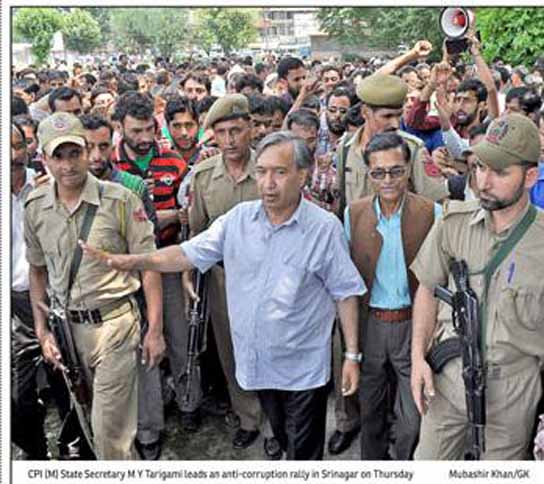
Lashing out at the National Conference led Coalition Government for its “failure” to curb rampant corruption in J&K, the CPI (M) state Secretary M Y Tarigami Thursday alleged that “instead of tackling corruption, the state government is promoting it.” “Chief Minister, Omar Abdullah had on the Floor of the House said that his government will remove corrupt officers. Then it was said that the list of corrupt officers has been prepared. I would like to ask Omar Abdullah what happened to that list. Ironically , instead of sacking these corrupt employees , the government is placing them on key positions in the administration which indeed means promoting corruption culture in the state,” Tarigami alleged. He said: “We have time and again raised the issue of empowering the State Accountability Commission but instead of giving it authority, it has been rendered defunct. The Vigilance GKOrganization has failed to deliver. Time has come that Accountability Commission should have its independent organizations that will investigate graft cases.” Addressing his party workers at Pratap Park here, Tarigami said “in our state people are being charged to pay for darkness. “We have to pay power tariff despite no electricity available and whenever people try to lodge their protest, police is brought to muzzle their voices.” He demanded that state government should issue ration to the people living below poverty line (BPL) at the rate of Rs 2 per kg. "The present poverty line figures of Rs 26 a day for an adult in rural India and Rs 32 in urban India continues to be the basis for access to Public Distribution System (PDS), which means larger sections of the poor will be legally excluded from the right to food," he said. He said the Centre is planning to pass Food Security Bill which will make Public Distribution System (PDS) dysfunctional. “Our central leadership is protesting against it, we will also join them,” he said. Later, Activists of CPI (M), led by Tarigami, staged a demonstration against the proposed food legislation and continuous rise in prices of essential commodities in the country. Carrying banners and placards, the CPI (M) activists and supporters assembled outside the Press Enclave here and tried to take out a march to submit a memorandum to the office of Divisional Commissioner, Kashmir. However, the march was not allowed by policemen.
(Courtesy: Greaterkashmir.com)

CPIM protest in Jammu against price rise


Regional Committee, Jammu of Communist Party of Indian (Marxist) observed protest demonstration at Green Belt Park, Gandhi Nagar, Jammu on the call of left parties including CPI(M) to demand a universal public distribution system to ensure food security for all citizens. A large number of party activists from different sectors participated in this protest. All the activists holding red flags and placards in their hands raised slogans against the policies of the government. The rally started from Green Belt Park and after passing through the Panama Chowk and culminated at Divisional Commissioner office and handed over the memorandum to the Divisional Commissioner.

Speaking on the occasion Comrade Sham Prasad Kesar, Regional Secretary of CPI (M) said that this demonstration is the culmination of the month-long joint campaign on the issue of food security and price rise conducted by the Left parties throughout the country. Kesar demanded to concede the following demands immediately that is No BPL or APL, we demand a universal public distribution system, give 35 kg of food grains at a maximum rate of two rupees a kilo per family, distribute the huge eight crore food grain stocks by increasing allocations immediately, scrap the Planning Commission’s highly dubious poverty estimates. Do not use them as basis for allocations for welfare rights, Implement the Swaminathan Commission’s recommendations for a fair procurement price and profit margin for formers.

According to the United Nation’s Global Hunger Index, India ranks 67 amongst the 80 countries in the world which suffer from acute hunger of its people. Twenty five percent of the world’s hungry are (shameful to admit) today Indians. According to this Index, India ranks even below counties like North Korea and civil war ridden and now divided Sudan.
Kesar further demanded uninterrupted power supply and check on rampant corruption.

While addressing the gathering senior leaders of party like Om Parkash, State General Secretary CITU, Kishore Kumar, Sohan Lal, Dharm Singh, Bishan Dass, V. K. Vaid said that with the introduction of the neo-liberal economic reforms, the universal public distribution system through ration cards was abandoned in 1997, this system allowed 21 million tonnes of foodgrains, i.e., 45 per cent of the available food stock in 1991 to be distributed through the ration shops. By 2001, such distribution reduced to a mere 13 million. The draft food Security bill perpetuates the targeting of people into priority (BPL) and general (APL). This will automatically exclude 54 per cent of the families in rural areas and 72 per cent in the urban areas. The below-poverty-line (BPL) cardholders will have to pay Rs three per kg of rice when eight states are providing rice at Re one or two per kg for those in the BPL list. Other addressing the gathering were Babu Ram, Ganesh Dass Bawa Ram, Sunita, Kanta , H.D.Bhomick , Kulbir Singh.

Fifth and Final day of Left Parties Dharna


Five-day dharna organised by the Left parties concluded today (3rd August) with the participation of thousands from Delhi, Haryana and Rajasthan. The dharna concluded with the call that September 12, 2012 will be observed as the 'Food Security Day' throughout the country. On that day, demonstrations will be organised in all the states and FCI godowns will be picketed. This was announced on behalf of all the four Left parties by A.B. Bardhan, veteran leader of the Communist party.

The last day of the dharna was addressed by A.B. Bardhan, former General Secretary of the CPI, Brinda Karat, Polit Bureau member, CPI (M), Debabrata Biswas, General Secretary, AIFB and Abani Roy, Secretary, RSP. Complimenting all the thousands of people who have responded to the call of the Left parties and participated in the dharna at Delhi and also demonstrations organised in various parts of the country, they called upon the people to mobilise in even larger numbers for the September 12 programme.

Prakash Karat, General Secretary of the CPI(M) and S. Sudhakar Reddy, General Secretary of CPI attended the dharna. Apart from the Central leaders, state leaders of the four Left parties from Delhi, Rajasthan and Haryana addressed the dharna. The dharna ended with the slogan, 'food security for all', 'do away with APL, BPL categorisation', 'strengthen and universalise the PDS', 'end speculative activities on foodgrains and other essential commodities' and 'take immediate steps to address agrarian distress'.

Thursday, August 2, 2012

Fourth Day of Left Parties Dharna on Food Security


Peasants, agricultural workers and common people from Rajasthan, Punjab and Himachal Pradesh participated in thousands on the fourth day of the Left parties dharna on 2nd August. Leaders of the four Left parties criticised the government for its biased policies that are favouring the rich.

The central leadership of the four Left parties exposed the true character of the UPA – II government, which masquerades under the slogan of aam aadmi. They pointed out the fact that while the government is unwilling to supply food grains to all the deserving people in our country in the name of 'excessive subsidies', it does not mind providing 'incentives' to the rich in our country. These incentives, they pointed out, are in fact nothing but subsidies to the rich, given under the garb of tax concessions. These tax concessions are nearly to the tune of 5,28,000 crores according to the official statistics mentioned in the union budget as revenue foregone. Left leaders brought to the notice of the people that if this amount was used to provide food security, strengthen the PDS, subsidise fertilizers, provide seeds, MSP for the produce of the peasants and such activities, it would have benefited crores of our peasants and agricultural labourers who are reeling under severe agrarian duress. That the government is not ready to implement such measures itself shows the vacuous nature of their slogan 'aam aadmi'. Today being Rakshabandhan, many women participants tied the Rakhi to the Red Flag stating that this is the best `brother’ today to protect them and their interests.

Sitaram Yechury, Polit Bureau member of the CPI (M), Atul Kumar Anjaan National Secretary of CPI, Manohar Tirkey, Member of Parliament of RSP, Jasbir Singh of AIFB addressed the protesters along with the state leaders of the four Left parties. Tapan Sen, General Secretary of the CITU, too addressed the gathering. Cultural troops of IPTA, Jan Natya Manch performed plays, while the participants sang progressive songs.

Centre subsidies for corporates, not for poor: Brinda


CPI(M) politburo member Brinda Karat today alleged that the Centre was extending subsidy to the corporate sector, but denying it to the common man for proper food security. Comrade Brinda Karat was attending a massive dharna in Agartala organised by Left front to protest against price rise and to oppose the proposed food security bill.

"Prime Minister Manmohan Singh always says that subsidy should be reduced. His government cannot give subsidy for food security of people but can provide different kinds of subsidy to the corporate houses. All these are the results of new liberal economic policy," Karat told.  She said that the proposed Food Security Bill is inadequate for people, and that her party demanded division of BPL and APL category in the proposed Bill be abolishedbecause poor people in the country were not given BPL cards.

"65 per cent Dalits and 55 per cent tribals in the country are still deprived of BPL cards, so we demand abolition of the division of BPL and APL in Public Distribution System (PDS)," she said. Karat said the central government had stocked eight crore tonnes of food granules as buffer stock, but according to rules only three crore tonnes were enough. "We have demanded that the rest five crore tonne granules be distributed to people at subsidised rate."\


Alleging that India was exporting food granules to foreign countries for feeding animals, she demanded to stop export of food and distribute them to the poor through PDS. The central government should follow Tripura which made an example in the country by giving rice to poor people at Rs two per kg, she said.

Appeal for Donation in Fund Raising for Ganashakti

For last 14 months Ganashakti has been facing fierce attack of the ruling parties of West Bengal. From urban belt to rural belt the attacks were everywhere. The attacks were initiated all over the state just after the declaration of result of the Assembly election. To stop the selling and circulation of Ganashakti the ruling party started threatening and also initiated attack. Several boards of Ganashakti were dismantled by the anti-socials. Still the circulation and sell of Ganashakti continued under difficult situation. Readers’ increasing interest toward Ganashakti is also evident. Beside the physical attack the state Government in a completely illegal move has stopped issuing advertisement to Ganashakti. Even the institutions who are issuing advertisement to Ganashakti are facing direct or indirect threat from the ruling party. So Ganashakti has been facing huge financial loss for last one year. Moreover, the devaluation of the rupee in comparison to dollar has resulted into a steep increase in price of newsprint. Allied expenditures have also increased. Ganashakti has been playing its role even amidst these multidimensional attacks Ganashakti has been playing its role. Only Ganashakti has been regularly taking initiatives to protect the interests of poor people including the workers and peasants and also unveiling the attacks on democracy. Through its news, features, articles and special contributions Ganashakti has been instrumental to reveal the undemocratic face of the state Government.
Ganashakti has been resolutely continuing fight against the anti-people policies of the Central Government. It has been operating as the only alternative newspaper when almost all business newspaper groups are playing anti-left role and eulogizer of TMC and Congress. Daily newspapers and other organs of Communist Party always have tried to intimate the real picture of the society to the largest possible reach. Ganashakti has the rich inheritance of Janajudhha and Swadhinata. Common people have always extended assistance in publication and management of the organs of the Communist Party. The people of West Bengal protected Ganashakti during Emergency. In those dark days many people had to take life risk to render support for Ganashakti. The support of the readers helped Ganashakti to overcome stiff hurdles. We appeal to all the workers, sympathizers of Left force, common people and above all the readers of Ganashakti to stand by Ganashakti in this adverse situation. Fund raising to support Ganashakti will be organized in the entire month of August. I hope we will get your support in this appeal. We further believe, Ganashakti will play stronger role to bolster the right to freedom of expression of the democratic people of West Bengal in the future.

Biman Bose
Secretary,
Communist Party of India (Marxist),
West Bengal State Committe

Wednesday, August 1, 2012

On Arrest of P. Jayarajan

The Polit Bureau of the CPI(M) condemns the arrest of P. Jayarajan, Secretary of the Kannur District Committee and a member of the Kerala State Committee of the Party. This arrest charging Jayarajan of conspiracy in a murder case is a deliberate act motivated by political considerations.

The CPI(M) appeals to all democratic minded sections of the people to strongly protest against this vindictive action.

Third Day of Left Parties Dharna on Food Security


Thousands of people from Punjab, Himachal Pradesh and Madhya Pradesh participated on the third day of the Left parties dharna on 1st August. The leaders of the Left parties congratulated the people who had come to participate in the dharna travelling hundreds of kilometres and braving many odds. They highlighted the fact that the thousands sitting in dharna in Delhi are joined by thousands more who are protesting in various parts of the country. They criticised the government for its failure to address the agrarian distress and its faulty agricultural policies.

Addressing the gathering, the leaders said, the government, instead of supporting the peasants by announcing remunerative support prices, is leaving them to the vagaries of market. Moreover, it is encouraging the cultivation of commercial crops for export, rather than cultivation of food grains. As a result, the production of food grains in the country has declined and this together with the speculative activities like forward trading is contributing to the rise in the prices of food grains and other essential commodities. This is leading to a situation where even the producers of food grains too are unable to buy them from the market. They demanded the government to immediately address the concerns for storage of food grains. Instead of letting the food grains to rot, the government should take steps to distribute them through the PDS by strengthening it.

S. Ramachandran Pillai, Polit Bureau member of the CPI (M), D. Raja, National Secretary of CPI and Member of Parliament, Amarjeet Kaur, National Secretary of CPI, Basudeb Acharia, Member of Parliament and Leader of the CPI (M) in Lok Sabha, Subhashini Ali, Central Committee member, CPI (M), Ashok Ghosh of RSP, Charanjeet Singh of AIFB addressed the protesters along with the state leaders of the four Left parties. Leaders of various mass organisations: AIDWA, AISF, DYFI and SFI too addressed the dharna. Jan Natya Manch performed a play highlighting the impact of price rise on the common people.