Tuesday, December 11, 2012

Land Struggle to start in Kerala from January 2013


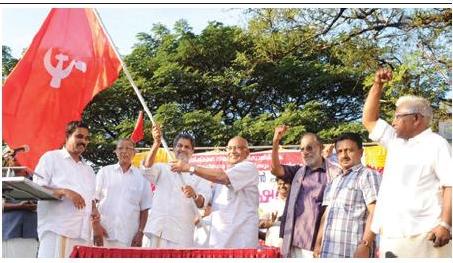
The CPI(M) Kerala state committe will start the land struggle (Bhoo Samaram) and occupy government land in illegal possession of individuals from the 1st of January 2013. The party is of the view that The government should take over all lease-expired properties in the State and distribute it among landless tribal people and those in the economically weaker sections of society.  Large tracts of government land were in illegal possession and there was large-scale encroachment on government land. Such land should be taken back by the government. The government was trying to amend the paddy and wetland conservation law to help the ‘land mafia’ in the State. There were also moves to amend the Kerala Land Utilisation Act to help the conversion of paddy and other agriculture land. The land ceiling law should be applied to huge tracts of and bought by the ‘land mafia’ in recent times.

With These demands the agricultural organisations, KSKTU (Kerala State Karshaka Thozhilali Union) AIKS (All India Kisan Sabha) PKS (Scheduled Caste and Tribe Development organisation) are going on the war path from the New Year day of 2013 onwards. 

Two Jathas proclaiming the demands of the struggle was inaugurated from the two ends of Kerala. CPIM General Secretary Com. Prakash Karat Inaugurated the South zone jatha from Neyyatinkara in Trivandrum District, while the North Zone jatha was inaugurated by CPIM P B Member Com. S Ramachandran Pillai from Kasargod District. The south zone jatha is led by CPIM CC Member com. E P Jayarajan and the North Zone jatha is led by CC member Com A Vijayaragahavan. 

CPI(M) General Secretary Prakash Karat while inaugurating the jatha alleged that attempts were on in the country to sabotage land reforms legislation under the cover of industrial requirements. "An attempt is on by the Centre and state governments to sabotage land reforms by handing over agriculture lands to corporates and such monopolies should be resisted," he said. Kerala, West Bengal and Tripura were the only three states where land reforms had been implemented and this was mainly due to the governments run by Left parties, Karat said.

The CPI(M) leader lambasted the Congress led UDF government in the state, saying it was trying to weaken the land reform act in the state with its decision to allow five per cent of Plantation land for other purposes. 'The decision will have serious adverse consequences. With this government decision, nearly 1000 acres would reach the hands of real estate groups," he alleged. In Kerala, land was scarce, but the number of landless people were more, he said. The possibility of poor landless people getting land would become difficult with government's new land policy, he said.

Karat also urged people to oppose UDF government's move to dilute the legislation for protection and conservation of water bodies and paddy fields brought by the previous LDF government. The UDF government planned to bring amendments to allow conversion and filling of paddy fields, he alleged.

“The United Democratic Front, whenever it comes to power, tries to scuttle the Act to delay the identification of surplus land for swift and effective rehabilitation of hundreds of landless families in the State. The present dispensation is continuing the same policy,” S. Ramachandran Pillai, Polit Bureau member of the party, alleged while inaugurating the north-zone leg of its land protection march at Kumbla in Kasargod. He said the party would intensify its agitation for rehabilitation of the landless people in the State.

The march, led by the party Central Committee member A. Vijayaraghavan, will join the south-zone leg from Neyyattinkara in Ernakulam on December 23, culminating in a public function expressing solidarity with the landless people in the State.

CPI(M) demands probe into land deals around Chamundi Hills

Members of the Communist Party of India (Marxist), Mysore district committee, staged a protest in Mysore on Monday urging the State government to order a probe into land deals involving more than 2,000 acres in and around Chamundi Hills.

The 1951 agreement between the erstwhile Mysore royal family and the Government of India should be scrapped as the land in contention belonged to the State, they said.

‘Issue title deeds’
The protesters criticised the district administration for remaining “silent” on issuing title deeds to farmers who had been cultivating ‘bagair hukum’, ‘gomala’, ‘gundutopu’, forest and revenue land for over 40 years. They demanded that the government initiate the process of issuing title deeds.

The land mafia had entered politics in the district and had a hand in the distribution of sites by the Mysore Urban Development Authority, they charged. The CID probe ordered by the government was dismissed as “eyewash”.

The workers drew the attention of the government to “large-scale irregularities” in land purchase by the Karnataka Housing Board for developing a housing complex at Gungaral Chatra area and surrounding villages in Mysore taluk. This case too should be handed over to the CBI or the Lokayukta, they demanded.
(Courtesy : The Hindu)

Backward classes students to get own hostels in Vizakhapatnam after SFI Struggle

Students belonging to the backward classes, Scheduled Castes and Scheduled Tribes in Visakhapatnam will soon have hostels of their own, a team of district officials assured protesting students at a rally conducted by the Student Federation of India (SFI)  on the 6th Decemeber.

Thirty-eight activists of the SFI, who were on fast for the last five days in front of the Collectorate here demanding that the government solve the problems relating to hostels and other issues, called off their protest following an assurance from district officials that the issues that could be solved at the district level would be addressed to immediately. 

The officials, including additional joint collector Narasinga Rao and deputy director BC welfare department Srinivasa Rao, said the DRO had been asked to identify land for the construction of the buildings. About 5,000 students from over 31 hostels have been agitating over issues pertaining to the upkeep and running of the hostels for the last couple of days.

L Satyavathi, an inmate of BC Hostel at Isukathota and SFI activist, said that inmates have been suffering over the past one year due to the indifference of the authorities. "Out of about 31 hostels spread across the city, 19 are set up in rented buildings. The welfare department has not paid the rent for the past one year and the owners, instead of dealing with the authorities concerned, have been threatening to evict us. At times they also cut power and water supply to harass us," she said.

Member of Legislative Council from the Graduate Constituency, North Coastal AP, MVS Sarma, alleged that the government was aware of the situation but was deliberately not doing anything to resolve it. "In reality they want to phase out the hostels and hand them over to the private sector. To get the attention of the government, the students had to take up an agitation," said Sarma. Apart from the building issue, the students said they have been facing scores of other problems. Most of the hostels are supposed to be managed by students. Earlier each of the student was being paid a paltry sum of Rs 520 per month to cover their expenses for breakfast, lunch, dinner and other things like laundry and stationary. Due to the meager amount doled out, students said over the last six months they were often forced to skip their breakfast and cut down on eggs and plantains, which were supposed to be provided at least three days a week. "There were days when we did not even have sufficient rice to cook and had to depend on starch," said Ganga Rao of SFI.
The authorities have now enhanced the amount to Rs 1050, but no one knows from when it will be implemented, said Satyavathi. "Even Rs 1050 is very low compared to the rising prices," said Sarma.

The hostels, be it for girls or boys, do not have adequate bathrooms. One bathroom has to be shared by at least 25 inmates. The windows and doors are broken and the security aspect has been completely ignored. There is also no running water and facility for safe drinking water is missing in most of the hostels. It may be recalled that a year ago there were two deaths due to water borne diseases.

However, the additional joint collector said on Wednesday that the concerned departments such as BC welfare and SC and ST welfare would take up the pending issues on a war footing. "We would not only focus on constructing our own new buildings but also take up repairs and maintenance and provide filtered and treated water facility to all hostels," said the additional joint collector.n While the authorities have agreed to almost all the demands, we will have to wait and watch to see whether it will translate into action or if it is just a ploy to quell the agitation, said CPM district secretary Ch. Narasinga Rao.
 
Among the students who went on fast were SFI State vice-president Jagan and city secretary Chinnari.
 
CPI(M) city secretary B. Ganga Rao, district secretary of UTF Y.A.R.K. Prasad, and DYFI leader B.A. Naidu expressed their solidarity with the students.
 

CPI(M) lay siege to Vijayawada sub collector’s office


The Communist Party of India-Marxist (CPI-M) has laid a siege to Sub Collector’s Office in Vijayawada on 10th December to draw the attention of the State Government on problems faced by the people in the city. 

The people in large numbers turned out near the Sub Collector’s office on Monday. The police took nearly 200 people into custody as soon as they reached the dharna spot. The police shifted the agitators, including CPI(M) leaders, to Suryaraopeta and Governorpeta police stations. 

They were locked up at the police stations till afternoon. The agitators staged a dharna at the Governorpeta police station against the arrests. The CPI(M) leaders, earlier, addressing the gathering, said that the commonman was not in a position to bear the burden being levied by the government under the garb of surcharges, and cap on subsidised LPG cylinders. The AICC president Sonia Gandhi has announced that 9 subsidised cylinders would be supplied in Congress ruled states, but the State Government is averse to it. 

The people were at the receiving end due to inefficiency of the Government, they said. The fuel adjustment surcharge was a burden of Rs.16,000-crore on the people. The people were at the receiving end due to the nepotism in the Government and its policies on the power sector. The policies were benefiting the private companies like GMR, and the Lanco owned by Vijayawada MP Lagadapati Rajagopal. 

The Government was stealing from the people to giving to corporate companies, the said. Rao said that the Government imposed a burden of Rs.20,000 crore on the people in last two years. The people went broke because of the new takes and hike in old one, user charges etc. The people should teach a befitting lesson to the Government, they said, adding, the Government would fall if it did not withdraw the surcharges.The CPI(M) Central Committee member Paturu Ramaiah, city secretary Ch. Babu Rao and others were present

Friday, December 7, 2012

CPIM Polit Bureau Communique

The Polit Bureau of the Communist Party of India (Marxist) met in New Delhi on December 6 and 7, 2012. It has issued the following statement:

FDI in Retail Trade
The decision of the UPA government to allow foreign supermarket chains in the multi-brand retail trade has met with widespread opposition from all sections of the people throughout the country. In Parliament, after refusing to accept a debate and vote on the issue, the government had to finally accede to the demand. The debate in both Houses of Parliament revealed that an overwhelming number of political parties representing a clear majority of the MPs are not in favour of allowing FDI in retail trade. This reflects the views of the majority of the people of the country.
However, despite this opposition, the government was able to maneouvre to get the motion against FDI in retail trade defeated. This was possible due to the opportunism of the Samajwadi Party and the dubious position adopted by the Bahujan Samaj Party. Both these parties spoke out against FDI in retail trade but acted in a manner to help the government succeed.
The strong opposition registered in Parliament and the actual minority status of the government on the issue should be utilized to intensify the struggle against the entry of Walmart and other supermarket chains into India. The Polit Bureau resolved to continue the campaign to mobilize public opinion to prevent the entry of the foreign supermarket chains.

Cash Transfer Scheme
The Polit Bureau reiterates its strong opposition to the move to implement the cash transfer scheme to replace the public goods like foodgrains through public distribution system and fertilizers. In a period of high inflation, cash transfers to replace subsidized goods is meant to actually cut subsidies since the cash to be transferred will not cover the increased costs of the same amount of subsidized foodgrains or fertilizers. Cash, instead of foodgrains, can also be end up for other consumption needs and result in increasing malnutrition and hunger. Having cash transfers in place of foodgrains will end up dismantling the public distribution system and procurement from farmers.
Regarding the linking of MNREGA wages to the Aadhar card, bio-metric identification for manual workers has a high 20 per cent margin of error as fingerprints of such workers change. The linking of MNREGA enrollment to Aadhar card holders will restrict the universality of the scheme. Moreover, the Bill proposed for the Unique Identification Number (UID) has not yet been passed by Parliament, but the government is going ahead with such far-reaching measures.
As far as scholarship, pensions etc are concerned, most of these schemes are already cash transfer schemes through bank accounts. The amount and also the coverage of these schemes should be increased and linked to the price index.

Communal Violence
The Polit Bureau noted with concern the outbreak of communal violence in Faizabad in Uttar Pradesh on October 24. The trouble started during the procession of the Durga puja idols for immersion. In a pre-planned manner, the minority community came under attack. 42 shops belonging to Muslims were burnt down. Attacks took place in two other sub-divisions of the district the same evening. This was not a communal riot but a planned attack on the Muslim community. The role of the Hindutva outfits has emerged. Faizabad is the twin town of Ayodhya which saw no communal violence even at the height of the Ram temple movement and the demolition of the Babri Masjid.
There have been a number of communal incidents in Uttar Pradesh in the recent months. The Samajwadi Party government has to take these communal incidents seriously. The Polit Bureau wants the state government to take firm measures to curb the activities of the communal forces.
In Hyderabad, the issue of extending the construction around the temple illegally constructed adjacent to the Charminar has led to communal tensions. The Muslim community and the secular forces have opposed the efforts to build up the temple which did not exist there till the 1960s. The state government should intervene firmly to check the communal forces from utilizing the “temple” issue.

Five Crore Signatures
The Polit Bureau called upon all its Party units to undertake the mass signature campaign on food security and for a universal public distribution system. The Left parties have given a call for the collection of five crore signatures by the end of January 2013. The Party units should organize a door to door campaign to collect these signatures.

All India Jathas
The Polit Bureau decided that the Party would organize all India jathas to project a national alternative. The Left platform on food, land and house sites, employment, education, health and the fight against corruption will be propagated. Jathas led by all-India leaders will cover the whole country in March 2013 and they will culminate in a mass rally at Delhi. The details of these jathas will be finalized at the Central Committee meeting to be held in Kolkata in January 2013.

Wednesday, December 5, 2012

West Bengal Demands Immediate Food Security Legislation

 
West Bengal Left Front Committee has launched a huge statewide signature campaign as a part of the nationwide campaign ensuring the demand for 35 kg rice at the cost of Rs.2 per kg for every household beyond APL or BPL delimitation. The historic signature campaign would thus fulfill the slogan of Food for All.

So the demand affirms no distinction between APL and BPL, the government has to ensure Food for All. Every signature therefore would ensure a step forward to fulfill the demand throughout 19 districts of the state. While inaugurating the signature campaign Left Front Chairman Biman Basu at Entally market area said that food grains are getting rotten in government stores, gobbled by rats. But people still starve to death in this country. This is no way acceptable.


To ensure Food Security the Left Front would ensure 5 crores signature in the whole country in which the 19 districts of West Bengal would ensure 1.5 crores signatures. ‘We would reach every household with the demand of Food Security for all, interact with them. People would give their signature to ensure food for millions of lives. We are trying to convince the Prime Minister the actual food situation of the country, said Biman Basu.


CPI(M) Polit Bureau member Buddhadeb Bhattacharjee, veteran Left Front leader Ashok Ghosh, and other Left Front leaders initiated the signature campaign programme.


While speaking on how the UPA government has not fulfilled the promise they once assured to the people of India, the leader of opposition Surya Kanta Misra said that ‘the Presidential speech of the first session after the UPA-II government came in power assured the promulgation of Food Security Act within first 100 days of the government. Time has gone by from 2009 to 2012, but that 100 days never returned’. Biman Basu also said in this context that ‘it was a long standing demand of the Left Front that the country must implement Food Security Act to prevent starvation and death. Although the bill is prepared and tabled but the act is yet to be promulgated’.


Misra while criticizing the UPA government said that ‘the government spares no time to ensure food security for its own people whereas it takes no time to implement FDI in retail sector. It takes a minute to hike the price of Petrol, Diesel and Cooking Gas’.


The signature campaign programme in its inaugural day has however witnessed people’s spontaneous participation. From leaders of different parties to the dignitaries of different field of excellence to the common mass the campaign marked its success and promise to succeed the month long programme.


The important signatories were Ashok Ghosh, Buddhadeb Bhattacharjee, Biman Basu, Manjukumar Majumder, Kshiti Goswami, Surya Kanta Misra, Rabin Deb, Raghunath Kushari, Avik dutta, Pratim Chatterjee, Manoj Bhattacharya, Subhas Roy, shaibal Chatterjee, Jayanta Roy, Shayamsri Das, former Vice Chancellor Pabitra Sarkar, Shubhankar Chakraborty, Ashok Nath Basu, Dilip Basu,
Malini Bhattacharya, litterateur Abul Bashar, film director Tarun Majumdar etc.

Tuesday, December 4, 2012

CPI(M) protest in Khamman demanding houses for poor


A protest demonstration by the CPI (M) cadres in pursuit of their demand for allotment of house sites to all the shelterless poor in the town into the office of the Revenue Divisional Officer on Monday. Mild tension prevailed at the entrance of the RDO’s office when the police stopped the protesters from venturing into the building.

Later, the agitated CPI (M) cadres staged a protest demonstration in front of the office denouncing the alleged apathetic attitude of the government towards fulfilling the housing needs of thousands of hapless poor of the town. The leaders of the party's frontal organisations also participated in the demonstration.

Sunday, December 2, 2012

Contribution of Communist Party of India (Marxist) at the 14th IMCWP

Intervention of Sitaram Yechury Member Polit Bureau Head, International Department Communist Party of India (Marxist) Dear Comrades, At the very outset allow me to thank the Lebanese Communist Party for not only hosting the 14th International Meeting of the Communist and Workers' Parties, but also making such splendid arrangements. The importance of this meeting, held here in Lebanon, cannot be lost for any discerned observer. We are meeting here in West Asia (or Middle-East as is commonly referred to by Western observers), at a time when the region is extremely volatile. In fact, there is no better place in the world than this that stands testimony to the imperialist aggression. As we are meeting and discussing the dangers and threats of imperialism, Palestinians in Gaza are experiencing it. Reports are coming out on an hourly basis about the many innocent lives lost in the aerial attacks. Even the injured are fighting for lives due to the non-availability of medicines – thanks to the Israeli blockade. Four years ago, coinciding with the elections in the US, Israel had attacked Gaza, which had resulted in more than thousand dead and many more injured. Barack Obama, the President-elect then, condemned the attack. Today, the winner of the Nobel Peace Prize, President Barack Obama, who won the right to be the President of the US for another four years, is staunchly defending Israel and its 'right to self-defence'. This illustrates how US and Israel are arrogantly appropriating the right to execute anyone they want, anywhere in the world, without any limitations, regardless of how many innocent civilians they kill in the process. It is not just Palestine. Just bordering Lebanon, Syria is another example of imperialist aggression. Now it has been clearly established that imperialist countries are openly arming and helping the rebels to destabilise the Syrian administration. As the people are dying in thousands, imperialist countries are openly planning the distribution of Syrian resources, once the current regime is overthrown and the rebels capture power. This was how they had operated in yet another country in the neighbourhood – Libya. All these go on to show once again that imperialism is the aggressor numero uno. And all these are happening even before the blood stains have dried in Afghanistan and Iraq. Iran is the declared target, on whom the Damocles sword is hanging. The reasons for this naked aggressiveness of imperialism cannot be understood unless we consider the political and economic conditions of the contemporary world. Imperialism is using all the means at its disposal – military, economic and political – to come out of the current global economic crisis and ensure that it retains its hegemony over the world. Comrades, Starting from the 10th IMCWP in Brazil, 2008, we had underlined in all our annual meetings that the world is reeling under the severest recession since the Great Depression of the 1930s. The global economic crisis is not a 'one-off' crisis, but a systemic crisis that is deeply rooted in the intrinsic functioning of the capitalist system. Fours years had passed and despite the brave claims made by the leaders of developed countries, the world is yet to come out of this systemic crisis. What we are now witnessing today is in fact, the fifth phase of the present crisis. The raison d etre of capitalism is profit maximisation. In its quest for maximising the profits and come out of the crisis it had found itself in the decade of the 70s, capitalism had initiated neo-liberal economic policies. As a result, the maxim for the State became, 'it is no business for the government to be in business'. With the setback to socialism in Soviet Union and East European countries, the apologists for capitalism propagated that capitalism is here to stay and that there is no alternative (TINA). End of history was proclaimed and neo-liberalism as a philosophy was trumpeted. Market dominance, led by the private corporates was unleashed on the people. This period witnessed intensified exploitation and increasing inequalities within the countries and across the countries. As a result real incomes saw a fall plunging the purchasing power of people into a steep pit. This in fact is the genesis of the present crisis and can be termed as its first phase. Capitalism unable to sell what it had produced, once again found itself in a crisis. To wiggle out of this situation it had designed ingenious methods like providing people with what are called as sub-prime loans. To cover the risks arising from the non­payment of these loans, new forms of financial instruments were evolved. Many financial institutions that were viewed as 'too big to fail', found their books full of these volatile financial instruments. They in fact sat on a volcano that was soon to erupt and erupt it did swallowing all those 'big' financial institutions. This corporate insolvency is the second phase of the crisis. Now, when the financial corporates collapse, taking down the stock market – regarded as a thermometer for market sentiment – it is bound to adversely affect the interests of capitalism. We find a situation where private capitalists who were till then shouting against government interference, at once demanding the government to bail them out. The capitalist State, true to its class character, came out in defence of these big financial corporates and bailed them out with huge packages. States that did not have any monies for enacting pro-people policies suddenly found trillions of dollars to rescue the financial institutions. While these financial institutions collapsed sinking the dreams of millions of tax payers who had invested their pensions and hard earned savings in them, the very money of these people – taxes paid to the government – is used to bail out these financial giants and ensure that they do not lose. This is the third phase in the current global crisis that rapidly led to the fourth phase. By undertaking huge and unprecedented bailout packages for those very corporates who, in the first place, caused the financial meltdown, developed countries incurred huge amounts of debts surpassing their GDPs. Thus, global capitalism sought to overcome the crisis by converting corporate insolvencies into sovereign insolvencies. This, in turn, has intensified the crisis today plunging the world economy into a state of uncertainty. Now we are in the fifth phase of the crisis, where the governments to wiggle out of the morass they find themselves in, impose what they term as 'austerity measures'. These are in fact nothing but a naked attack on the hard won rights of the working people. Retirement ages are raised, pensions and wages froze, widespread retrenchment became the norm, accentuating the already severe unemployment prevalent in many countries. This attack on the economic rights won by the working class is complemented by an attack on their social and political rights. The right to organise, strike and oppose the policies of the government are curtailed. Trade unions are repressed and political parties are painted black. The formation of 'technocrat' government in Italy, exemplifies this philosophy. Capitalism to defend its actions launches an intense ideological campaign. Attempts to rewrite history, malign communism as a theory by equating it with fascism, trying to negate the achievements of socialism are all part of such ploys. They thus intend to rob the working class of its historical legacy and deny it the ideological weapon to fight capitalist system. But as history had repeatedly shown and recent events once again testify, working class will not be fooled forever by such trickery. The 'austerity measures' introduced in many of the countries are indeed an attempt by the ruling classes to transfer the burden of the crisis on to the shoulders of the working class and common people. As the burden of sovereign debt in the name of 'austerity' is passed on to the common people, their purchasing power correspondingly declines. Combined with the growth of unemployment, this leads to a sharp contraction in domestic demand. Further, this global crisis has drastically reduced global trade. With the contraction of domestic demand in all the major economic powers, the contraction of GDP is inevitable. This, in turn, will lead to a contraction in governmental revenues, imposing further debt. The servicing of this would lead to imposing further burdens on the people. This vicious cycle has been set in motion. Reports are already emanating that Europe is now in double dip recession. It was officially accepted by European Union officials when they announced that the Euro zone was officially back in recession after a 0.1% fall in output in the third quarter. This follows a 0.2% drop in gross domestic product in the second quarter. For the first time, the reports also point out that this phenomenon was not confined to the 'southern' countries and 'peripheral' economies. Germany's growth rate has slowed since the start of 2012. France's economy is stuttering, earning it the sobriquet that it is 'the time-bomb ticking among the European economies' from The Economist. But the most important and serious observation that the recent data provides is that the 'triple A' rated Netherlands too saw a sharp 1.1% quarterly fall in GDP, which was more than five times the expected drop. Austria too is following a similar path. All these, apart from Portugal, Spain, Italy, Greece and Cyprus which saw their economies contract in the third quarter, shows that the contagion is spreading from the periphery to the core. On the other side of the Atlantic too the situation is not rosy. The USA and, indeed, the global economy are bracing itself to face the consequences of what is called the US “fiscal cliff”. If both the Republican and Democrat lawmakers do not arrive at any agreement, as it appears to be, the newly re-elected President Obama would be helpless. The levy of new taxes and automatic spending cuts are set to take effect from the beginning of 2013. This will lead to a severe contraction of the US economy. The impact would be devastating leading, according to some analysts, to as much as 4 to 6 per cent decline in the US GDP. Such a falling of the 'cliff' would push not only the USA into prolonged recession but lead to a global economic devastation. The Fitch, a rating agency, says that this would push the global economy into recession and “halve the rate of global growth in 2013”. On the top of these two catastrophes awaiting to happen – the double dip recession of the EU and the US fiscal cliff – in 2014 Greece, Portugal and Spain have to re-service their debts. This, they cannot. In order to adhere to their promises made to the international funding agencies like the IMF and ECB, they will be forced to accept further more conditions and increase the burdens imposed on their people. This will adversely affect the livelihoods of the people by further impoverishing them. Convergence of all these three elements is what is making this global economic crisis more acute and whatever efforts capitalism is making to come out of the current crisis are bound to fail. It is in this background that imperialism is becoming more and more aggressive – to bring under its control all the major pockets of natural resources, trading routes and world market. The military aggression in Middle-East, attempts to scuttle the popular uprisings, increase its military presence in Asia-Pacific, establish military bases across the world, particularly in Latin America are all part of this game-plan. But as the global developments point out people are not taking the attacks on their livelihoods and aspirations lying down. They are coming out in big numbers and forcing changes worldwide. The popular protests that we had witnessed in West Asia/North Africa; the strike actions, protests, demonstrations in Europe and other parts of the world; and the recent re-election of Hugo Chavez in Venezuela, all point to the mood of resistance amongst the people. It is this urge to resist and change the world for better that needs to be harnessed by us, Communists. As Marx had taught us and Lenin had subsequently proved in practice, capitalism will not collapse on its own. It has to be overthrown. This requires the united action of all the exploited forces, led by the working class. It is only through adherence to Marxism-Leninism – the only theoretical weapon that guides the working class in the struggle for systemic change – and 'concrete analysis of the concrete conditions', as Lenin had taught us, can we strengthen the subjective factor for the overthrow of capitalism. There is no better time than now to change the world. Socialism is the future, let us bring it now!
Long Live Marxism-Leninism.
The Fourteenth meeting of the International Communist and Workers’ Parties (IMCWP)


Beirut Declaration
 The Fourteenth meeting of the International Communist and Workers’ Parties (IMCWP) was held in Beirut, Lebanon’s Capital, between the 22nd and the 25th of November 2012, under the banner:

“Strengthen the struggles against escalating imperialist aggressiveness, for satisfying peoples’ socio-economic-democratic rights and aspirations, for socialism”.
 
The meeting was attended by 84 delegates, representing 60 parties, from 44 countries from the five continents of the world – while letters of apology were sent by those parties unable to attend due to circumstances beyond their control.
The meeting, follows the extraordinary meeting which was held in the Arab region, in Syria 2009, about Palestine within a three year period, and constitutes a new opportunity for the Communist and Workers' Parties to express their continued solidarity and support for the struggle of the working class and the popular struggles and uprisings in the Arab countries against imperialist aggressions and big capital and for democratic change. The discussions, which took place during the meeting, contributed to the exchange of views regarding unfolding developments worldwide and to agreement on the development of common and convergent actions aiming to effect a revolutionary struggle for socialism.

xxxx
The 14th meeting of the International Communist and Workers’ Parties (IMCWP) re-asserted its earlier statements issued during previous meetings between 2008 and 2011 regarding the capitalist crisis of capital overproduction and over accumulation, the root of which lies in the sharpening of the main contradictions between capital and labour, which continued to deepen and intensify. The different bourgeois versions for the management of the crisis have failed to bring it under control; all of them have the same barbaric effects for the people's rights. The imperialist reaction to the crisis is being marked by a multifaceted offensive of imperialism against the social, economic, democratic and national rights of the peoples, an offensive that aims to destroy the achievements won by the workers' and people's struggles during the XX century and to intensive  the level of exploitation and oppression.

This fact, in combination with the increased aggression of imperialism and the expansion of the imperialist wars, the realignments in the international correlation of forces where the relative weakening of the position of the USA co- exist with the growing economic and political power of several countries raises a group of issues which indicate that the world is, once again, at a critical and dangerous junction where the contradictions and the competitions are intensifying, and where great dangers coexist with real opportunities for the development of the workers and peoples' struggle.

In this regard, it is useful to pose the question: how does the universal, increased, imperialist aggression manifest itself, militarily, politically, economically and socially and what forms does it take?

Firstly, imperialism is pursuing an offensive that aims at large-scale destruction of economic, social, political, cultural and national rights, and a regression in the correlation of forces even more in favor of capital and against labour. Massive operations are under way to further concentrate and centralize capital. At the same time far reaching attacks are launched against social and labour rights, with massive cuts in salaries, massive unemployment, privatization and destruction of social functions of States, the privatization of nearly all the sectors of the economy and areas of social life. This anti-social offensive is accompanied by an unprecedented offensive against the democratic, national and ecological rights of the peoples.

In particular, the attack against the labour, economic and social rights of women has sharpened, provoking a brutal worsening in the conditions of life both in public and private fields. Addressing and defeating this aggression is crucial, because the struggle for the real equality of women is a vital part in the struggle against capitalism.

Secondly, it should be stressed that the reassertion of Barack Obama in the UN, where he stated that his country will not “withdraw” from the world, agrees with the program approved by NATO at its latest Chicago summit effectively implying an increased military imperialist intervention throughout the world under the slogan of “clever defense”.  This includes launching the first phase of “rocket shield” or “star wars” in Europe and the global anti-missile shield program, direct military intervention in Libya, intermittent threats against Iran and DPR of Korea, increased military activity, aggressions and provocations in the Middle East, the Asia Pacific zone and throughout the African continent, intensified imperialistic militarism in Latin America and the Caribbean. The intensification of hostility and the blockade against Cuba continues, as well as the plots against Venezuela.

Thirdly, this campaign of military aggression is accompanied by insolent and public political interventions in the affairs of most countries worldwide. These interventions are manifested by the use of capital and influence in order to distort and falsify the will of the people, in order to manipulate, intimidate and prevent the representatives chosen by the people from reaching power.  Imperialist forces do not hesitate from employing the worst tools in order to reach their goals, including organizing terrorist attacks, military coups, allying themselves with neo-fascist powers, promoting political - religious powers, and the various counter-revolutionary forces of different ideological backgrounds - all for the sake of exerting imperialist control throughout the planet, by redrawing borders and rearranging sectoral markets, especially the energy market with its oil and gas resources and transportation routes.  

Fourthly, this military aggression campaign is also accompanied by the intensification of the aggressiveness, such as employing the full resources of various international agencies and organizations, and in particular the IMF, World Bank, and the European Union with a view to safeguard the power of Big Capital.  In order to guarantee its interests and objectives, in addition to further developing its aggression and insolent interventions in the countries of the world, the global capitalist regime is adamant on waging war on the international working class and their representatives, through a variety of measures including:
  • A denial of the basic human right to work, and the associated gains achieved by the working class.
  • A global ideological and media offensive aiming to restrain the workers and people struggles and persecute all the social and political forces that struggle against imperialism, specially the Communist and Workers’ Parties.
  • Concerted efforts and actions in violation of all that is included in the UN charter and in the “Universal declaration of human rights”, which have been formed in conditions of a different correlation of forces thanks to the presence of the Soviet Union and the other socialist countries.
Fifthly, in the context of this over reaching, global imperialistic aggression, attention must be paid to the manner in which it is manifesting itself in the Middle East through the project of “the New Middle East” which aims at re-dividing the region and its people into ethnic and religious groups, constantly fighting each other. This in turn allows the appropriation of the natural resources found in this region and particularly the oil and gas resources. The military wars and occupation of Afghanistan, Iraq and Libya, and of the Israeli aggressions on Lebanon and against the people of Palestine are an inseparable part of the imperialistic "Big Middle East' project. In addition, it is within the context of this project that recent developments should be analyzed including 1.The escalation in the rate of the USA and European Union imperialist threats of military intervention in Iran, and against Syria, taking advantage of both violence acts being perpetuated against civilians and relying on the forces which are supported by the imperialists, 2. the continued efforts to control the path of the uprisings which have occurred over the past two years in several of the Arab countries and, in particular, Egypt and Tunisia, through the use of sectarianism, racism and prejudice as well as the forever-obliging petro-dollars of all Arabian Gulf regimes.

These developments, and their potential consequences, exert pressure on the working class and communist and Workers’ parties to carry out their historic responsibilities of confronting the capitalist system and imperialist aggression.  This confrontation, which must take place in different countries separately, and on the international level, is necessary in order to conquer anti-monopolist and anti-imperialist ruptures and achievements and, succeed in building socialism, as specified by the thirteenth International Meeting of Communist and Workers' Parties, held in December 2011 in Athens.

The confrontation with imperialism dictates the strengthening of the cooperation and solidarity of our Parties and the definition of our common goals and guidelines of struggle on the one hand, and the convergent action with the various anti-imperialist forces and mass movements, including Unions, Women, Youth and Intellectual organizations, on the other hand.
In Latin America, the anti-imperialist forces, the trade union and other social movements continue their struggles for people’s rights and against imperialism. These struggles, that are the target of a counter-offensive of imperialism, led, in some cases, to the emergence of governments that declare themselves programmatically in defense of national sovereignty and of social rights, for the development and protection of their natural resources and biodiversity, considering that they give new impetus to anti imperialistic struggle.

This universal confrontation also dictates the organization of the working people in the workplace and the trade unions, the strengthening of the class oriented movement the promotion of the alliance of the working class with the oppressed popular strata, the intensification of the struggle of the international working class and the peoples of the world. In order to impede the anti- people measures  and promote goals of struggle that meet the contemporary people's needs, demands a counter attack for anti- monopoly and anti- imperialist ruptures for the overthrow of capitalism.

The ideological struggle of the communist movement is of vital importance in order to defend and develop scientific socialism, to repulse contemporary anti- communism, to confront bourgeois ideology, and all alien tendencies, anti- scientific theories and opportunist currents which reject the class struggle; and combat the role of social democratic forces that defend and implement anti- people and pro- imperialist policies by supporting the strategy of capital and imperialism. The understanding of the unified character of the duties of the struggle for social, national and class emancipation, for the distinct promotion of the socialist alternative requires the ideological counteroffensive of the communist movement.

Considering the capitalist crisis and its consequences the international experiences from the socialist construction prove the superiority of socialism. We underline our solidarity with the peoples who struggle for socialism and are involved in the construction of socialism.

Based on all the above, we stress the need to focus on the following joint actions:
  1. Struggling to confront the new plans of imperialism on the military, political, economic and social levels in order to prevent it from controlling the world and destroying it.
  2. Rallying for the removal of NATO military bases and the right of withdrawal from the imperialist alliances.
  3. Expressing class solidarity with and providing support to strengthen the working class and popular struggles in the capitalist countries against the policies that put further burdens on people and for winning benefits for improving the livelihoods of the workers and peoples effecting revolutionary change.
  4. Reasserting international solidarity with democratic popular movements and uprisings in the face of occupation and oppressive regimes; and the adamant rejection of imperialist intervention in these countries.
  5. Confronting anti-communist laws, measures and persecution; waging an ideological struggle against the revision of history, for reasserting the contribution of the communist and labour movement in human history.
  6. Condemning the US blockade of Cuba and supporting Cuba’s struggle for its immediate lifting. Strengthening the campaigns for the release and return of the five Cuban patriots to Cuba.
  7. Condemning the ongoing atrocities perpetuated by the Israeli occupying forces against the Palestinian people, supporting their right in resisting occupation, and building their independent state, Jerusalem as a capital, and strengthening the campaign for the immediate lifting of the blockade against Gaza and for the Right of Return.
  8. Promoting the international front against imperialism and the support for the international anti-imperialist mass organizations, the World Federation of Trade Unions (WFTU), the World Peace Council (WPC), the World Federation of Democratic Youth (WFDY), and the Women’s International Democratic Federation (WIDF), in the specific framework of every country.

CPI(M) flays Congress for the miseries of the people in Andhra


CPI (M) State secretary B.V. Raghavulu called upon the people to revolt against the Congress government, as it had failed to meet their aspirations.Com Raghavulu held a walk for about six km from Isnapur to Patancheru on Saturday to know the problems being faced by the people.

During his walk, he has also interacted with people and visited pollution treatment plant.
Later addressing a gathering at Patancheru, Com Raghavulu said that the government left the people to their fate and not bothered to address their problems. He said that both TDP and YSRC were indulged in mutual mud-slugging while the TRS was confined only to Telangana issue and not bothered about public issues.

“Only CPI(M) has been trying to find out the problems of the people and bring them to the notice of the officials to get them addressed,’’ he said. He also demanded the government provide Manjeera drinking water to all villages in the district.