Thursday, July 5, 2012

Left parties plan agitation in Haryana

The Haryana units of the CPI (M) and the CPI have decided to hold block level protest actions during July 16-27 all over the State on the issue of food security and other burning problems including failure of the recently set up thermal power plants in Khedar and Yamunanagar leading to acute power and water crisis.

CPI (M) State secretary Inderjit Singh and CPI State secretary Daryao Singh Kashyap told  that a joint meeting was held in Rohtak where it was underlined that the system of remunerative price of crop for farmers was entirely dependent on making the public distribution system fully universal rather than a targeted one as sought by the United Progressive Alliance regime in the proposed Food Security Bill.
The Left Parties have also demanded a thorough probe in the “most grave case of sub-standard machinery and equipment used in the thermal power plants in Khedar and Yamunanagar.

“Only through an impartial inquiry can the persons responsible for alleged corruption be severely punished,’’ Mr. Singh asserted.
The Haryana Government was not coming out with reasonable explanation even as the people were reeling under acute scarcity of power and water all over the State. “The continued silence of the government over the failure of the power plants is intriguing,’’ he added. Problems related to the MGNREGA, residential plots and worsening crime situation would also be focused upon during the forthcoming mass campaign, he added.
Courtesy : The Hindu

Tuesday, July 3, 2012

Drought in Maharashtra: Massive Mobilisation of 33,000 Rural Poor

Ashok Dhawale
Secretary, CPIM Maharashtra State Committee


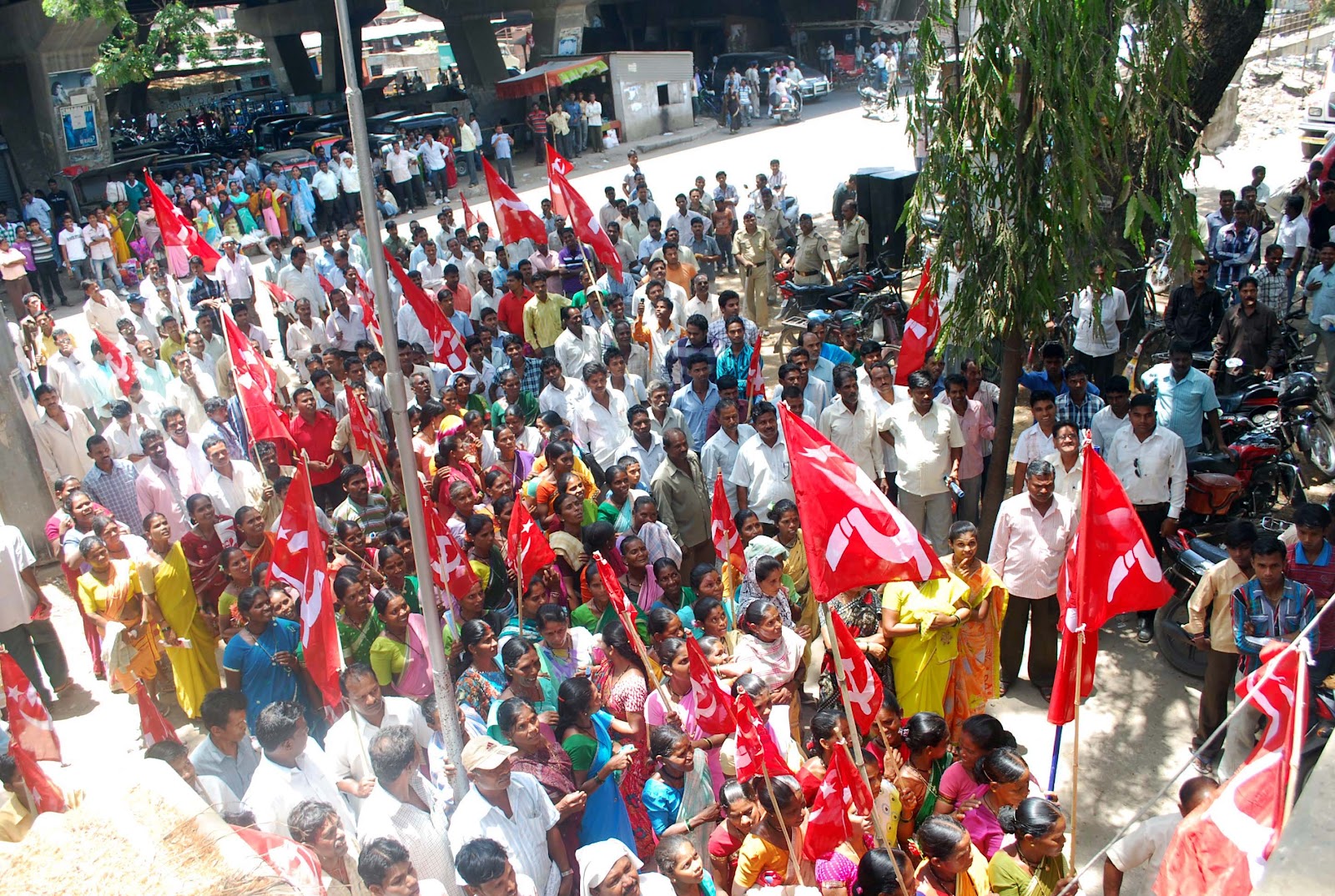
Responding to the call of the CPI (M) Maharashtra state committee, over 33,000 rural poor comprising mainly peasants and agricultural workers held demonstrations on district collectorates and tehsil offices in 19 districts of the state on May 14, 2012. The vital issue taken up was that of the severe drought currently stalking Maharashtra and the utter insensitivity of the Congress-NCP-led state government in dealing with this issue affecting crores of people and also lakhs of cattle.

In Chandwad
GENESIS OF CHRONIC DROUGHT   

After dithering for weeks, in the beginning of May the state government finally admitted that 7753 villages in 15 districts were drought-affected. As always, this was also a gross underestimate, based on the ridiculously false ‘paisewari’ estimates of crop produce that are still based on the crop production criteria set up during the British colonial era!

Today, the situation in thousands of villages is grave. There is great scarcity and even complete absence of drinking water. Wells have run dry. Dams and reservoirs are depleted. There is lack of adequate fodder for cattle. Maharashtra is one of the worst states in the country so far as the implementation of MNREGA is concerned. Last year in 17 districts not even a single man day of work was provided. The wage paid is a pittance. The public distribution system is in shambles and is riddled with corruption and black-marketeering. To add to the woes of the drought-hit, load-shedding of power has increased to the tune of 12 to 16 hours a day in the rural areas.

In Jawhar

Drought is by no means a new phenomenon in Maharashtra. It recurs every three to four years. The number of tehsils that were earlier declared to be chronically drought-prone was 87. This figure has now crossed the 100 mark. Beyond setting up several Irrigation Commissions one after the other, successive state governments – be they of the Congress, Shiv-Sena-BJP or Congress-NCP - have done nothing. None of the recommendations of these Irrigation Commissions have been implemented.

For instance, some of these Commissions had said that with optimum utilization of both groundwater and surface water resources, 45 per cent of the land under cultivation could have been brought under irrigation. But what is the actual situation? As per the Economic Survey of Maharashtra 2011-12, when the state of Maharashtra was formed in 1960, 6.5 per cent of the cultivated area was under irrigation. It rose very gradually to 8.4 per cent in 1970-71, 12.3 per cent in 1980-81, 15.2 per cent in 1990-91, 17.8 per cent in 2000-01, and just 17.9 per cent in 2010-11. Dry land agriculture over 82 per cent of the area in the state has been suffering immensely as a result. It must be noted that the cultivated land under irrigation in India as a whole is 45.3 per cent.

In Parbhani

The nadir was reached in the last ten years. As part of the running battle between the Congress and the NCP (the NCP has long held the Irrigation portfolio in the state), chief minister Prithviraj Chavan declared recently that after spending Rs 70,000 crore on irrigation in the last ten years, the proportion of irrigated land increased by only 0.1 per cent. He announced that a White Paper on the issue would be published. This led to a war of words between both the parties in the ruling alliance.

Another significant issue concerns the massive escalation of irrigation expenses. The Irrigation Commissions in the early 1960s had opined that with an expense of 1,300 crore rupees, 30 per cent of the land could have been brought under irrigation by 1980. Today the chief minister says that a sum of 77,000 crore rupees would be required for the completion of incomplete projects! Needless to say, a significant part of this cost escalation is directly related to rising corruption at all levels. Now the rulers say that since such massive outlays are not possible, priority would be given to water conservation schemes. Nothing stopped them from doing so for the last several decades.

The third issue is the completely skewed nature of the distribution of irrigated water. It is well known that sugarcane is a water-guzzling crop. It is equally well known that Maharashtra is ruled by an alliance of the big bourgeoisie and the sugar lobby, predominantly from Western Maharashtra. As Kumar Shiralkar wrote recently in the CPI(M) state committee weekly ‘Jeevanmarg’: “In 1950, 45 per cent of irrigation water went to sugarcane. This rose to 60 per cent in 1987. In the last ten years, although Rs 70,000 crore spent on irrigation has come to naught, in 2011 the proportion of irrigation water going to sugarcane has reached 70 per cent. Today the average amount of water in the dams in the state is 23 per cent. In Vidarbha it is only 12 per cent. In 12 dams it is zero. In the medium and small irrigation projects it is between 11 to 15 per cent. It is in such a grim situation that 70 per cent of irrigation water is being given to cane, which occupies only 4.5 per cent of the cropped area.”

In Solapur

The last issue concerns the neo-liberal prescription - privatization of water resources and diversion of water to the rich in the cities and to SEZs, at the expense of the countryside. As a major step towards privatization, the Maharashtra Water Resources Bill was hurriedly passed and in 2005, the Maharashtra Water Resources Regulatory Authority was set up. Since the state government claims that it has no money to set up or complete irrigation projects, the policy of allowing private players in this sector began in right earnest, with all the attendant ill-effects on water-users.

Simultaneously, a drive began to divert scarce water resources from the rural areas to the uncontrolled expansion of the cities to cater to the interests of the builder lobby, and to SEZs. It was this same drive that led last year to the peasant resistance and police firing at Maval in Pune district, which killed three farmers, including a woman. It is now proposed to build as many as ten dams by displacing thousands of Adivasis and others from several villages in the Thane and Raigad districts adjoining Mumbai. Thane district, which has some of the largest dams and water reservoirs in the state, has only 2 per cent of irrigated land and there is great scarcity even of drinking water in several tribal-dominated tehsils.

On the other hand, it has been reported that Mukesh Ambani’s new 27-storey residence ‘Antilia’ in Mumbai, built at a cost of Rs 9,000 crore, is provided 60 lakh litres of water per month! While most of the state is in darkness due to power load-shedding (which is itself a direct result of the power privatization policy of the ruling classes that led to the Enron fiasco, and is now being compounded by the Jaitapur nuclear power project drive), the monthly electricity bill of this modern-day Ambani palace is to the tune of Rs 70 lakh! This is only one instance amongst many in Mumbai.

STRUGGLE AGAINST DROUGHT

The CPI(M) Maharashtra state committee, which met on April 29, decided to launch an independent struggle on the issue of drought with two objectives in mind. The first was, of course, to ensure that immediate relief in the form of drinking water, employment, ration grain and fodder reached the people and their cattle. Towards this end, a charter of demands was prepared by the state committee. The second was to highlight the bankrupt ruling class policies briefly outlined above that had led to plunging the state in a chronic drought situation over the last several decades.

In Talasari
The two districts where the biggest mass actions were held were Thane and Nashik districts. Over 12,000 people stormed 7 tehsil offices in Thane district and over 11,000 people stormed 9 tehsil offices in Nashik district. In Thane district, the people gheraoed government offices in four tehsil centres and did not move until the authorities gave written assurances on their demands. At Igatpuri in Nashik district, over 500 people blocked the Mumbai-Agra National Highway.

In the Akole tehsil of Ahmednagar district, which hosted the Party state conference in March, over 3,000 people were mobilized in several village level actions. In the South Solapur tehsil of Solapur district, over 2000 people led a road blockade. In Parbhani district, a 1500-strong demonstration marched to the district collectorate. In Hatkanangale in Kolhapur district, a 1000-strong demonstration was held. In Nandurbar district, road blockades were organized in four tehsils, and nearly 400 people were arrested.

Similar actions took place in districts like Nanded, Beed, Jalna, Aurangabad, Hingoli, Amravati, Buldana, Jalgaon, Satara, Sangli and Raigad districts. Special mention must be made of demonstrations held by the Party in the urban centres like Mumbai, Nashik, Jalna and Aurangabad, where the working class raised the demand of the peasantry for drought relief. The actions in Solapur, Kolhapur and Parbhani districts also mobilized the working class along with the peasantry. In Pune, a Convention on Water was organized by left and secular parties.

All these mass actions succeeded in wresting concessions and immediate action from the government authorities for drought relief. Most of these actions were well covered by both print and electronic media, some of whom reported that it was only the CPI(M) among all other political parties in the state that took up concerted cudgels against the severe drought situation in the state.

Sunday, July 1, 2012

Golden Jubilee Celebrations of Theekathir Daily commences


The 50th Anniversary Celebrations of Theekathir Tamil Daily commenced on June 20 in Thiruvarur District. Theekathir, the official organ of Communist Party of India Marxist, commenced publishing on the same date in 1963 with one edition. Now the paper is having 4 editions, viz, Chennai, Madurai, Coimbatore and Tiruchi. More editions are in the offing during this golden jubilee year.  CPIM Polit Bureu member Com. K Varadarjan inaugurated the event. Several programmes will be held across the state as part of the Golden Jubilee celebrations. CPIM State Secretary Com N Ramakrishnan praised the contributions made by late Com. P Ramamoorthi, A Nallasivam, N Varadarajan, K Ramani for the growth of the newspaper. He praised the stand taken by the Newpaper, perhaps the only newspaper, regarding untouchability that is prevailing in the state. Several Newpaper agents of Theekathir daily and the earlier year workers of the paper where honoured during the function. On the ocassion, a fund of Rs. 3 lak which was collected by CPIM thirivarur district committee was handed over to PB member Com. K Varadarajan.

Left Front to organise protest against Mamta Raj in West Bengal

The CPI(M)-led Left Front today demanded that the Mamata Banerjee government call an all-party meeting to chalk out a mechanism to arrest the price rise in West Bengal."The state government should convene an all-party meeting within seven days to find a mechanism to check price rise of essential commodities. There should not be any delay," Left Front chairman Biman Bose said.

The state government should also explore application of the Essential Commodities Act, Bose said referring to the price of potato shooting up. On Chief Minister Mamata Banerjee's suggestion for sending an all-party delegation to the entre to press for a three-year moratorium on interest payments by the state, theFront chairman said that its draft should be made clear so that Front could be part of the delegation.

He said that a Front delegation submitted a memorandum to Prime Minister Manmohan Singh, when he last visited Kolkata, seeking central assistance to tide over the financial crisis in the state.

Claiming that the food security bill would not be of help to the common man, he said that since foodgrain stocks in the country were seven crore tonne against the required 2.12 crore tonne, it should be distributed through the public distribution system. Bose said that this would cost the exchequer Rs 30,000 to Rs 40,000 crore.

On Singur, Bose said the state government should not differentiate between willing and unwilling farmers for givingrice at Rs two per kg and Rs 2,000 as a monthly allowance. "The government should give the assistance to all till disposal of the case in court," he said.

The Front, he said, would launch a massive campaign from July four to July 17 statewide against the price rise. Bose said that sit-in demonstrations would be held from July 11-15 at block and municipal areas and also at Kolkata and Siliguri on July 17 together with a law-violation programme. He said that from July 25 to August 31, the Front would launch a campaign against price rise in West Bengal and in Delhi.

Friday, June 29, 2012

CPIM protest Electricity tarrif hike in Delhi

Comrade Vijender Sharma adressing the protestors
The Delhi State CPI (M)  on 28 June, 2012 held a demonstration at ITO to protest against the massive increase in power tariffs announced by the DERC two days ago. Hundreds of men and women participated.

The protestors were addressed by Anurag Saxena (CITU), Sehba Farooqui (JMS), Puran Chand (DYFI), Arjun Sengupta (SFI) and P.M.S. Grewal (CPI-M). Party State Secretariat member, Vijender Sharma presided over the protest meeting.

The speakers strongly condemned the Delhi State Government for heaping such a huge burden upon the people of Delhi. Power tariffs have increased by an unheard of 64% in just 10 months. Coming in the backdrop of high inflation, especially in food items, this hike in power tariffs is nothing but a brazen attack on the livelihood of the people. The alacrity, with which the Chief Minister has defended hikes in power tariffs, makes it amply clear that she has no concern for the people of Delhi. Instead she is behaving more like an agent of private power companies.

The speakers demanded immediate withdrawal of the recent power tariff hike. This must be followed by an independent and transparent audit of the accounts of the power companies, who as is known have been fudging their books to conceal the massive profits that they are actually making.

The demonstration ended with the resolve to take the campaign against the power hike to wider sections of the people for building pressure to force the government to withdraw these atrocious hikes in power tariffs.

Leaders too busy with power tussle to focus on drought in Karnataka : CPIM

The factional politics on the question of leadership change prevailing in the Bharatiya Janata Party has resulted in complete neglect of the severe drought situation in the State, according to the Communist Party of India (Marxist)
.
Speaking to mediapersons here on Thursday, CPI(M) State Secretariat member Nityananda Swamy said that farmers, who had taken up sowing, were in deep crisis because of deficient rain.

Migration
“There is large-scale migration from north Karnataka and other drought-hit areas into cities like Bangalore,” said Mr. Swamy, adding that poor implementation of the Mahatma Gandhi National Rural Employment Guarantee Act had worsened the migration situation.
Daily wage workers in places such as Koppal and Bellary were migrating to far away places for wages far lower than what was promised under MNREGA, he said. Mr. Swamy said that the districts of Hyderabad-Karnataka and coastal regions had received only 43 per cent of the normal rainfall.

The nine districts of southern Karnataka had received 59 per cent of normal rainfall and Malnad districts of Kodagu, Shimoga and Chikmagalur had received 22 per cent of normal rainfall. The least rain of 10.02 mm was received in Koppal, said Mr. Swamy.

Inaction
While water-levels in reservoirs and power generation situation was dire, the Ministers were busy in factional fights, he said.
(Courtesy : The Hindu)

Tuesday, June 26, 2012

CPIM Stand on the Current Presidential Election

Article Appearing in the forthcoming Issue of People’s Democracy
 
Prakash Karat (CPIM General Secretary)
 
The Presidential election is being contested by two candidates – Pranab Mukherjee, standing on behalf of the UPA, and P. A. Sangma, supported by the BJP (and sponsored initially by the AIADMK and the BJD). This election is not to be seen as just a contest between these two candidates. Beneath the surface are stirrings and a churning process that presage a political realignment.
 
In the background of the presidential contest are the troubles afflicting the UPA government, which include the worsening economic situation due to its bankrupt policies, the lack of cohesiveness in the alliance itself and its inability to take political and policy initiatives. Price rise and corruption have eaten into popular support for the Congress and the UPA government.
 
The BJP’s credibility has also taken a battering. The Mumbai National Executive session put the leadership tussle and the aggressive rise of Narendra Modi on public display. The RSS’s role was evident. These events have had their repercussions on the NDA. The JD(U) response has been firm. Its assertion that it will not support Sangma or any other BJP-sponsored candidate shows its discomfiture.
 
The weakening of the UPA and the NDA was manifested in the ways in which they dealt with the presidential issue.
 
In the UPA, there was a rift between the TMC and the Congress over the candidate to be proposed. This event is not to be seen in isolation. The TMC has been at odds with the UPA government on various issues. While much of the conflict is posturing by the TMC, there is a deeper reason for it. In West Bengal, the TMC is working to marginalize the Congress and to appropriate its base, and is quite willing to resort to strong-arm methods to accomplish this objective.
 
The BJP wants the NDA to expand; in reality, it is in disarray. On the issue of the Presidential election, the JD(U) and Shiv Sena have decided to support Pranab Mukherjee.
 
As against the Congress and the BJP, the regional parties have been gaining ground. These parties are not bound to either of the major parties. They are acting on the basis of their interests, sometimes opportunistically. But the common stand they are taking is to assert the federal principle, which is a positive trend.
 
 This is the background to the current presidential elections. The CPI(M) has always seen the presidential elections as a political issue and taken a political stand. The political-tactical line of the Party decided at the recent 20th Congress calls for fighting the Congress-led UPA government and its economic policies; at the same time, the Party is opposed to the BJP and its communal agenda. The Party will fight against neo-liberal policies, communalism and the growing imperialist influence. The Party will seek to cooperate with non-Congress secular parties on issues and initiate joint movements and struggles on people’s issues. The Party will work to build a Left and democratic alternative. Such an alternative requires the strengthening of the CPI(M) and the Left as an independent force. The process of strengthening the CPI(M) and the Left also requires the defence of the Party and the Left movement in West Bengal, which is under severe attack.
 
It is in this framework that the Party has worked out its approach to the presidential election. The Polit Bureau of the CPI(M) has decided to support the candidature of Pranab Mukherjee. The basis for this decision has to be explained.
 
Approach Since 1992
 
Ever since the 1991 Lok Sabha elections, there has been no question of supporting a BJP-sponsored candidate. This is because, after the BJP grew in strength, an important task has been to prevent it from putting in place a constitutional head of State who would be amenable to the influence of the Hindutva forces, a development that would, in turn, be inimical to the secular democratic principle of the Constitution.
 
Such a consideration led the Party to support the Congress candidate Shankar Dayal Sharma in the 1992 presidential election. It is also the reason why, from 1992 onwards, notwithstanding the Party’s firm opposition to the policies of liberalisation introduced in by the Narasimha Rao government and followed by successive governments, the question of protecting the secular basis of the Constitution and the polity has been given priority. This is the understanding that led to the Party’s support to Shankar Dayal Sharma, K R Narayanan and Pratibha Patil. The only exception was in 2002, when the NDA government was in office. The BJP sponsored A. P. J. Abdul Kalam, and the Congress supported his candidature. Since there was no other viable candidate from the non-BJP camp, the Left parties put up their own candidate.
 
The candidature of Pranab Mukherjee in the current Presidential election has led to a deepening of the rift between the Congress and the TMC. The TMC tried to get Dr. Kalam to be a candidate, a move that had the full backing of the BJP. Having failed in that, the TMC is now left with the option of abstaining or reversing its position and supporting Pranab Mukherjee. The rift within the ruling alliance is something that the CPI(M) took into account when deciding its stand.
 
The CPI(M) has also taken into account the fact that a number of non-UPA parties have announced support for Pranab Mukherjee. They include the Samajwadi Party, the BSP, the JD(S) and the JD(U).  The CPI(M) would have considered the possibility of another candidate to be supported if there were other secular opposition parties willing to do so. But with the exception of the AIADMK and the BJD, who sponsored the candidature of Sangma, who has now got the support of the BJP, most other parties veered round to supporting the UPA candidate. Pranab Mukherjee thus became the candidate about whom there was the widest agreement. This fact has also to be taken into account, particularly in the context of the frantic efforts that were made by the BJP and Mamata Banerjee to get Dr. Kalam to contest. It is significant that Mulayam Singh and the Samajwadi Party refused to go along with this move, more so given the fact that Kalam was their choice in 2002.
 
The UPA is not strengthened by the fact that many parties support its candidate. On the contrary, it highlights the dependence of the Congress on outside forces to get its own candidate through. It also indicates that these forces are going to deal with the Congress on equal terms, and that the Congress cannot lord it over them.
 
Not Equidistance
 
The political line of fighting the Congress and the BJP should not be equated as maintaining equidistance from both on all matters. For instance, on the question of President, there can only be a President chosen by the major bourgeois parties. Nevertheless, since the key issue is that the constitutional head of State should be firmly secular and not in any way open to BJP influence, the CPI(M)’s thrust will be against a BJP-sponsored candidate. When it comes to the fight against economic policies, the thrust will be against the Congress and the UPA government. The votaries of equidistance can accuse the CPI(M) of supporting the Congress-led government on the issue of President; they would also charge the CPI(M) of joining hands with the BJP when it comes to fighting and developing mass movements against price rise and other anti-people measures of the Congress. The political line of the CPI(M) cannot be interpreted in this fashion.
 
The removal of Pranab Mukherjee from the Cabinet and the Finance ministry will not change the orientation of economic policies. Whether it is P. Chidambaram or Pranab Mukherjee or whoever will take over from him, neo-liberal policies will continue, since it is the policies of the ruling classes that the Congress pursues. In fact, there is going to be a renewed push for neo-liberal reforms, something that the big business and international finance capital are clamouring for.
 
Allowing FDI in multi-brand retail is part of this renewed thrust. This is a major issue, involving the livelihood of four crore people. This has to be resisted and stopped. It can be done only by mobilizing all the political parties outside the UPA. Such mobilization must also include many parties that are supporting the UPA and those who belong to the NDA. The CPI(M) is for a strong powerful mass movement to stop Wal-Mart and others opening shops here. It would like all opposition parties to take a united stand. It would hence be erroneous to confuse the approach towards the selection of a Presidential candidate with the tactics of fighting neo-liberal policies.
 
On Abstention
 
The question is posed as to why the CPI(M) is not abstaining in the presidential election. As against the UPA and BJP-backed candidates, the Party could have opted out of voting for anyone.
 
Abstention in this case would mean lining up with Mamata Banerjee and the TMC in West Bengal. This would be politically damaging and unacceptable. The TMC is conducting a violent terror campaign against the CPI(M). Sixty eight members and supporters of the Party and Left Front have been killed since the Assembly elections. The attack on democracy extends to all sections. Even the Congress is not spared. To take the same position as the TMC will only harm the interests of the Left and the fight against the TMC in West Bengal. The CPI(M), being the largest Left party, has the major responsibility with respect to protecting the rights of the working people of West Bengal, which are under severe attack. One of the important tasks for the Party is to defend the strongest base of the Left, which, in turn, will help the Party and the Left to advance nationally.
 
Further, it is not a question of West Bengal alone. At the national level abstention would amount to the Party withdrawing from the fray. It would blunt the intervention of the Party in the developing political scenario.
 
The ruling classes have been attacking the Left in a concerted fashion with the aim of isolating it. Since 2009, the CPI(M) and the Left have been weakened. Without having any illusions that the ruling classes will cease their hostile approach, and given the unremitting position of the Left against the neo-liberal policies, it is necessary to utilize the conflicts and fissures within the ruling alliance between the bourgeois parties. Abstention at this juncture will not help in this regard.
 
Left Parties’ Positions
 
The Left parties have not taken a common stand on the presidential election. While the CPI(M) and the All India Forward Bloc have decided to support the candidature of Pranab Mukherjee, the CPI and the RSP have decided to abstain. Earlier too there have been instances of the four Left parties being unable to take a common stand on the Presidential election. For instance, from the 1992 election onwards, the RSP has often refused to support the Congress candidate.
 
The different positions adopted by the Left parties on this issue will not affect Left unity. As far as the major political and economic issues are concerned, the Left parties have a common understanding. It is on this basis that the Left parties have given a call for a united campaign and movement on the issue of food security and for the establishment of a universal public distribution system. Such a campaign is being launched unitedly from July 1.

Wednesday, June 20, 2012

Kerala or Tamil Nadu...Police has the same face of Dragons

Brutal attack on SFI comrades in Chennai on Tuesday 19th June 2012, fighting against government decision on closing down the Government school.... this is the second incident in week the attack on SFI comrades by Tamil Nadu Government and police
SFI had been agitating for the past two weeks to press its demand for the immediate arrest of ruling front supporters who are behind the murder of Com. Aneesh Rajan, vice-president of the SFI unit in Idukki district, last month.On monday the SFI cadres who were protesting against the lazy investigation carried out by the police were brutally lathicharged. The police repressed the students in a manner that the students were enemies in the warfield. SFI Palayam Area Secretary seen in the image above was beaten until the lathis were broken. He is still in a critical stage in the hospital. Meanwhile after big criticism from the people, the Congress government has ordered and enquiry into this brutal lathicharge.


Tuesday, June 19, 2012

Last Journey of Com. Dipankar Mukherjee

Today at 4 PM Com Dipankar Mukherjee's mortal remains were consigned to flames at Lodhi Road electric crematorium. Beside CPI (M) polit bureau members Sitaram Yechury, Brinda Karat and A K Padmnabhan and CPI leaders Atul Kumar Anjan and Amarjeet Kaur large number of other leaders of left parties and CITU and other trade unions and democratic mass organisations were present there to pay their last respect to their respected colleague, friend and leader. Ravishankar Prasad, chief spokesman of BJP and member Rajya Sabha was also present on this occasion.

Before that last journey began from CITU head-quarters, BTR Bhavan. Com Dipankar's body was brought here and kept in state, before last journey. Here also large number of trade union and left political leaders and workers gathered to pay their last respect to departed leader. On behalf of CPI(M) beside party and TU leaders from various states, PBMs Sitaram Yechury, Brinda Karat and K Vardrajan laid wreath while on behalf of CPI A B Bardhan and D Raja paid floral tributes.

All India Secretary of CITU and former member of Rajya Sabha, com Deepankar Mukharjee passed away last morning at a Delhi hospital.

SFI National Conference Logo Released


All India conference of the Students Federation of India (SFI) will held in Madurai (Tamil Nadu) between September 4 and 7 would focus on centralisation and commercialisation, the two issues bothering Indian education, general secretary of the organisation Ritabrata Banerjee said on Monday.

Talking to reporters after releasing the logo for the conference, Mr. Banerjee said higher education in the country was in severe crisis and the Centre was trying to bring education under its control to pave the way for an increasing role of private players. “It wants to take away the rights of the State Government over education and the proposed bill to allow foreign universities to set up their campus in India is a proof that the Centre was not interested in spending for education,” he said.

  SFI president P.K. Biju said though the J.M. Lyngdoh committee had recommended elections to student unions in colleges and universities, many colleges and universities were against the idea though all citizens at the age of 18 was allowed to vote in general elections. Mr. Biju said SFI in Tamil Nadu had registered a good growth with its membership increasing around 35,000. The total membership in the country is 40 lakh.

CPI (M) politbureau member Sitaram Yechury, senior leader N. Sankaraiah and noted economist C.P. Chandrasekar are among those who will participate in the conference.