Tuesday, July 17, 2012

Monday, July 16, 2012
CPI(M) to protest against price rise in westbengal
The State Committee of the Communist Party of India
(Marxist) has called for a sustained month-long campaign across West
Bengal in August to highlight its demand for the incorporation in the
Centre’s proposed Food Security Bill provision for a universalised
public distribution system that ensures a monthly allocation of at least
35 kg of foodgrains per family at the rate of Rs. 2 per kg.
Demands
like remunerative prices to farmers for their produce, reducing the
prices of fertilisers and other agricultural inputs, and financial
assistance for farmers who have committed suicide in the State are also
being raised by the Left-backed peasant organisations during their
on-going campaigns, the State Committee noted at its two-day meeting
which concluded here on Sunday.
More than 60 farmers
committed suicide because of agrarian distress ever since the Trinamool
Congress-led government assumed power in the State in My 2011.
While
the campaign on such matters would continue, more attention has to be
paid on issues like the social security to those in the unorganised
sector, the State Secretary of the CPI(M) Biman Bose pointed out at the
meeting. The party would have to play a more active role in organising
farmers as well as workers in other sectors, he said. The CPI(M) will
organise law-violation programmes in the different districts on Monday
and in Kolkata and Siliguri the next day to protest against the rise in
prices of essential commodities and to highlight the need for protecting
the democratic rights of the people, a statement issued by the party’s
State Committee said.
Monday, July 9, 2012
SFI makes a clean sweep in Calicut university union poll

Students Federation of India (SFI) made a near-clean sweep in the
Calicut University union elections
held on 7th of July, 2012 by winning nine of
the 10 seats for which the polls were held. SFI candidates won in all the five Central
Posts. SFI won all the seats
except that of the district executive member from Malappuram which was
won by the Kerala Student Union (KSU)-Muslim Students Federation (MSF)
combine. SFI has been continuing its unbroken winning streak in the CU
union elections since 2002.

The newly elected office bearers are: Chairman- M Sameesh (
Guruvayoorappan College, Kozhikode); vice chairman- Anson C Joy (Kerala
Varma College, Thrissur); lady vice chairman- P Athira (NSS College,
Manjeri); general secretary- C Anoop (Sree Krishna College, Guruvayoor)
and joint secretary- P Lakshmi (Marthoma College, Chungathara).
The five university office bearers and five district executive members
were elected by the 227 university union councillors from the colleges
under the university in the five districts.
The CEC of SFI congratulates the students of Calicut
University and Kerala SFI for registering such an emphatic victory
braving and overcoming all sorts of malicious campaigns related with the
murder of T.P.Chandrasekharan, unleashed by the Kerala Students Union
and Muslim Students Federation with the help of right wing and corporate
media.
This enormous victory is a tremendous source of inspiration for the entire democratic progressive student movement in the country. The valiant comrades of Kerala will go on to inspire all struggles fought against oppression, repression, dominance and vulgar campaigns. The entire rank and file of SFI is proud at this great victory.
The SFI CEC once again congratulates the students of Calicut University and the state unit of Kerala for registering such a massive win and making the entire organization proud.
This enormous victory is a tremendous source of inspiration for the entire democratic progressive student movement in the country. The valiant comrades of Kerala will go on to inspire all struggles fought against oppression, repression, dominance and vulgar campaigns. The entire rank and file of SFI is proud at this great victory.
The SFI CEC once again congratulates the students of Calicut University and the state unit of Kerala for registering such a massive win and making the entire organization proud.
CITU AP State Conference


Tripura chief minister and CPI(M) Polit Bureau member Manik Sarkar has
said that there is a distinct possibility of realignment of political
forces in the country after the presidential polls in view of the
current situation where both Congress and BJP are losing ground in many
states. He asserted that only Left and democratic forces, which have
consistently fought against neo-liberal policies, can be the real
alternative to Congress and BJP.
Sarkar was addressing a huge public meeting in Hyderabad marking the successful conclusion of the 13th state conference of CITU. Sarkar said the regional political parties that are emerging in the states can grow stronger only if they are really serious about solving people's problems instead of supporting neo-liberal policies and if they do not indulge in political opportunism.
Sarkar said the country and its people are going through difficult times with spiralling price rise, agrarian distress, farmer suicides, faltering economy etc. The UPA government is steeped in unprecedented corruption involving lakhs of crores of rupees and this phenomenon is clearly a result of neo-liberal economic policies. Yet it is stubbornly refusing to provide any sort of relief to people in the form of universal PDS, remunerative procurement of crops etc. The government it appears is only acting in favour of monopoly corporate houses, money-lenders, blackmarketeers etc and leaving the farmers, workers, agricultural labour in distress. With the prime minister taking over as finance minister also, there could be intensified attacks on the working class in the coming period, he felt.
Expressing serious concern at the growing unemployment in the country, the Tripura chief minister said that as per some estimates the number of unemployed could be around 17 crore. With the agrarian sector also in the doldrums, more number are joining this lot. In view of this there is falling demand for industrial products leading to closure of industries and a further rise in unemployment. Sarkar cited how the central government was not filling up the nearly 40 lakh vacant posts in government. Moreover it is insisting on state governments also not to fill vacant posts or create new posts. The Left Front government of Tripura has disregarded this advice even risking cut in funds and is recruiting people into government jobs, he said.
Manik Sarkar concluded his speech by calling on CITU to lead united working class struggles to provide relief to the suffering common people and strengthen the Left and democratic alternative in the country.
Sarkar was addressing a huge public meeting in Hyderabad marking the successful conclusion of the 13th state conference of CITU. Sarkar said the regional political parties that are emerging in the states can grow stronger only if they are really serious about solving people's problems instead of supporting neo-liberal policies and if they do not indulge in political opportunism.
Sarkar said the country and its people are going through difficult times with spiralling price rise, agrarian distress, farmer suicides, faltering economy etc. The UPA government is steeped in unprecedented corruption involving lakhs of crores of rupees and this phenomenon is clearly a result of neo-liberal economic policies. Yet it is stubbornly refusing to provide any sort of relief to people in the form of universal PDS, remunerative procurement of crops etc. The government it appears is only acting in favour of monopoly corporate houses, money-lenders, blackmarketeers etc and leaving the farmers, workers, agricultural labour in distress. With the prime minister taking over as finance minister also, there could be intensified attacks on the working class in the coming period, he felt.
Expressing serious concern at the growing unemployment in the country, the Tripura chief minister said that as per some estimates the number of unemployed could be around 17 crore. With the agrarian sector also in the doldrums, more number are joining this lot. In view of this there is falling demand for industrial products leading to closure of industries and a further rise in unemployment. Sarkar cited how the central government was not filling up the nearly 40 lakh vacant posts in government. Moreover it is insisting on state governments also not to fill vacant posts or create new posts. The Left Front government of Tripura has disregarded this advice even risking cut in funds and is recruiting people into government jobs, he said.
Manik Sarkar concluded his speech by calling on CITU to lead united working class struggles to provide relief to the suffering common people and strengthen the Left and democratic alternative in the country.
 CITU all India
president A K Padmanabhan greeted the people in a short speech in
Telugu. CITU secretary Dr K Hemalata said the central trade unions are
contemplating holding of all India general strikes for more than one day
in the coming period because successive one-day general strikes have
not been able to pressurise the government against pursuing anti-people
policies.
CITU all India
president A K Padmanabhan greeted the people in a short speech in
Telugu. CITU secretary Dr K Hemalata said the central trade unions are
contemplating holding of all India general strikes for more than one day
in the coming period because successive one-day general strikes have
not been able to pressurise the government against pursuing anti-people
policies. Among those who addressed the meeting included CITU newly elected president P Saibabu and general secretary R Sudha Bhasker, outgoing president S Veeraiah and others.
Earlier, a huge rally was taken out from Sundarayya Vignana Kendram, Baghlingampally to Indira Park, the venue of public meeting.
Saturday, July 7, 2012
AIDWA members lay siege to Nalgonda Collectorate

The Nalgonda district unit of the All India Democratic Women’s
Association (AIDWA) on Friday lay siege to the Collectorate to focus
attention on the problems of DWACRA groups, including non-release of
‘pavala vaddi’ and the promised inter-free loans.
Large
number of women tried to force their way into the office and even
attempted to remove the barbed fence put up by the police, who were
outnumbered.The road in front of the Collectorate was blocked by the agitators.
Problems
Swaruparani,
AIDWA State leader, who led the protest, alleged that no self-help
group had got ‘pavala vaddi’ benefits and not all eligible families were
given the ‘Deepam’ connections. She charged the district administration
of denying scholarships to all eligible students. She demanded that the
‘Abhayhastam’ scheme be continued.
Leaders of the
district AIDWA Mallu Lakshmi, Prabhavati, Pramila were among those who
took part in the demonstration. Hanumanth Reddy, DRO, came out of the
office to receive a representation from a delegation.
(courtesy : The Hindu)
CPIM to picket Government offiices on July 12 in Kerala against inflation
The CPI(M) State secretariat has given a call for making
the State-wide picketing of government offices on July 12 demanding
food security and universal public distribution system (PDS) a success.
The
secretariat said in a statement Friday that the United
Progressive Alliance (UPA) government had failed to control inflation
that had reached an unprecedented level in the country. Never before had
inflation reached a two-digit figure in the country since independence.
This was mainly on account of the neo-liberal policies being pursued by
the UPA government. The permission granted for speculative trading,
hoarding, and wrong export policy had all added to the crisis.
The
entry of corporate giants into the food sector, the lapses in
increasing productivity, and low growth in the farming sector were also
some of the main reasons that led to the crisis. The government’s
policies had weakened the public distribution system. Without learning a
lesson from the crisis, even now the government was trying to
categorise the public as above and below the poverty line (APL and BPL).
The Planning Commission recommendation that those with a daily income
of Rs.26 in rural areas and Rs.32 in urban areas could not be deemed
poor would deprive a vast majority of the benefits of the PDS.
The
Central government policy to cut subsidy in farming sector had led to
an increase in fertiliser prices. Still, the government had not taken
any step to implement the Swaminathan Commission recommendation that 50
per cent of the production cost should be included while fixing the
floor- price of agricultural produce.
The previous
Left Democratic Front (LDF) government had used the PDS and cooperative
sector to curb inflation caused by the erratic policies of the UPA
government. Since the United Democratic Front (UDF) came to power, the
prices of essentials had gone up by 200 per cent. Kerala stood 17th in
controlling prices as per the Labour Index Survey.
The
CPI(M) has, among other things, demanded for the abolition of APL-BPL
classification; introduction of universal PDS; provision of 35 kg
foodgrains to all families at Rs.2 a kg; and for produce-price stability
for farmers.
Thursday, July 5, 2012
July 30-Aug 3 - CPIM Struggle for Food Security
Importance of the Struggle for Food Security
Prakash
Karat
THE
Left parties are conducting a joint campaign and movement on
the issue of food
security throughout the country in July-August. This movement
is to demand a
universal public distribution system to ensure food security
for all citizens.
The
demand for a food security law which will ensure the right to
food for all
people has become all the more urgent and necessary as there
is no let-up in
the price rise of food items and as the food inflation rate
hovers around 10
per cent. India
has the largest number of malnourished and undernourished
people in the
world.
One
would have thought that in such a grim situation, the UPA
government would
urgently take up the Food Security Bill pending before
parliament. But it has
become evident that the government has other priorities.
HANKERING
FOR FREE
MARKET
ENTERPRISE
The
worsening economic situation has led to strident calls for the
implementation
of more neo-liberal measures. The economic slowdown is being
attributed to the
UPA-2 government’s failure to push through neo-liberal
reforms. The economic
advisors and the corporate media see the present impasse as
the most opportune
to prod the Manmohan Singh government into undertaking the
very measures which
have led to the crisis in the first place. The chorus of
demands are coming in
thick and fast: decontrol diesel pricing; open up multi-brand
retail trade to
FDI; stop harassing foreign investors and speculators with tax
avoidance
regulations; step up the disinvestment of shares in the public
sector
enterprises, and so on.
That
the UPA government is heeding to these demands became evident
once again in the
last few days. The prime minister has taken charge of the
finance portfolio
after the exit of Pranab Mukherjee on his becoming the
candidate for the post
of president. Immediately after assuming charge of the Finance
Ministry, the prime
minister met the officials of the ministry and told them: “We
need to reverse
the climate of pessimism. Revive the animal spirits in the
country’s economy;
there are problems on the tax front which need to be
addressed.” The “animal
spirits” is a refrain of the prime minister whenever he wishes
to give a fresh thrust
to free market enterprise.
The
advent of the prime minister to the Finance Ministry has led
to two immediate
steps being taken. The first is a re-look at the retrospective
tax amendment
passed in the finance bill during the last budget. This
amendment enables the
revival of the demand for capital gains tax on Vodafone to the
amount of Rs
13,000 crore. The
amendment was cited
as one of the main reasons for scaring off foreign investors
and FII flows.
Both C Rangarajan, the head of the prime minister’s Economic
Advisory Council,
and Montek Singh Ahluwalia, deputy chairman of the Planning
Commission, have
decried this step. Though
this has been
passed by parliament, Ahluwalia had declared that it should be
used in the
rarest of occasions.
The
second step is the review of the General Anti-Avoidance Rules
(GAAR). These are
rules meant to check avoidance of tax on funds flowing into India
utilising
tax havens. This could have been used to check tax evasion by
those utilising
the Mauritius
route. Due to strong opposition of the financial lobbies, the
finance minister
had announced that its implementation would be postponed by a
year. Now the
effort is to scuttle it altogether.
At the efforts of the prime minister and his economic advisors
is to meet the
demands of finance capital and speculators. The revival of
investor sentiment
and “animal spirits” is designed to appease these interests.
For the rest, the
talk of curbing the fiscal deficit and the runaway expenditure
means austerity
measures for the people. The demand to urgently cut subsidies
on fuel and fertilisers
is a corollary of this.
DEMANDS
OF
THE
MOVEMENT
With
such an outlook to revive the economy, measures such as the
food security law
are seen as populist and wasteful. The food security
legislation was expected
to be passed in the monsoon session of parliament. But there
are no signs of
this happening. The
Standing Committee
of parliament looking into the legislation has not completed
its work yet. The
draft bill perpetuates the targeting of people into priority
(BPL) and general
(APL). This will automatically exclude 54 per cent of the
families in rural
areas and 72 per cent in the urban areas. The
below-poverty-line (BPL) cardholders
will have to pay Rs three per kg of rice when eight states are
providing rice
at Re one or two per kg for those in the BPL list.
The
government is eager to please the foreign speculators and
finance capital by
further liberalising their entry and ensuring that their
profits are not taxed
while people of India
are to suffer from hunger and malnutrition because the
government cannot
increase the food subsidy to provide for a public distribution
system for
all. It is in
this context that the Left
parties’ movement for food security assumes importance. In the
weeks to come,
lakhs of people are going to be mobilised on the four demands
of the campaign
which are as follows:
1)
No BPL or APL, we demand a universal public distribution
system
2)
35 kg of foodgrains at not more than Rs two per kg every month
for each family
3)
Scrap the Planning Commission’s bogus poverty estimates as the
basis for
welfare rights
4)
Implement the Swaminathan Commission recommendations for a
fair price and
profit margin for farmers.
CPI(M)’s Demands for Nagri Peasants in JHARKHAND
ON June
29, the
Jharkhand state secretariat of the Communist Party of
India (Marxist) urges
immediate intervention of the Arjun Munda government of
the state for
rehabilitation and resettlement of about 500 poor peasant
tenants of Nagri in Ranchi district.
It also
demanded that
the state government must submit a petition before the
Ranchi High Court for
grant of stay on operationalisation of its earlier order
to begin construction
work on the acquired land at Nagri for a law university.
It may
be noted
that in 1958 the then state government of Bihar had
acquired 227.71 acres of
mostly tribal land at Nagri in Kanke block of Ranchi
district, affecting a total of 153
tenants. A majority of 128 tenants at that time actively
opposed this
acquisition and refused to take compensation.
The
state government
did not use this acquired land during the last 54 years
and about 500 peasant
descendants of the tenants continued to keep the land in
their possession and cultivate
it. They depended on it for their livelihood.
Now
after 54 years,
however, the state government suddenly woke up to
establish their right on the
land for construction of an IIM, an IIT and a law
university on this land. The
Ranchi High Court passed order for forcible removal of
these peasants treating
them as encroachers and for early construction of the law
university on this
tribal land. The Supreme Court refused to admit the SLP
filed on behalf of the
land losers.
The
state unit of
the CPI(M) has been of the opinion that this British made
antiquated Land
Acquisition Act 1894 has been anti-peasant and ensures no
legal right for the
tenants. The party has therefore demanded its amendment.
Two bills before the parliament
--- the Land Acquisition (Amendment) Bill 2007 and the
associated
Rehabilitation & Resettlement Bill 2007 --- were
allowed to be lapsed and
replaced by a new one --- The Land Acquisition,
Rehabilitation and Resettlement
Bill 2011 --- which is now pending before the parliament.
Left parties plan agitation in Haryana
The Haryana units of the CPI (M) and the CPI have
decided to hold block level protest actions during July 16-27 all over
the State on the issue of food security and other burning problems
including failure of the recently set up thermal power plants in Khedar
and Yamunanagar leading to acute power and water crisis.
CPI (M) State secretary Inderjit Singh and CPI State secretary Daryao Singh Kashyap told
that a joint meeting was held in Rohtak where it was underlined that the
system of remunerative price of crop for farmers was entirely dependent
on making the public distribution system fully universal rather than a
targeted one as sought by the United Progressive Alliance regime in the
proposed Food Security Bill.
The Left Parties have
also demanded a thorough probe in the “most grave case of sub-standard
machinery and equipment used in the thermal power plants in Khedar and
Yamunanagar.
“Only through an impartial inquiry can
the persons responsible for alleged corruption be severely punished,’’
Mr. Singh asserted.
The Haryana Government was not
coming out with reasonable explanation even as the people were reeling
under acute scarcity of power and water all over the State. “The
continued silence of the government over the failure of the power plants
is intriguing,’’ he added. Problems related to the MGNREGA, residential
plots and worsening crime situation would also be focused upon during
the forthcoming mass campaign, he added.
Courtesy : The Hindu
Tuesday, July 3, 2012
Drought in Maharashtra: Massive Mobilisation of 33,000 Rural Poor
Ashok Dhawale
Secretary, CPIM Maharashtra State Committee
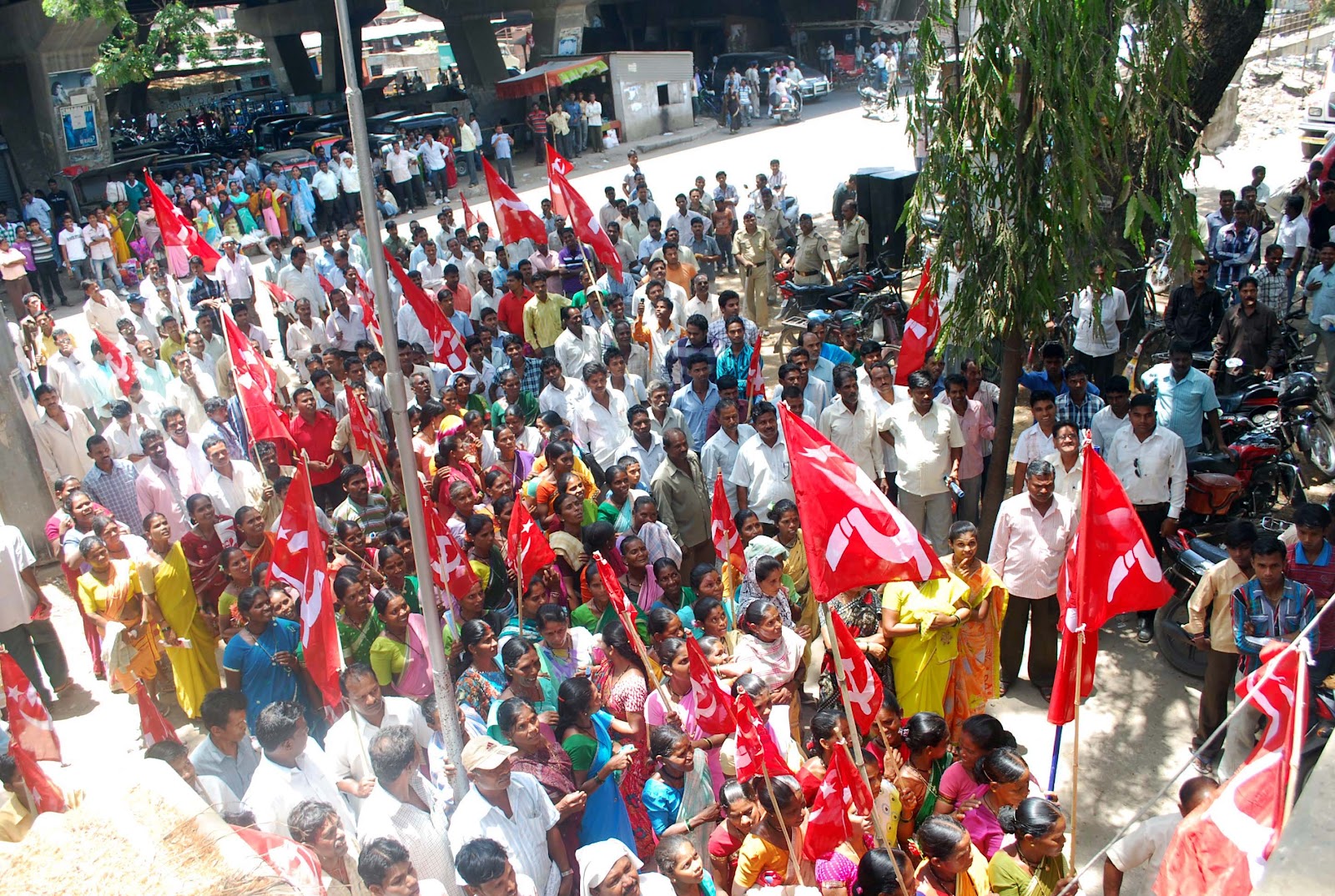
Responding to the call of the CPI (M) Maharashtra state committee, over 33,000 rural poor comprising mainly peasants and agricultural workers held demonstrations on district collectorates and tehsil offices in 19 districts of the state on May 14, 2012. The vital issue taken up was that of the severe drought currently stalking Maharashtra and the utter insensitivity of the Congress-NCP-led state government in dealing with this issue affecting crores of people and also lakhs of cattle.
Responding to the call of the CPI (M) Maharashtra state committee, over 33,000 rural poor comprising mainly peasants and agricultural workers held demonstrations on district collectorates and tehsil offices in 19 districts of the state on May 14, 2012. The vital issue taken up was that of the severe drought currently stalking Maharashtra and the utter insensitivity of the Congress-NCP-led state government in dealing with this issue affecting crores of people and also lakhs of cattle.
 |
| In Chandwad |
GENESIS OF CHRONIC DROUGHT
After
dithering for weeks, in the beginning of May the state government
finally admitted that 7753 villages in 15 districts were
drought-affected. As always, this was also a gross underestimate, based
on the ridiculously false ‘paisewari’ estimates of crop produce that are
still based on the crop production criteria set up during the British
colonial era!
Today,
the situation in thousands of villages is grave. There is great
scarcity and even complete absence of drinking water. Wells have run
dry. Dams and reservoirs are depleted. There is lack of adequate fodder
for cattle. Maharashtra is one of the worst states in the country so far
as the implementation of MNREGA is concerned. Last year in 17 districts
not even a single man day of work was provided. The wage paid is a
pittance. The public distribution system is in shambles and is riddled
with corruption and black-marketeering. To add to the woes of the
drought-hit, load-shedding of power has increased to the tune of 12 to
16 hours a day in the rural areas.
 |
| In Jawhar |
Drought is by no means a new phenomenon in Maharashtra. It recurs every three to four years. The number of tehsils that were earlier declared to be chronically drought-prone was 87. This figure has now crossed the 100 mark. Beyond setting up several Irrigation Commissions one after the other, successive state governments – be they of the Congress, Shiv-Sena-BJP or Congress-NCP - have done nothing. None of the recommendations of these Irrigation Commissions have been implemented.
For
instance, some of these Commissions had said that with optimum
utilization of both groundwater and surface water resources, 45 per cent
of the land under cultivation could have been brought under irrigation.
But what is the actual situation? As per the Economic Survey of Maharashtra 2011-12, when
the state of Maharashtra was formed in 1960, 6.5 per cent of the
cultivated area was under irrigation. It rose very gradually to 8.4 per
cent in 1970-71, 12.3 per cent in 1980-81, 15.2 per cent in 1990-91,
17.8 per cent in 2000-01, and just 17.9 per cent in 2010-11. Dry land
agriculture over 82 per cent of the area in the state has been suffering
immensely as a result. It must be noted that the cultivated land under
irrigation in India as a whole is 45.3 per cent.
 |
| In Parbhani |
The nadir was reached in the last ten years. As part of the running battle between the Congress and the NCP (the NCP has long held the Irrigation portfolio in the state), chief minister Prithviraj Chavan declared recently that after spending Rs 70,000 crore on irrigation in the last ten years, the proportion of irrigated land increased by only 0.1 per cent. He announced that a White Paper on the issue would be published. This led to a war of words between both the parties in the ruling alliance.
Another
significant issue concerns the massive escalation of irrigation
expenses. The Irrigation Commissions in the early 1960s had opined that
with an expense of 1,300 crore rupees, 30 per cent of the land could
have been brought under irrigation by 1980. Today the chief minister
says that a sum of 77,000 crore rupees would be required for the
completion of incomplete projects! Needless to say, a significant part
of this cost escalation is directly related to rising corruption at all
levels. Now the rulers say that since such massive outlays are not
possible, priority would be given to water conservation schemes. Nothing
stopped them from doing so for the last several decades.
The
third issue is the completely skewed nature of the distribution of
irrigated water. It is well known that sugarcane is a water-guzzling
crop. It is equally well known that Maharashtra is ruled by an alliance
of the big bourgeoisie and the sugar lobby, predominantly from Western
Maharashtra. As Kumar Shiralkar wrote recently in the CPI(M) state
committee weekly ‘Jeevanmarg’: “In 1950, 45 per cent of
irrigation water went to sugarcane. This rose to 60 per cent in 1987. In
the last ten years, although Rs 70,000 crore spent on irrigation has
come to naught, in 2011 the proportion of irrigation water going to
sugarcane has reached 70 per cent. Today the average amount of water in
the dams in the state is 23 per cent. In Vidarbha it is only 12 per
cent. In 12 dams it is zero. In the medium and small irrigation projects
it is between 11 to 15 per cent. It is in such a grim situation that 70
per cent of irrigation water is being given to cane, which occupies
only 4.5 per cent of the cropped area.”
 |
| In Solapur |
The last issue concerns the neo-liberal prescription - privatization of water resources and diversion of water to the rich in the cities and to SEZs, at the expense of the countryside. As a major step towards privatization, the Maharashtra Water Resources Bill was hurriedly passed and in 2005, the Maharashtra Water Resources Regulatory Authority was set up. Since the state government claims that it has no money to set up or complete irrigation projects, the policy of allowing private players in this sector began in right earnest, with all the attendant ill-effects on water-users.
Simultaneously,
a drive began to divert scarce water resources from the rural areas to
the uncontrolled expansion of the cities to cater to the interests of
the builder lobby, and to SEZs. It was this same drive that led last
year to the peasant resistance and police firing at Maval in Pune
district, which killed three farmers, including a woman. It is now
proposed to build as many as ten dams by displacing thousands of
Adivasis and others from several villages in the Thane and Raigad
districts adjoining Mumbai. Thane district, which has some of the
largest dams and water reservoirs in the state, has only 2 per cent of
irrigated land and there is great scarcity even of drinking water in
several tribal-dominated tehsils.
On
the other hand, it has been reported that Mukesh Ambani’s new 27-storey
residence ‘Antilia’ in Mumbai, built at a cost of Rs 9,000 crore, is
provided 60 lakh litres of water per month! While most of the state is
in darkness due to power load-shedding (which is itself a direct result
of the power privatization policy of the ruling classes that led to the
Enron fiasco, and is now being compounded by the Jaitapur nuclear power
project drive), the monthly electricity bill of this modern-day Ambani
palace is to the tune of Rs 70 lakh! This is only one instance amongst
many in Mumbai.
STRUGGLE AGAINST DROUGHT
The
CPI(M) Maharashtra state committee, which met on April 29, decided to
launch an independent struggle on the issue of drought with two
objectives in mind. The first was, of course, to ensure that immediate
relief in the form of drinking water, employment, ration grain and
fodder reached the people and their cattle. Towards this end, a charter
of demands was prepared by the state committee. The second was to
highlight the bankrupt ruling class policies briefly outlined above that
had led to plunging the state in a chronic drought situation over the
last several decades.
 |
| In Talasari |
The
two districts where the biggest mass actions were held were Thane and
Nashik districts. Over 12,000 people stormed 7 tehsil offices in Thane
district and over 11,000 people stormed 9 tehsil offices in Nashik
district. In Thane district, the people gheraoed government offices in
four tehsil centres and did not move until the authorities gave written
assurances on their demands. At Igatpuri in Nashik district, over 500
people blocked the Mumbai-Agra National Highway.
In
the Akole tehsil of Ahmednagar district, which hosted the Party state
conference in March, over 3,000 people were mobilized in several village
level actions. In the South Solapur tehsil of Solapur district, over
2000 people led a road blockade. In Parbhani district, a 1500-strong
demonstration marched to the district collectorate. In Hatkanangale in
Kolhapur district, a 1000-strong demonstration was held. In Nandurbar
district, road blockades were organized in four tehsils, and nearly 400
people were arrested.
Similar
actions took place in districts like Nanded, Beed, Jalna, Aurangabad,
Hingoli, Amravati, Buldana, Jalgaon, Satara, Sangli and Raigad
districts. Special mention must be made of demonstrations held by the
Party in the urban centres like Mumbai, Nashik, Jalna and Aurangabad,
where the working class raised the demand of the peasantry for drought
relief. The actions in Solapur, Kolhapur and Parbhani districts also
mobilized the working class along with the peasantry. In Pune, a
Convention on Water was organized by left and secular parties.
All
these mass actions succeeded in wresting concessions and immediate
action from the government authorities for drought relief. Most of these
actions were well covered by both print and electronic media, some of
whom reported that it was only the CPI(M) among all other political
parties in the state that took up concerted cudgels against the severe
drought situation in the state.
Subscribe to:
Posts (Atom)


