Thursday, February 23, 2012

28th February All India Strike : A CHALLENGE BEFORE THE WORKING CLASS


Tapan Sen (General Secretary : CITU)
The trade union movement of the country has entered into a new phase with all the eleven Central Trade Unions in the country having different affiliations and political line-up coming together on a single platform for joint action on common issues facing the working class of the country. It is the culmination of mass scale resentment among the common workers at the grass root against the grievous fall out of the policies of liberalisation, privatisation and globalisation on their life and livelihood and an urge increasing for united action. The decades-long process of united trade union action by many central trade unions and independent employees federations and also the experience of united actions in many sectors like banks, insurance, defence, telecom, coal and in many other public sector units also have contributed in a big way towards developing such a prospect of all in unity in the trade union movement in the country. That process has witnessed 12 countrywide general strikes by the Sponsoring Committee of Trade Unions since the onset of the neoliberal policy regime in 1991. The platform of the 13th General Strike got further widened with INTUC joining the strike action on 7th September 2010. The 14th General Strike on 28th February 2012 is going to create history in the annals of the trade union movement embracing all the eleven central trade unions including BMS and LPF on its platform.
 
The Issues before the Working Class
The call for the countrywide general strike was to press for the 10 point charter of demands pertaining to the most burning problems facing crores of the working people in the country. 

The problems relate to their survival, which is being put in jeopardy by the neoliberal policies being pursued by successive governments. This strike is intended to make the voice of the toiling people heard by the government so far insensitive to their demands.
 
Price Rise
One of the major demands is against the continuing price rise of essential commodities demanding concrete action to contain the same. The trade unions have put forth in concrete terms the measures to be taken to arrest the spiralling rise in prices before the government. They have demanded universalisation of public distribution system and a complete ban on speculation and futures trade in commodity market which alone can contain the rising prices; there cannot be a third way for the same.

The government is refusing to adopt those concrete measures to contain price-rise. Instead, every now and then, the Prime Minister, Finance Minister et al announce that prices would come down or get moderated soon which did never happen.

The government is also claiming that prices are going up owing to increase in the Minimum Support Price (MSP) for the farmers! In 2011, minimum support price of rice was Rs 1080/- per quintal, i.e., Re 10.8/- per kg. But for the consumer it is no less than Rs 24 to Rs 28 in the open market. The minimum support price of wheat is Rs 1120 per quintal working out to be Re 11.20 per kg. For the consumer, it is no less than Rs20/- per kg. How does the MSP influence the prices in the retail market? Some of the regularly used pulses like tur and urad dal cost hardly Rs 30 per kg as per the minimum support price; but none is available at below Rs 60 to Rs 100 in the open market. Even in the public distribution system for the APL category, the price of rice and wheat is much above the MSP level, even if procurement, storage and transportation costs are taken into account. Talking of minimum support price to justify price rise is nothing but a shabby act of deception and fraud on the people.

Another plea put forward by the government, by no less than a person the like Prime Minister is that the prices were going up because people have more money in their hand owing to rise in their incomes as a result of economic growth. Workers themselves know the utter falsehood of such a claim. Nothing else can be farther from truth. Increase in GDP is no doubt a contribution entirely of the toiling class but the fruits of growth are looted away by the employer’s class-the corporates and big-business, both domestic and foreign, under the government’s active patronage. GDP is growing, and at the same time growing is the number of contract workers with low wages with sharply declining regular workers in almost all the workplaces. The share of wages in the net value added has come down to around 9.2 per cent while the share of profit has gone up to 53.8 per cent.

 In fact the realities are exactly the opposite. As per the latest Economic Survey, growth of private final consumption expenditure has fallen from 8.6 per cent in 2005-06 to 7.3 per cent in 2010-11.

During the last five year period, population has increased and even then the growth of private final consumption expenditure has fallen. Can this ever be possible unless the mass of the consumers are consuming less?

The rise in the prices of essential commodities is being promoted by the government through their deliberate policy of weakening and debilitating the public distribution system on the one hand and patronising corporate consolidation in commodity trade, particularly in food and related commodities on the other. When the price of rice and wheat were soaring in the market, the government most shamelessly, kept locked a huge stock of 600 lakh tones of food grains in the FCI godowns preventing prices from coming down, just to please their trader bosses. When a part of the stock was released, the public distribution system route was bypassed and the grains were released in the open market to facilitate private corporate traders to lift the stock for hoarding. In fact the price-rise has become a joint venture of the government and the corporate traders to facilitate windfall profits for the latter.

The public distribution system has been virtually dismantled throughout the country except in a few states. A large number of people have been pushed out of its purview on the restrictive plea of ridiculous poverty line to make them the sacrificial animal for profiteering by the traders lobby, both domestic and foreign. To add fuel to flame, petroleum price has been deregulated, energy prices are being pushed up, and urea prices are being doubled.
 
Enforcement of Labour Laws
Trade Unions have been demanding for strict enforcement of all basic labour laws without any exception or exemption and stringent punitive measures for violation of labour laws. Violation of labour laws by the employers with active connivance of law enforcement machinery has become a major instrument for increasing profit where workers and workers alone are targeted for cost-minimisation in the production or services in all the workplaces. So in majority of the workplaces, statutory minimum wages are not paid, basic social security benefits are denied with impunity. In fact, 90 % of the disputes and conflicts going on in different workplaces in the country relate to just non implementation of the existing labour laws. The employers’ class in close connivance with the respective governments and the labour departments in particular have made a gang up to subject the mass of the working people, who create wealth for the economy, revenue for the exchequer and profit for the employers, to worst form of exploitation and loot through just non implementation of the basic labour laws pertaining to minimum wages, working hours, safety in workplace, social security benefits etc.

To prevent the workers to organise and resist such barbarous exploitation, the governments flung into action in support of the employers to prevent formation of trade union activities in their workplaces. In most of the private sector workplaces and even in some public sector units, whenever workers take initiative to form trade union, those taking such initiatives are thrown out of employment on some fabricated charges. Implicating the workers in false criminal cases for taking part in trade union activities has become a regular practice in many of the states. The recent happenings at Maruti Suzuki Plant at Gurgaon/Manesar at Haryana, incidents at Hyundai and Foxconn at Tamilnadu, Allied Nippon at Ghaziabad, and Mother Dairy in Delhi are some glaring examples of such government - employers’ gang up to crush trade unions in workplaces. Trade unions are not being registered; applications for registration of trade unions gather dust in the office of registrar for months together in most of the states in the country. This is nothing but an attack on right to freedom of association and right to collective bargaining which is considered to be essential component of labour rights in any civilised society and codified as “core labour standards” by ILO which adopted specific conventions no 87 and 98. The government of India has not yet ratified these conventions on flimsy grounds. The Central Trade Unions therefore have put forth specific demand that there must be compulsory registration of trade unions within a period of 45 days after the application is made and the government of India must ratify the ILO Conventions nos. 87 and 98 without further delay.
 
Universal Social Security for Unorganised Sector Workers
More than 93% cent of country’s workforce is in the unorganised sector. They have been practically kept outside the purview of most of the labour laws and do not have any protection in respect of working hours, minimum wages, social security and above all any kind of job security despite contributing around 65% to the country’s GDP. Since the onset of neoliberal policy regime, the unorganised sector workforce is expanding fast along with simultaneous decline in the size of regular or permanent workers in all the sectors of economy. Due to pressure from the trade union and popular movements the government after long dilly dallying enacted the Unorganised Workers Social Security Act in 2008 but that legislation is nothing but a fraud on the unorganised sector workers. The provisions of the said legislation practically throw overwhelming majority of the unorganised sector workers out of the purview of the social security schemes envisaged under the same. Almost all the ten social security/welfare schemes listed in its schedule are meant for only the persons below the poverty line. The official definition of “poverty line” is such that overwhelming majority of the unorganised sector workers will not qualify and therefore will not get any benefit under those schemes. The National Commission for Enterprises in the Unorganised Sector (NCEUS) constituted by the UPA-I government recommended universal coverage of all unorganised sector workers by a National Floor Level Social Security cover and constitution of a National Social Security Fund with adequate fund provision. This was unanimously upheld by the Parliamentary Standing Committee on Labour. The National Social Security Board constituted under the Act also made the same unanimous recommendation. But the government has done nothing on this till now.

The deceptive approach of the government towards the unorganised sector is reflected by the nature of fund allocation for the social security benefit for unorganised sector workers. Union Budget (2010-11) allocated a paltry amount of Rs 1000 crore for the purpose. No body yet knows how that money was or has been spent. The government has been boasting that more than 2 crore people have been issued “smart cards” under Rashtriya Swasthya Bima Yojana (RSBY). But, the allocation made by the central government in 2010-11 Budget cannot take care of even 1% of the below poverty line (BPL) families, not to speak of the unorganised sector workers in general. The RSBY envisages covering all the 6.52 crores families estimated by the Planning Commission to be BPL, in5 years. The government would have to spend Rs 4,875 crores annually to pay the 75% of the annual premium of Rs 750, as per the RSBY. But, in the 2009-10 Budget, only Rs 308 crore was allotted in that account. The last budget has not increased the allocation.

This is an integral part of the ongoing process of loot being engineered by the neoliberal policy regime while the government seeks to befool the people chanting aam admi slogan on every occasion. To cry halt to such cruel approach towards the overwhelming majority of country’s working people, the Central Trade Unions demanded in one voice that concrete measures have to be taken for universal social security cover for the unorganized sector workers without any restriction and creation of a National Social Security Fund with adequate resources in line with the recommendation of NCEUS and Parliamentary Standing Committee on Labour.
 
Stop Disinvestment
The Central Trade Unions also demand complete stoppage of disinvestment of shares in profit making Central and State PSUs. The government is arguing that disinvestment is meant for expanding peoples’ ownership including employees’ ownership of public sector companies, for garnering resources for social sector welfare expenditures and also for modernisation expenditures for public sector companies themselves. It is also pleading that only minority shares will be disinvested and hence there is no fear for privatisation. Such plea of the government is nothing but a total falsehood widely propagated to befool the workers and the people.

It is utterly obnoxious to talk about expanding people’s ownership through disinvestment. Peoples’ ownership of PSUs can no way be ensured through ownership of PSU shares by private individuals. Rather 100% government ownership and accountability to the parliament elected by the people ensure peoples’ ownership over the PSUs. Any dilution of such status through disinvestment dilutes public ownership in favour of private corporates. The profile and character of private shareholdings in the PSUs disinvested so far clearly exposes this reality. Hardly 1- 1.5% of disinvested shares has gone to private individuals. The majority of them have been cornered by private corporate entities including MNCs and by private mutual funds, both domestic and foreign.

Secondly PSUs do not require to sell their equity for funding their modernisation because they are having huge reserves and surpluses at their command amounting to around Rs five lakh crore plus.

PSUs listed for disinvestment in the current phase are all carrying on their modernisation projects with their own resources without any budgetary support from the government. Moreover, the debt equity ratio of the PSUs is around 0.75 which shows that PSUs can very much go for loans from the banking system if they require for funding their capital expenditure and any dilution of equity for resources with such low-debt-equity ration can no way be justified.

Social sector welfare expenditure for the people is a responsibility of the government elected by the people and is recurring and continuous in nature. Any idea of funding such expenditure through disinvestment of shares of PSUs makes the disinvestment process also a continuing exercise ultimately culminating in privatisation of the PSUs. This clearly exposes the real game plan of privatisation by the government for befooling the people.
 
No contractorisation
The widespread contractorisation and casualisation of work in most of the workplaces has created an alarming situation. As per official estimate, of the total workforce in work in the country, 51 per cent are self employed, 33.5 per cent are casual and hardly 15.6 per cent are in salaried employment. Of the salaried employment, majority are on contract. In public sector units, share of contract employment is around 50% of the total workforce on the average and in private sector; more than 70% are on contract. These vast sections of contract workers are mostly deprived of almost all statutory benefits barring rare exceptions; their employment is always under threat by the respective contractor and the principal employer. This has given rise to a dangerous dichotomy where, under the same roof, contract workers doing the same work as the regular workers in the establishment, are getting hardly the sixth or even less than their counterpart among regular workers. Continuity of such a grossly discriminatory situation would not only aggravate exploitation of contract workers but also put downward pressure on the wages and service conditions of the regular workers. That is precisely what is taking place in most of the workplaces particularly in private sector establishments. The average level of wages is going down owing to sharp decline in the size of the permanent workers and widespread contractorisation of work. This can no way be tolerated by the working class movement lying down. That is why the demands for “same wage as regular workers for same work for the contract workers”, “benchmarking of minimum wage at not less than Rs 10,000/-”, “removal of all restricting ceiling on provident fund, payment of bonus, gratuity etc” have come up as most pressing demands before the working people of the country as well as before the entire trade union movement voicing their concern.
 
Assured Pension for all
The present economic policy regime has been working overtime to drastically curtail whatever meager social security benefits available to workers. A grave conspiracy is afoot to drastically dilute the existing pensionary rights of the workers and employees.

The Employees Pension Scheme launched with much fanfare in 1995, despite staunch opposition by CITU has finally proved to be a farce for crores of retired workers who are getting a meager amount as pension compared to their last-drawn wages. In the days to come maintenance of existing level of pension also is going to be difficult given the attitude of the government in administering the present EPS scheme. There has already been curtailment of number of benefits promised under the Employees Pension Scheme at the time of its introduction. The existing pensionary benefits for the government employees are being sought to be dismantled and replaced by a so called New Pension System (NPS) which make the defined pension benefit for the retired government employees totally uncertain and market dependent despite making them to pay 10 per cent of their wages every month for the pension fund. The Pension Fund Development & Regulatory Authority Bill has already been introduced in Parliament to legitimise such retrograde and anti worker exercise. Experience worldwide has already proved that market can never ensure an assured pension for the workers.

In case of the NPS, workers would be made to pay for their pension corpus and the corpus will be used in the stock market for speculation through various fund managers. Not only that, the government is also trying to trap and allure vast section of unorganised sector workers to accept the NPS and subscribe to this scheme from their meager income to the Swavalamban scheme although they will not have any guaranteed amount of pension even after contributing towards the scheme for long thirty years. Just like the Unorganised Workers Social Security Act, the Swavalamban scheme under NPS is another exercise of deception on the unorganised sector workers to harness their contribution to pension corpus for speculation in the stock market.

Through all these exercises in the name pension, the government is making the pension for the workers market dependent and absolutely uncertain. Such evil design cannot be allowed to pass. Hence, the trade unions have unitedly demanded “Assured Pension for all”.
The issues raised by the joint platform of strike action have to be carried to each worker and toiling people in each work place and workers habitations through intensive campaigns. Preparatory campaign for the strike must unleash initiatives of widespread joint campaign at the work place level countrywide. This alone can get the unity percolated at the grass root level and build up sustained and heightened united action against the mounting offensive of the exploiting class and their governments and carrying our struggle to offensive height. That is the way before us. We must leave no stone unturned in carrying the preparatory campaign for the strike to widest possible section of the workers and unleashing joint initiative of campaign in each workplace countrywide to make the General Strike a resounding success throughout the country.

Wednesday, February 22, 2012

CPI(M) Tamil Nadu state conference begins


Communist Party of India (Marxist) Tamil Nadu State 20th Conference began on Tuesday in the east coastal port town of Nagapattinam. Conference proceedings began with veteran Communist leader R.Umanath raising the red flag at the inaugural session of the conference. Earlier Martyrs torch which came from Keezhvenmani Martyrs Memorial , Chinni Palayam Martyrs memorial torch and Salem Jail Martyrs torch were lit up at the conference venue. The Red flag was brought from the Com. Lelavathi Memorial in Madurai.
 
The party MLA K. Balakrishnan read out a resolution to pay respects to the veteran communist leaders. Polit Bureau members K. Varadharajan, Brinda Karat, S. Ramachandran Pillai and B.V. Raghavulu, State secretary G. Ramakrishnan and delegates from various parts of the State participated. 

 CPIM general secretary Prakash Karat inaugurated the conference and made a clarion call to the working class of Tamil nadu to make a grand success of the 28th February general strike.

He explained the importance of this united movement of the all central trade unions in the background of rising attacks of the UPA government on the working people. Inaugurating the 20 th state conference of the Communist Party of India (Marxist), Tamil nadu unit at today, Prakash Karat asked the delegates to build the CPI (M) as a powerful force and build the left and the unity of the left.

He expressed happiness about his presence in Nagapattinam and recalled that this district has historic revolutionary tradition of vibrant movement of agricultural workers.Prakash Karat outlined the abrupt failures of the UPA 2 government. He questioned the government's record during the past 3 years rule. "We have seen unprecedented price rise; massive corruption; and the continuation of the agriculture crisis; the government continue to pursue pro-US foreign policy" he said.

He vehemently criticized the BJP that it is also advocating the same policies and it is also indulging massive corruptions. Prakash Karat have seen no difference between Congress, BJP and other regional capitalist parties. “The only political alternative to save the people of India is CPI (M) and the left", he claimed.

He noted the historic massive rally at Kolkata on the last day of the Bengal state conference of the party and said that the lakhs and lakhs of working people gathered in the Brigade Parade ground gave a clear message that the CPI(M) and left front will be powerful force again and it will inspire the whole working class of the nation. Earlier,  CPI state secretary D.Pandian greeted the conference.
In the delegates’ session, state secretary G.Ramakrishnan placed the political and organisational report. The conference vehemently condemns the brutal kiiling of comrades Pradip Tah and Kamal Gayen in West Bengal by the goons of TMC.

The conference will conclude on 25 th with massive rally and red volunteers parade..

Condemn TMC Politics of Murder in West Bengal

CPI(M) Polit Bureau member Nirupam Sen, opposition leader of the West Bengal state assembly Surjya Kanta Mishra paying their tribute to Com. Pradip Tah and Com. Kamal Gayen on Wednesday in Burdhaman.

In a brutal attack, two district committee members of CPI(M) in Burdwan were killed on Wednesday morning. Pradip Tah and Kamal Gayen were murdered when Trinamool Congress anti socials violently attacked a rally, which was brought out in support of 28th February’s strike, in Dewandighi in Burdwan town.

Yesterday, TMC activists tore down festoons and banners in support of 28th’s strike. Some CPI(M) supports were attacked when they protested the vandalism. Today, at about 10.30 in the morning, a rally was organized in Dewandighi by CPI(M) in support of the strike. The rally was huge in numbers. People of that area including unrorganised workers joined the rally. Suddenly TMC anti socials attacked the rally with axe, sharp weapons and arms. Pradip Tah and Kamal Gayen were brutally and repeatedly attacked. Tah died on the way to hospital. Gayen was first admitted in Burdwan Medical College hospital but later he was being shifted to Kolkata. He died on the way to Kolkata. CPI(M) supporter Rupkumar Gupta has also been injured badly and admitted in hospital. Some other Party workers and sympathizers were also injured.

Pradip Tah was former MLA of Burdwan North assembly constituency, former District Secretary of DYFI, and now a CITU leader. He was a leading organizer of the unorganized workers; Kamal Gayen was a district level leader of cultural movement. With them 58 CPI(M) and Left leaders and activists have become martyrs in last nine months in the state.

CPI(M) State Secretary Biman Basu has strongly condemned the killing. In a statement, Basu said, these attacks throughout the state were planned. The attack has been intensified after massive rally in Brigade Parade Ground on 19th February. TMC has been jolted by the massive participation of people in that rally. Armed activists of TMC have unleashed desperate terrorization to thwart the strike of 28th February.

CPI(M) has called a 12hour Burdwan bandh on Thursday and two day protests throughout the state. CPI(M) leaders Nirupam Sen, Madan Ghosh, leader of the opposition Surjya Kanta Mishra and others have rushed to the spot. Thousands of people gathered in Burdwan to protest the killing.

TMC and Mamata Banerjee Government have declared a war against the 28th’s strike. Already the State Government has issued dictate that no employee would be allowed to take leave on that day. Trade unions are being threatened not to participate in strike. Moreover, the TMC leadership has asked its cadres to actively oppose the strike. It is clear from today’s incident that this active opposition is nothing but an euphemism for attacking and murdering CPI(M) cadres. But, the working people of the state are not going to bow down before such terror tactics. 28th February will teach a lesson to the TMC when the working people will participate in the strike on the face of all terror and attack.

The Polit Bureau of the Communist Party of India (Marxist) has issued the following statement:

The Polit Bureau of the CPI(M) strongly condemns the murder of two leaders of our Party in West Bengal, both members of the Burdwan district committee of the CPI(M) – Comrade Pradip Tah and Comrade Kamal Gayen – in open daylight in the Dewandighi on the outskirts of the Burdwan town by the Trinamool Congress goons. Comrade Pradip was a former MLA representing the Burdwan (North) Assembly constituency. These heinous murders took place when both these leaders were leading a huge procession of people which was protesting against attacks on Party sympathisers campaigning for the all-India strike of February 28 called by the Central trade unions. These are murders most foul and is part of planned attacks and killings of Left leaders and activists after the assumption of office by the Mamata Banerjee led government. These two murders takes up the toll of people killed to 58 since the change of government. These attacks come in the background of the massive popular mobilization, at the call of the CPI(M), in the Brigade Parade Ground on February 19 which reflected people’s anger against the politics of violence and vendetta. Frustrated by the growing resistance of the people, the TMC led goons have indulged in this gruesome act. This act of violence is also to try and at any cost stop the certain overwhelming success of the industrial strike at the call of the Central trade unions. The Polit Bureau calls upon the Party units and all other Left and democratic minded people in the country to raise their voice of protest against such politics of violence and terror.

Red flag is fluttering and can never be brought down in West Bengal : Call of the CPIM West Bengal State Conference


The Communist Party of India-Marxist 23rd state conference re-elected Comrade Biman Bose as the secretary on the concluding day of the state conference on sunday. A state Committee of 83 members has been elected from the conference.25 resolutions have been passed from the conference. 175 delegates have been elected for the 20th Congress of C.P.I.(M), to be held in Kozhikode, Kerala in April 2012. Comrade Nirupam Sen has been elected as the treasurer of the Party State Committee.The control commission, consisting 4 members, has been elected from the conference.

The biggest highlight of the concluding day of the conference was the mammoth rally carried out by party members and sympathisers in the Brigade Parade ground in Kolkota. This is for the first time after the Left front government was voted out, that the party has arranged this rally. The participation of more than 10 lakh people itself came as a shock to the medias and corporates who have "written off" CPIM from WB state politics.

Wave after wave of crimson troops flooded the heart of Kolkata. For all those who were intimidated, attacked, forged, raped, evicted and vandalized under the autocratic ruling of the Trinamool Congress led coalition government, it was the day for reclaiming their lost independence. The reign of terror across Bengal districts for last nine months of the new government received a big bash by the red brigade . Every living being that still crawls, creeps even after the rule of terror converged into the Brigade Parade ground.

This Brigade rally was important for being the first one after the historic 34 years of the Left Front government discontinued. 13th May 2011 is already in the hallmark as this day not only marks the end of a lengthy pro-people government, it started the decline of democratic rights of common people in West Bengal. The last nine months were all haunted with political murders, infant’s death, farmers’ suicide, unleashing attack on students and college campuses etc.  Every red-clad youth of this state avowed their protest against the TMC-led state government .

Massive rallies of farmers, agricultural labourers and working people emerging from all across the state attended the Brigade with full confidence to recapture the lost democratic rights and to set forth a new political journey. The 23rd state conference of the Communist Party of India (Marxist) concluded on 18th February with the call for intensive class struggle and mass movements in the state. Strengthening mass base among poorer class of people with class ideology; removing all predicaments and organizational inertness were the prime call of the 23rd conference. The scheduled proceeding of the open session started from sharp 1 P.M. when the newly elected state secretary Biman Basu commenced his presidential address.
 
Basu's life-size picture, alongside that of former party general secretary H.K.S. Surjeet, adorned the stage in the open session at the Brigade Parade ground, that brought the curtains down on the CPI-M's 23rd state conference.

Two prominent CPI-M leaders began their speeches by remembering Basu and the role he played in consolidating the party in the state and also guiding it in national politics.
"This is the first (state) conference when comrade Jyoti Basu is not with us. During earlier conferences he used to give directions and guide us. We will always remember the path he has shown us and follow his guidance," party general secretary Prakash Karat told the rally at the sprawling ground, where the late leader had addressed big crowds dozens of times during his long political career.Karat's comments drew loud applause from the lakhs of party supporters who shouted in unison 'comrade Jyoti Basu amar rahe'. Referring to the large assembly of people, CPI(M) general secretary Prakash Karat said: “The message being sent across the country and the world by this sea of humanity that has converged here today is that the red flag is fluttering and can never be brought down in West Bengal.”
  
Claiming that the Communist Party of India (Marxist) in the State had never before been able to rally people together in such large numbers on the scale it did here on Sunday, the former Chief Minister Buddhadeb Bhattacharjee told a massive congregation that the very size of the gathering “proves that we are standing on firm ground and from which they [those in power now] have not been able to evict us.”

He was speaking at the open session that marked the conclusion of the 23rdState Conference of the CPI(M).
This was the first public rally to be organised by the party at the Brigade Parade ground since the Trinamool Congress-led government assumed power in the State in May 2011.

Leader of the Opposition in the West Bengal Assembly, Surya Kanta Mishrasaid: “The Chief Minister, I understand, is at home; I only hope she is watching it [the rally] on the television. I kindly request her not to switch off the set.”
Her government, Dr. Mishra said, “is trying to silence the CPI(M) both inside and outside the Assembly, but never would it be able to silence so many lakhs of people [gathered at the rally].”
 “We [CPI(M)] are here because you [the people] are there.” he added.

Wednesday, February 15, 2012

CPIM West Bengal State Conference begins


The 23rd State Conference of Communist Party of India (Marxist) commenced at Kolkata today by hoisting the red flag of the Party and offering floral tributes to the martyrs who have sacrificed their lives to carry forward the ideology of the Party. The red flag of the Party was hoisted by Com. Prakash Karat, General Secretary of the Party. The Politburo members including the General Secretary of the Party Com. Prakash Karat, West Bengal State Secretary Com. Biman Basu, Com. Sitaram Yechury, Com. K Vardarajan, Com. Buddhadev Bhattacharya, Com. Brinda Karat, Com. Md. Amin and Com. Nirupam Sen offered floral tribute to the martyrs on the martyrs’ column. The other delegates also paid their homage to the martyrs by offering flowers.

The conference is being held at Comrade Jyoti Basu Nagar (Kolkata) and Comrade Harkishen Singh Surjeet Manch (Pramod Dasgupta Bhawan). To conduct the proceedings of the conference, the following comrades were elected in the Presidium: Com. Binoy Konar, Com. Bonani Biswas, Com. Md. Selim, Com. Rupchand Murmu and Com. Dinesh Dakua.

At the beginning of the delegate session condolence resolution was moved in the memory of Comrade Jyoti Basu, Comrade Harkishen Singh Surjeet, Comrade M.K Pandhe three politburo members of the Party, Com. Subhash Chakraborty, Secretariat member of West Bengal CPI(M), who died after the last State Conference. The condolence resolution also remembered all great personalities from politics, arts, literature and sports who passed away since the last state conference was held. A martyrs’ resolution was also moved at the conference, remembering the sacrifices of all those who were martyred while keeping high the banner of the party and Marxism-Leninism.

Com. Biman Basu, secretary of the State Committee of CPI(M) placed the political-organizational report in the conference. While placing the report, Com. Basu mentioned that since the last conference till April 2011, 506 comrades were martyred and since the new government came to power, in May 2011, 56 more comrades have been martyred. These comrades were martyred because they were fighting to keep up the red flag of the party. The party has to live up to the sacrifices of these comrades. The party has to rectify the mistakes and emerge as an ideologically and politically strong party with an increased mass base amongst the poor people. Com. Basu also pointed out that the policies pursued by the state government are no different from the policies pursued by the central government, which are basically anti-people policies. In the coming days, the party has to struggle and mobilize people against these anti-people policies propagated by both the central and state governments.


The General Secretary of the party, Prakash Karat delivered the inaugural speech in the conference. In the course of his speech he made the following salient points:

On International Issues

He analyzed the international situation prevalent at the current juncture and stated that capitalism is in a deep crisis. In order to come out of the crisis, capitalism is trying to put more burden on the common working people through the imposition of austerity measures. Simultaneously, imperialism is becoming more aggressive in its efforts to emerge from this crisis. Imperialism, led by the US continues to further the ‘Washington Consensus’. However, in the aftermath of this crisis, the economic policies of neo-liberalism and the Washington Consensus are being questioned by the people. People, across the nations, have risen up in protest against the anti-people policies imposed by neo-liberalism.

He discussed the differing nature of the anti-imperialist movements, the spontaneous ‘Occupy Wall Street’ protests in 1500+ cities around the world, the experiences of the left-democratic governments of Latin America executing an independent, sustained pro-people policy framework and the increasing success of China. While the US and other developed western capitalist powers are on the wane economically, China continues to grow as an economic power. He however cautioned that in spite of the crisis, the US continues to maintain the hegemony of its imperialistic economic ideology over the globe. He also cautioned about the current US policy of hijacking people’s uprisings for its own designs, as seen in Libya, Egypt, etc.

He said that while the capitalist world is mired in a severe economic crisis with high sovereign debts and deficits, China continues to generate a huge surplus every year, which the capitalist world now seek to aid its rescue. India too, is facing a relentless assault by these imperialistic forces. The party needs to focus on getting the masses to participate in this agitation against imperialism.

On National Issues

The results of the last few elections, Prakash Karat agreed, have weakened the left’s capability to intervene to some extent. In this situation the party has to increase its independent functioning to move ahead. Movements have to be built up raising the demands of the vast masses of the people who are being adversely affected by neo-liberal policies. At the same time, movements need to be built upon on local issues. Emphasis should be laid on building movements of the unorganized sector workers and the rural poor. Secondly, the left and democratic forces should be strengthened. This should not be taken merely as a propagandist slogan. In order to materialize this, the left parties, left forces and left minded people should be unified. The democratic forces should be rallied. Thirdly, in the current situation, issue based movements have to be built up against the Congress and BJP rallying other bourgeois regional parties. This will not become the Third Alternative immediately.

On West Bengal

Prakash Karat noted the immense gains of the 34- year Left Front government and said that the current dispensation, led by reactionary forces are on the path of reversing all the gains made by the people. Their attempt at destroying the economic and social infrastructure created by the left is clear and that while West Bengal has been an oasis of social stability and peace in the ‘identity-politics’ ridden India, the forces of reaction are attempting to nurture the divisive forces by encouraging identity politics, as is clear in their bonhomie with the separatist forces in the hills, Maoists, etc. He observed that the Bengal government has unleashed a campaign of political terror to mortally wound the party’s organization across the state. However, the people of Bengal are increasingly getting resentful of the government’s policies and the party needs to commit itself to provide leadership to the people’s movements.

Prakash Karat observed that the West Bengal party has to go back to establishing a close relationship with the people and severe steps have to be taken to deter any unwanted trends in the party. It is through this rectification process that a stronger party will be built. The current government will continue escalating the miseries of the people and the party has to build a movement along with the people, patiently. The West Bengal Party, honed through great sacrifice, struggles and loss of lives will succeed, he said emphatically.
(Courtesy : WWW.cpimwb.org)

CPI (M) Kerala State Conference Concludes


Underlining the invincibility of CPI (M) in Kerala a red ocean of people descended on the Capital city on February 10th. Around 3 lakh people,  from Thiruvananthapuram district, marched in a massive rally marking the successful conclusion of 20th state conference of the CPI (M). 25000 red volunteers also marched through the two major roads of the city and converged at E Balanandan Nagar (Chandrasekhran Nair Stadium) also displayed the discipline and indomitable strength of the Communist movement.

The Political - Organisational report presented by the state secretary was unanimously adopted by the conference. The conference unanimously elected 85s member new state committee. The new state committee re-elected Politburo member Pinarayi Vijayan as state secretary. Oppositon leader and Central Committee member V S Achuthanandan proposed Pinarayi’s name and state secretariat member T Shivadasa Menon seconded the proposal. 

The party proposed to launch a massive mass education programme as part of its campaign against social ills such as alcoholism, superstitions, and various evil practices.


Credential Committee Report
Opposition Leader V S Achuthanandan at 89 years and P K Chandranandan at 88 were the senior-most delegates and K Rafeeq, 24, from Wayand the youngest delegate at the 20 the state conference of the CPI(M)

Of the 556 delegates who represented 3,70,000 party members from across the state, 343 representatives had undergone rigorous imprisonment. V S Achuthanandan and M M Lawrence spent the most number of days in jail. Lawrence spent five years and ten months, while Achuthanandan was behind the bars for five years and six months. Party secretary Pinarayi Vijayan went to jail during the Emergency period and he spent 18 months in jail.
Out of the delegates, 53 were women. 

T V Anitha from Ernakulam and Rajeena, Malappuram, were the youngest. Some 246 of them are degree holders, and 122 of them passed intermediate, higher secondary or various diploma courses. While 457 are full-time party workers, 364 representatives became party members through student-youth movements.

 
New State Committee
There are 12 new faces on the reconstituted CPI(M) State committee, which has 10 women members. The members of the State committee are Comrades V.S. Achuthanandan, Pinarayi Vijayan, Kodiyeri Balakrishnan, Paloli Mohammed Kutty, A. Vijayaraghavan, M.A. Baby, P. Karunakaran, Vaikom Viswan, P.K. Gurudasan, P.K. Sreemathy, E.P. Jayarajan, T.M. Thomas Isaac, M.C. Josephine, T. Sivadasa Menon, V.V. Dakshinamoorthy, A.K. Balan, M.V. Govindan, Anathalavattom Anandan, K. Kunhiraman, A.K. Narayanan, K.P. Satheesh Chandran, P. Jayarajan, M.V. Jayarajan, K.P. Sahadevan, K.K. Ragesh, K.K. Shylaja Teacher, P.A. Mohammed, C.K. Saseendran, Elamaram Kareem, N.K. Radha, T.P. Ramakrishnan, P. Sathi Devi, K. Ummer Master, P.K. Sainaba, T.K. Hamsa, P. Sreeramakrishnan, M. Chandran, P. Unni, C.T. Krishnan, Baby John, K. Radhakrishnan, K. Chandran Pillai, C.M. Dinesh Mani, K.N. Ravindranath, S. Sharma, K.M. Sudhakaran, M.M. Lawrence, P. Rajiv. M.M. Mony, K.K. Jayachandran, K.J. Thomas, V.R. Bhaskaran, K. Ananthagopan, R. Unnikrishna Pillai, P.K. Chandranandan, G. Sudhakaran, C.K. Sadasivan, C.S. Sujatha, M.K. Bhaskaran, K. Rajagopal, P. Rajendran, J. Mercykutty Amma, K.N. Balagopal, B. Raghavan, K. Varadarajan, S. Rajendran, M. Vijayakumar, Pirappancode Murali, Anavur Nagappan, Kadakampally Surendran, T.N. Seema, C.P. Narayanan, T.V. Rajesh, James Mathew, A. Pradeep Kumar, P.P. Vasudevan, C.K. Rajendran, A.C. Moideen, N.R. Balan, C.N. Mohanan, K.P. Mary, P.K. Biju, C.B. Chandrababu, and Koliyakkode Krishnan Nair.


Capital City Turned into Red Sea
The main thoroughfares of the State capital were draped in red for hours as a parade of 25,000 red volunteers and five different rallies by around 3 lakhs of of Communist Party of India (Marxist) [CPI(M)] activists and sympathisers weaved their way through the length and breadth of the city to mark the conclusion of the 20th CPI(M) State conference  on Friday.

Although the city received summer showers twice during the day, the rain did not play spoilsport. Shortly after 3 p.m., the parade by the red volunteers began from the Manaveeyam Veedhi and Manjalikulam followed by rallies from Chakka; Swati Tirunal Music College, Thycaud; Vellayambalam; Overbridge; and Kuravankonam under an overcast sky.
The march through the main roads to the Chandrasekharan Nair Stadium, named for the event after the late trade union leader and CPIM P B member Comrade E. Balanandan, turned into a show of strength. It took almost three hours for the red volunteers hailing from the district trivandrum district alone to march to the venue. Around 6.15 p.m., CPI(M) general secretary Prakash Karat and State secretary Pinarayi Vijayan received the Guard of Honour from the Red volunteers parade by moving in an open jeep.

Women constituted a sizeable proportion of the huge turnout in the rally, which assembled area committee wise and marched through one side of the road. It was decided by the organizing committee to make participation of 1 lakh women, but the actual number was beyond expectations.  Band troupes, ‘panchavadyam,' ‘chenda,' Theyyam, Thira, and folk art performers lent a festive touch to the rally. Besides women bearing decorated umbrellas and portraits of CPI(M) stalwarts, Bhangra dance and panchavadyam presented by an all-women troupe were the cynosure of all eyes.

Right from the morning, the arterial M.G. Road seemed to have donned a red cloak, as activists wielding red flags started making their way to the starting points of the rallies in small groups on foot and in vehicles. Many wore red and white caps emblazoned with the party's symbol.

Addressing the huge rally, Prakash Karat said that Left front is the lone force which oppose the anti people measures and corruption in the country. People of India find the Left as the only way out to oppose these evils. CPI (M) will take initiative to form the alternative with the help of secular and democratic forces.

Three year of UPA has increased the price rise and joblessness. Anti people neo liberal measures have led thousands of farmers to suicide. In Andhrapradesh 160 farmers have committed suicide in the month of January. In Kerala, farmers’ suicide returned and 31 farmers committed suicide after Oommen Chandy came in to power. In west Bengal 31 farmers have committed suicide after im Mamta regim. For the last 34 years it this phenomenon was unheard of.

Politburo members Brinda Karat, Kodiyeri Balakrishnan, state secretary Pinarayi Vijayan, Opposition leader V S Achuthanandan also spoke in the function. Organising committee general convenor Kadakampalli Surendran welcomed the crowd.

Tuesday, February 7, 2012

CPIM Kerala State Conference Begins


The 20th  Kerala State conference of the Communist Party of India Marxist began on Tuesday 7th at the Harkishan Singh Surjeet Nagar (AKG Memorial Hall)  making the capital city, Thiruvananthapuram to a virtual sea of red. 565 delegates representing the 3.70 lakh party members in the State is attending the conference. The delegates' session would continue till Friday and conclude with the election of a new State committee.

The delegates session of the conference, was inaugurated by CPI(M) general secretary Prakash Karat. Earlier senior party leader and Central Committee member Com. V S Achuthanandan, hoisted the red flag to mark the proceedings of the conference. Delegates and leaders escorted by the red volunteers paid floral tribute to martyrs who laid down their life for the cause of the people. The area was reverberated with thunderous slogans. party PB members, Com Varadarajan, Brinda Karat, S Ramachandran Pillai are attending the conference.


Flag Hoisted at the Public Meeting Venue
Yesterday The Chandrasekharan Nair Stadium in the State capital reverberated with slogans and the skies were lit up with fireworks as the flag of the Communist Party of India (Marxist) [CPI(M)] rose skyward as a prelude to the 20th State conference of the party .
Hundreds of CPI(M) workers and fellow-travellers shouted slogans shortly after conference organising committee chairman M. Vijayakumar hoisted the flag at the stadium, which was dressed up in red for the big moment. Flags and festoons filled the stadium, which got filled to a large extent well before the flag, flag mast, and torch reached there around 6 p.m.

The party flag was brought to the stadium from Kayyur, the land of legendary struggles in Malabar, by a jatha led by party Central committee member E.P. Jayarajan, and the flag mast from Vayalar, another scene of popular upheaval during the pre-independence days in Travancore, by another jatha led by CPI(M) Central committee member M.A. Baby.

The conference torch was brought by a team of runners led by party State committee member Anavur Nagappan from the memorial of the late Kattayikkonam V. Sreedhar in the suburbs of the capital.

Several senior CPI(M) leaders, including party State secretariat members P.K. Gurudasan and Anathalavattom Anandan and Left Democratic Front convener Vaikom Viswan, were present at the stadium to witness the hoisting of the flag.

Monday, February 6, 2012

Carry Forward the legacy of Glorious Telengana Armed Struggle : Clarion Call by CPIM Andhra Pradesh State Conference


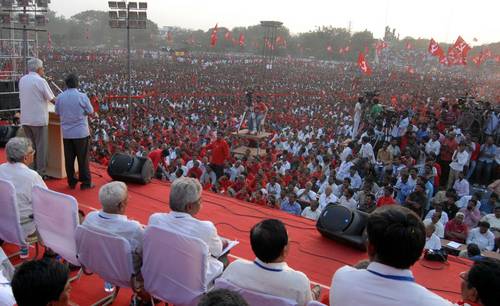
Those who had claimed that CPI(M) had been cut to size in Khammam district post 2009 elections were in for a rude shock. A sea of humanity descended on the town, drenching it in red. Around 1.5 lakh people, mainly from Khammam district, marched in a massive rally marking the successful conclusion of 23rd state conference of the Party on 4th February 2012.

Tribals of the district, attired in traditional gear, displaying their bows and arrows and dancing to the drum beats, were an attractive sight. Also attracting everyone's attention were hundreds of red shirt volunteers displaying their martial arts skills. Workers, agricultural labour, women, youth, employees formed the bulk of rallyists.

Three rallies from different parts of the town converged at the public meeting venue, Sardar Patel stadium, rechristened Jyoti Basu Nagar. The rally from Naya Bazar was led by newly re-elected state secretary B V Raghavulu, Polit Bureau member Sitaram Yechury and Central Committee member Thammineni Veerabhadram. They traveled to the meeting venue atop an open top jeep waving to the crowds en route. Around 40 per cent of the audience had to listen to the speeches sitting on the roads as the entire stadium was filled up with crowds.

The conference unanimously elected 81 members in new state committee. The new state committee re-elected B V Raghavulu as Party state secretary. A 15-member secretariat was also elected.
The members of the State secretariat are comrades P. Ramaiah, T. Veerabhadram, P. Madhu, S. Punyavathi, M.A. Gafoor, V. Krishnaiah, Y. Venkateswara Rao, Ch. Narasinga Rao, S.Veeraiah, S. Malla Reddy, Ch. Sitaramulu, G. Nagaiah, Midiam Babu Rao, and C. Ramulu.

The conference also constituted a three-member State control commission headed by B. R.Tulasi Rao. Five senior leaders, including noted freedom fighter Mallu Swarajyam, were appointed special invitees.
More than 700 delegates from all over the State participated in the deliberations during the three-day conference and adopted over 40 resolutions on issues concerning farmers, labourers, women, Schedules Castes and Scheduled Tribes besides other vulnerable sections of society.


CPI(M) general secretary Prakash Karat inaugurated the public meeting and said that the Party in Andhra Pradesh has been leading many militant struggles concerning various sections of people – farmers, dalits, workers, urban poor, land struggle etc braving repression. He mentioned about the martyrs of Mudigonda in this district and said that the Party has decided to take the same path of militant struggles all over the country. “We have decided to work towards building a Left and democratic alternative to the bourgeois parties all of who pursue neo-liberal policies.” He appealed to the people of AP to participate in the struggles to be launched by CPI(M) in large numbers. He expressed confidence that CPI(M) will emerge as a key force in the state in the coming period.


So nervous was the ruling regime about the turnout and the public meeting that the police removed the mike speakers kept some distance away from the venue so that common people can hear the speeches. They also ordered the local cable televisions to stop the live coverage of the rally and public meeting. Reacting to this Raghavulu told the public that this shows how fearful the government is about the voice of CPI(M) and warned that no amount of repression will suppress the voice of the people. He said the CPI(M) struggles in the coming period will show the government the power of the people. He lambasted the Congress party for ruining the state with its internal bickerings and careless attitude to the issue of division of state. 


He assured the gathering that CPI(M) will do everything to bring people's issues on to the agenda of politics in the state. Com B.V. Raghavulu said the party would undertake Jalasadhana Yatra and various other broad-based mass movements to mount pressure on the government to complete the pending irrigation projects and come to the rescue of farmers, labourers, and other poor sections of society. “We have discussed threadbare the multitude of problems confronted by a vast majority of the population under the present regime and evolved appropriate course of action to spearhead agitations for their cause,” he said, adding that the party would work towards bringing the Left, democratic, and seculars forces onto a single platform to wage relentless struggles against the proposed move of the State government to increase the power tariff. We would also undertake land struggles by drawing inspiration from the Mudigonda martyrs to ensure lands and houses for the poor, he said, and asserted that the party would make the ensuing all-India bandh called by all major trade unions on April 28 a grand success.

CPI(M) Polit Bureau member Sitaram Yechury took a dig at Manmohan Singh government saying that they may in near future need to hold their cabinet meetings in Tihar jail. He said that home minister P Chidambaram had cancelled all his appointments for the day and anxiously waited to know whether Supreme Court would send him also to Tihar. Luckily for him, the court gave an order that spared him. 

Thammineni Veerabhadram said that the gathering was much larger than what was expected. He asked the Congress leaders not to panic and resort to such repressive measures as to cut TV coverage.

Friday, February 3, 2012

CPIM Andhra Pradesh State Conference begins


The 23rd state conference of the CPI(M) Andhra Pradesh state committee ahead of the 20th Party Congress began on Thursday (2nd February) in Khammam, Bhakta Ramdas Kala Kshetram, rechristened Comrade Harkishan Singh Surjeet Nagar. The Conference began with the hoisting of Party Flag by  Freedom fighter Parsa Satyanarayana. Com. Prakash Karat, CPIM General Secretary inaugurated the conference and delivered the inaugural address to a packed gathering . Over 750 delegates and observers  along with scores of prominent citizens and well wishers of the Party formed the gathering.

Strengthen the Party to Fight the Onslaught of Neo-Liberalism : Prakash Karat

CPI(M) general secretary Prakash Karat stated while inaugurating the conference that CPI(M) will devote all its efforts in the coming period to strengthen itself because the need of the hour is a stronger Left in the country to fight back the onslaught of neo-liberal policies and to prevent communal forces from gaining ground. Towards this end it will take initiative to unite all Left forces and also rally all democratic and secular forces on people's issues.

Prakash Karat began his address by paying homage to the martyrs of Telangana armed struggle, many of whom were from Khammam district also. He said unlike non-Communist parties, CPI(M) conducts its affairs most democratically. “In our Party there is no 'high command' sitting in New Delhi issuing diktats. Our conferences upto the lowest levels discuss all issues democratically and chalk out their activity”, he said.

Karat lambasted the UPA government for focussing only on growth and refusing to see the all round deprivation of the masses. He said two decades of neo-liberal policies have increased growth but the benefits of that growth went only to a miniscule section of population. A shameless record of this government has been the consistently high double digit inflation rate for 38 months. People's lives are being attacked in the form of massive price rise and massive corruption. There is increased rural distress which is reflected in growing number of farmer suicides in many states of the country. In Andhra Pradesh in the month of January this year, a total of 160 farmers committed suicide, said Karat and held the central and state governments' policies responsible for this state of affairs. In Bengal also, ever since Trinamool Congress assumed power, the procurement machinery in the state has collapsed and indebtedness increased leading to number of suicides in the state, which was unheard of during the 34 years of Left Front rule.

Karat felt that it was because the CPI(M) and the Left had been consistently fighting against the government's neo-liberal policies and colloboration with imperialism, it has been targeted in Bengal where over 450 comrades were martyred. 177 of these comrades were murdered  by 'Maoists'. He said Trinamool Congress used 'Maoists' to weaken the CPI(M) and once that was achieved, it has started targeting them. “The 'Maoists' who keep claiming they were the most revolutionary force have actually played the most anti-revolutionary role in Bengal” charged Karat. He however noted that there is increased resistance in Bengal by farmers and other toiling sections against the anarchy of TMC rule. Karat concluded by saying that in the coming period the resistance against neo-liberal policies and imperialism is going to intensify.

CPI secretary K Narayana in his address said that only the Left parties had the moral right to fight against corruption because they have never been tainted by it. He said there is enough space for both the Left parties to expand instead of jostling in the same places. He expressed the willingness of his party to carry on a united fight against these anti-people policies.

CPI(M) state secretary and Polit Bureau member B V Raghavulu said that the 23rd state conference of the party will discuss on how to bring back the issues of people on to the political agenda of the state, which is reeling under political crisis. The issue of Telangana is deliberately being kept burning while the Congress bigwigs in Delhi keep watching the drama. He charged the Congress of playing with the future of the state. He felt the main opposition party in the state, the Telugu Desam, has also lost credibility due to its opportunistic stance on this issue. In such a situation it is the responsibility of the Left to bring the people's issues on to the political agenda. He said the true strength of Left parties must not be weighed in terms of seats or in terms of the coverage they get in media. It must be assessed in terms of the struggles it wages.

CPI(M) Polit Bureau members Brinda Karat and Sitaram Yechury are attending the conference that will conclude with a massive public meeting on February 4.

Saturday, January 28, 2012

CPIM 20th Party Congress Draft Political Resolution released


The draft political resolution to be placed for the forthcoming 20th Party congress of the Communist Party of India (Marxist) was released on Saturday at the Party headquarters in Delhi. The resolution will be  debated within all ranks of the CPI(M). Each and every party member can send amendments to the resolution till March 15th. The draft would be finally adopted at the party congress to be held in Kozhikode from April 4-9.  Com Prakash Karat, General Secretary of CPIM said while releasing the resolution, the central focus now would be on strengthening the party and stepping up its independent role. The resolution focus on building Left unity and project a Left and democratic alternative to counter the Congress and the BJP. CPIM P B Members Com. Sitharam Yechury and Com. K Varadarajan was also present during the ocassion.

For the full text of the Draft Political Resolution