Monday, September 27, 2010

West Bengal Left Front Solidarity Week Observed in States

The voice of the Left and democratic movement of West Bengal was reverberated in corners of India during the solidarity week. Here is a short report from the states.

 Public meetings, rallies, seminars, hall meetings, street corner meetings, special conventions were held at hundreds of places throughout India in defence of the Left Front and its government in West Bengal during the solidarity week from September 12 to 18. In some states, the programmes were held beyond one week and it would actually continue throughout this month. The call to observe the week was given by the extended central committee meeting of the Communist Party of India (Marxist), in Vijaywada. 

CPI(M) general secretary Prakash Karat addressed a public meeting in Patna on 17th September. He alleged that the UPA government was abetting Banerjee 'using Maoists' to kill CPI(M) workers in West Midnapore, Bankura and Purulia in the state. Thousands of CPI(M) workers had also been forced to leave home by armed Maoists apparently to ensure that the Trinamool Congress-led alliance won the assembly elections. the CPI(M) leader claimed. Karat, however, said Left workers had launched action to retrieve lost ground in three naxal-infested districts bordering Jharkhand. He strongly defended the Left front government and cited the implementation of land reforms, panchayati raj, scientific education in madarsas, and prevalence of communal amity as its landmark achievements. Karat said the fight against reactionary and communal forces would suffer a blow if the Left forces were to be weakened in the country

 In Tamilnadu, thousands of general public gathered in this campaign programme from Chennai to Kanyakumari. As part of this campaign, CPI(M) central secretariat member, Nilotpal Basu, addressed special meetings at Thanjavur, Kalpakkam in Kancheepuram district and Ponneri in Thiruvallur district. CPI(M) Tamilnadu state secretary G Ramakrishnan, central committee members N Varadharajan, T K Rengarajan, MP, V Vasuki and state secretariat members participated at various places. CPI(M) central committee member Md Salim and west Bengal Tourism Minister Manab Mukherjee also addressed number of meetings. 

As a part of this campaign, a well prepared photo-cum-art Exhibition was conducted throughout the state. Thousands of people witnessed the exhibition. There are 60 pieces of art work which describe the great achievements of the Left Front government and the grave threats and violent attacks of the TMC-Maoist combine on CPI (M) and the Left in the past two years. The content of the exhibition was effectively prepared by veteran writer, N Ramakrishnan, and the photographic collage was made by writer and artist Dr Sri Rasa. This exhibition added a sensitive touch to the week long campaign programme. 

Earlier, the campaign was started with a special publication of "Theekkathir" daily on the Left Front government in West Bengal, the LDF government in Kerala and and the Left Front government in Tripura. The issue also focussed on the attacks of ruling classes on the party. Around 1.10 lakh tabloids of this special issue have been taken to the people throughout the state. 

In Andhra Pradesh, a number of programmes were held as part of the solidarity campaign. On Septemeber 15, B V Raghavulu attended a convention held in Vishakapatnam while central committee members P Madhu and M A Gafoor participated in a meeting in Kurnool on September 18. In Hyderabad, a convention was held on 19th September where the main speaker was CPI(M) West Bengal state secretariat member Sridip Bhattacharya. Polit Bureau member and state secretary B V Raghavulu presided over the meeting while the deputy general secretary of CPI S Sudhakar Reddy and state secretaries of Forward Bloc and RSP parties also addressed it. A 30-minute documentary on the latest situation in areas of West Medinipur district was screened on this occasion. The documentary has been produced by New Media, which is a part of the India News Network. Earlier a rally was taken out from the state committee office in RTC X Roads to the venue of the convention in Sundarayya Vignana Kendram in Bagh Lingampally. 

A land of martyrs, an eye witness to the semi fascist, anti communist terror, Tripura , stood firm in solidarity with West Bengal, the frontal of the Left and democratic movement of the country. From 11th September in each corner of the state, thousands of people joining in the mass meetings have expressed their unflinching support to the fighting masses of West Bengal and have warned against any attempt of creating an state of anarchy in Tripura.The Tripura state committee of the party has started the program from 11th itself and it would continue up to 29th of this month. 

The solidarity  program in the state got underway on 11th at Belonia with a huge number of toiling masses joining the rally addressed by CPI(M) CC member and Finance Minister of Tripura , Badal Choudhury. The mood of the gathering was that of taking a pledge to thwart the conspiracies of the national and international reactionary forces to weaken the Left Front Govt of West Bengal. The same mood of solidarity and resistance was visible in each and every mass meeting. On 15th,CPI(M) Polit Bureau member and Tripura CM Manik Sarkar addressed another mammoth gathering at Udaypur. On the same day, the state capital Agartala witnessed a huge gathering of masses in the solidarity rally.addressed by CPI(M) CC member and West Bengal Housing minister Gautam Deb. CPI(M) Tripura state secretariat member Gautam Das also spoke in the meeting. On 14th at a rally in Bishalgarh, West Bengal minister for SHG and self employment Rekha Goswami elaborated on the achievements and pro people measures of the LF govt in West Bengal. Goswami along with Tripura Left Front Committee convenor Khagen Das addressed a mass meeting in Kamalpur too. CPI(M) CC member Shyamali Gupta spoke in a rally at Dharmanagar. MP and CCM, Bajuban Reang spoke in a rally at Manughat. Addressing two meetings at Gandachheraa and Raisyabari on 14th, CPI(M) state committee sectary Bijan Dhar said the concerted attack on the Left in West Bengal is aimed at weakening the struggle against neo liberalism, imperialism. In Sonamurra, West Bengal minister for land and land revenue Rezzak Mollah addressed a well attended rally, while CPI(M) West Bengal state committee member Amiya Patro addressed a rally on 18th in Kumarghat. The campaign program shall conclude on 29th with a mass meeting at Khowai. This will be addressed by CPI(M) West Bengal state secretary Biman Basu and party CC member Aghor Debbarma. 

In Kerala, the week was organized in a big manner. Pinaray Vijayan, the state secretary Of CPI(M) and VS Achyutanandan, the Chief Minister addressed meetings. CPI(M) polit bureau member and West Bengal Industies minister Nirupam Sen and central committee member and West Bengal Health Minister Suryakanta Misra addressed public meetings in Thiruvantantapuram and Kochi. An exhibition on the martyrs in West Bengal drew response from the masses. 

In Madya Pradesh, more than 100 public meetings were held in different parts of the state. Thousands of posters in Hindi, with the slogan “victory will continue” have been printed. A campaign material explaining the pro people nature of the Left Front was distributed throughout the state. In Himachal Pradesh, a public meeting was organized in Shimla, where Nilotpal Basu explained the true face of the attack on the Left in West Bengal. The participation of the younger sections was particularly noticeable. 

In Assam, public rallies were held in Bongaigaon and Barpeta. West Bengal state committee member Jibesh Sarkar and state secretariat member Dipak Dasgupta addressed the rallies respectively. CPI(M) central committee member Uddhav Barman spoke in both the occasions.

AIDWA Kerala State conference opens


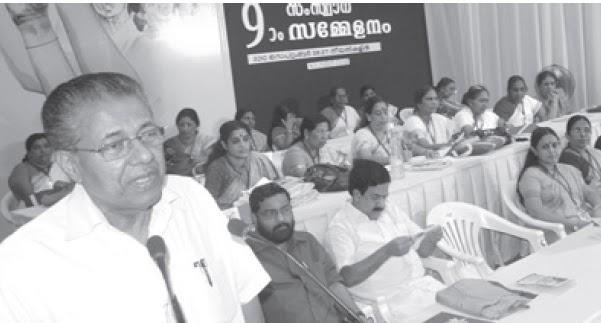
Ninth Kerala state conference of AIDWA, the fighting organisation of women started on 26th September in Trivandrum. The two day conference began the proceedings with unfurling of the flag by State president Com. T N Seema MP. The delegate session of the conferenc was inaugurated by Com. P K Sreemathi (Minister for Health and Social Welfare, Kerala State). She emphasized the importance of women movement in the era of globalization. She also highlighted the importance of 50 % reservation of seats in local body election. Com Sudha Sundararaman, All India Secretary AIDWA placed the organistaional report and greeted the deligates. Com N K Radha placed the Martyrs resolution and Com. Girija Surendran placed the Condolence resolution. After the inaugural session Com. K K Sailaja, State Secretary placed the work report for delibrations. 

 Later in the evening a seminar on religion and fundamentalism was held. CPIM State secretary Com. Pinarayi Vijayan inaugurated the seminar. KPCC president Ramesh Chennithala was also present. Pinarayi Vijayan said that the Communist parties had never taken an anti-religious stand, but only opposed intervention of religion in politics. He said it was Communists who reacted strongly when Christians were attacked in different parts of the country allegedly by Sangh Parivar forces."In our society there are believers as well as non- believers. Communists parties always desired co-operation of both these sections," he said.Stating that both majority and minority communalism were dangerous, he said these trends were mutually complementary 

Sunday, September 26, 2010

Left Parties finalise seat-sharing deal in Bihar


Leaders of the Left alliance (CPI-ML, CPI, and CPM) completed the seat-sharing deal on 130 assembly constituencies . The leaders of the left parties talking to the reporters in, in Patna on September 23, 2010, they said negotiations were on for 60 more seats.T he three major Left parties CPI CPIM and CPI(ML) have decided to contest 200 of the 243 assembly seats together in the state.

CPI state secretary Badri Narayan Lal said that, this is for the first time the three parties had decided to fight the assembly elections jointly. He said seat-sharing agreement had been reached on 130 seats, while talks were on for another 30. Rest of the 40 seats would be left for smaller Left parties and other like-minded people, he added.

CPI(ML) state secretary Nandkishore Prasad said out of 130 seats that had been finalised, CPI(ML) would contest 78, CPI 32 and CPM 20.. Prasad lambasted the ruling NDA for all-round corruption and alleged loot in social welfare schemes, rising inflation and opportunistic politics and said that the main agenda of the Left in the coming election would be land reforms, sharecropping, police-bureaucracy raj, unemployment, agriculture and industrial development. He said until land reforms are implemented properly in the state, development is not possible.

CPI M state secretary Vijaykant Thakur said, "We have decided to fight the election together so that a unified attack on feudal forces could be launched." Thakur said the Left would expose the JD(U)'s secular credentials in the poll campaign, as it has helped the BJP gain ground in the state. He also came down heavily on the congress stating its wish to make inroads into the state's political arena would remain a distant dream.

CPIM will be contesting from Bhibhoothipur Sitting Seat)(Samasthipur Dist), Loukaha, Phulpera (Madhubani Dist) Mothihari, Pipra (East Champaran Dist) Kudhni (Muzhapharpur Dist) Sasaram,(Rohathas Dist) Chatharpur (Supol Dist) Purnea, Beghusarai, Kagadia, Saharsa. In the remaining two seats decesion will be taken in two days. The names of the three major Left candidates would be released by September 27 or 28.


CPI-M general secretary Prakash Karat was in Patna on September 8. Karat had a day-long meeting with leaders on the party's poll preparedness and seat sharing arrangements with two other left parties.

CPI national secretary Atul Kumar Anjaan was in Patna on September 22 to review his party’s preparedness for the poll said left parties in Bihar (CPI, CPM, CPI-ML (Liberation) will fight Bihar assembly election on common manifesto. CPI has floated its slogan one vote, one note and support for the forthcoming Bihar Assembly election.

The Elections to the Bihar assembly will be held on October 23.

DYFI Tamil Nadu State conference begins in Kovai


DYFI Tamil Nadu State conference began on Friday in Coimbatore. Com P Sreeramakrishnan National President of Democratic Youth Federation of India (DYFI) inaugurated the delegate session of the congress.
Capitalist economies across the world are ruining the future and prospects of the developing and poor nations, said P. Sreeramakrishnan, on Saturday. He was speaking on the Inaugural Session of DYFI State Conference being held in Coimbatore since Friday. Mr.Sreeramakrishnan said that the fall of the US economy was a result of the anti-capitalist sentiments prevailing world over.

Mr.Sreeramakrishnan said that the capitalist economies always favoured only giant companies whereas China was in favour of the industries by the people irrespective of the profile of the company.

Accusing the Prime Minister of being a supporter of the United States of America, Mr.Sreeramakrishnan accused the Union Government of enabling back door entry of Foreign Direct Investments (FDI) in insurance, higher education, banks and retail trade killing the Indian trade and industry. In India, education is affordable today only for the affluent sections.

While FDI through door is being encouraged, the shares of the Public Sector Industries worth several crores of rupees are being sold at throwaway price.

Owing to a freeze on appointments in Indian Railways, the existing staff members are being made to work overtime and the overstretching leads to accidents every day.

He said that growth rate was without employment and pointed out that service sector that accounted for 65 per cent of the growth had only 17 per cent employment, while agriculture that contributed only 17 per cent for growth had 54 per cent employment.

Referring to Commonwealth Games-related issues, Mr.Sreeramakrishnan commented that Commonwealth was becoming “Congress Wealth”. The projected expenditure for Commonwealth had already increased manifold at the time of actual spending. Works worth crores of rupees are crumbling down every day.

On The Jammu & Kashmir Proposals

The Polit Bureau of the Communist Party of India (Marxist) has issued the following statement:

The eight-point proposal announced by the Central Government for Jammu & Kashmir is a step in the right direction. However, it is insufficient. More needs to be done to instill confidence among the people and to help restore peace and normalcy.

While the announcement of the release of young men in jail for stone-pelting, review of detention under the Public Safety Act and compensation for the families of those killed are welcome, it is necessary to provide for compensation for those injured in police firings and for the rehabilitation of those permanently incapacitated.

There has to be a change in the police methods of tackling protesters indulging in stone-throwing. The promise to review the location of bunkers in Srinagar city and the proclamation of Disturbed Areas should be done expeditiously. It should not remain only a promise. Finally, the group of interlocutors for initiating a dialogue should be primarily political in nature. It is only a political exercise which can help initiate a dialogue and sustain it.

Friday, September 24, 2010

CPI(M) to Launch Struggles in Andhar Pradesh on Local Issues of Common People

THE Andhra Pradesh state committee of the CPI(M) has decided to undertake struggles at the local level on burning issues facing the common man. Concrete issues that can be achieved through struggles are being identified and sustained struggles on them would be conducted. These struggles would be held along with the CPI. The Party has also called on all non-Congress secular parties in the state to join these struggles.

Party state secretary B V Raghavulu made this announcement at a press conference here at the end of two day meeting of the state secretariat on 21 September. He briefed the media about the decisions of the meeting. He said that every unit of the Party will be involved in the exercise of identifying the issues and planning the struggle. They will coordinate with other mass organisations in this regard.

Raghavulu emphasised the belief of the CPI(M) that all the secular opposition parties have to come together on people's issues, even as they can take their own independent decisions during the time of the elections depending on their policies. He made it clear that the CPI(M) will keep on fighting on the issues of the common man along with the other leftist parties, irrespective of whether anyone else would join with them or not. “We will bring about more pressure on the government for the resolution of the problems of the masses” he added. However, he hoped that Loksatta and Praja Rajyam parties would join these direct struggles along with the TDP. He acknowledged that the TDP is reluctant on the issue of joint the struggles with Loksatta and Prajarajyam.

Answering a question about ‘Arogyasri’ program (a government scheme for providing medical facilities for the poor families in corporate hospitals), he charged that the state government is driving away the white ration card holders from utilising this health scheme. He cited the instance of the newspaper reports, where in it was reported that the state cabinet has decided, Arogyasri will be provided to the people, whose names were not in the records of the civil supplies department, only on the condition that the district collector has endorsed them as genuine. This is a totally new decision, making it compulsory for the white card holders, to have their names listed in the records of the civil supplies department as well, in order to avail the health scheme. He condemned this decision as being against the welfare of the people.

Raghavulu also charged the government of trying to abdicate its responsibility of providing the rations through the fair price shops. All the hurdles being created by the government for the people in availing the welfare schemes is atrocious. He reminded that the state government has eliminated 18 lakh ration cards in the name of weeding out of bogus cards. He said the state government is proceeding stepwise in the direction of sabotaging the welfare schemes and warned that, such anti-people decisions of the government deserve nothing else but a fight back.

Jammu & Kashmir: Tangible CBMs Must Follow

(Editorial - Peoples Democracy)

FINALLY, an all-party delegation visited Jammu & Kashmir on September 20-21. This has come after a hundred days of disturbances and confrontation in the Kashmir valley which consumed 108 young lives – victims of firing by security forces. Soon after the disturbances broke out on June 11, the CPI(M) had demanded the convening of an all-party meeting and sending of an all-party delegation to Kashmir. This was reiterated in the parliamentary discussion on August 6, where the government was urged to take these steps before the holy month of Ramzan began. The government had then argued that these steps and the political process of dialogue and discussion will begin only when normalcy has been restored. The point made in these columns repeatedly was that the undertaking of such steps was essential to strengthen the process of restoring normalcy. The government’s refusal to consider this at that time has only contributed in escalating tensions and heaping greater misery and agony on innocent people.

By meeting a large cross section of the people and political parties in both Srinagar and Jammu, the parliamentary delegation conveyed its solidarity with the people of the state and shared their agony of sufferings. The principal appeal to all sections of the people and political leadership was to first, join together in restoring normalcy and peace and to resolve all issues of dispute through talks and negotiations. It was in this spirit that certain members of the delegation met various separatist leaders in Kashmir, who declined the invitation to meet the delegation, asking them to join the efforts to restore normalcy and save the lives of innocent youth and the consequent misery being imposed on the people. This unprecedented `out of the box’ step was aimed at conveying to the people of Kashmir the sincerity of the elected Indian political leadership in reaching out to all sections and all `shades of opinion’ in order to restore normalcy and provide relief from the present miseries and agonies. The unanimous 1994 resolution declaring Jammu & Kashmir as an integral part of India defined the parliamentary delegations’ approach.

The interactions with various cross sections of the people in Srinagar and the visit to the hospitals revealed the deep degree of alienation of the people in the valley. In these columns last week, we had detailed the concrete steps that need to be undertaken. The Left parties had, earlier at the all-party meeting convened by the government, presented a set of demands that need to be urgently implemented. None of these have been considered for implementation till date. This only adds to the growing `trust deficit’ and `governance deficit’ amongst the people. These measures must be urgently addressed in order to reverse the growing trend of alienation among the people in Kashmir.

While the representations made before the delegation in Jammu revealed the widespread feeling of a `Kashmir-centric approach’ of the central government at the expense of neglecting the Jammu and Ladakh regions, the visit by some members of the delegation to the camps of the displaced Kashmiri pandits revealed the other aspect of the agonies of the people of Jammu & Kashmir. Having forced to leave the valley 21 years ago, many of these families do not have a permanent roof over their head till date. All the promises and packages announced by the central and the state governments have remained largely unfulfilled. The agonies and the sufferings of the Kashmiri pandits and other displaced people need to be urgently addressed.

The harmonious cohabitation of the pandits and the Muslims in the Kashmir valley for centuries has been one of the strongest foundational pillars of the syncretic civilisational ethos that defines India. The rupture of this harmony is, thus, designed to destroy the soul of the `idea of India’ – the modern secular democratic Republic.

Therefore, the need to urgently tackle these problems and restore normalcy is not only required for relieving the people of their agonies and sufferings in the state of Jammu & Kashmir, it is also required to strengthen the consolidation of our modern secular Republic.

This visit of the parliamentary delegation must result in some tangible confidence building measures that the central and the state governments must undertake. The specific measures suggested by the Left parties, as reported in these columns last week, must form the basis. At the least, the central government must initiate action against those members of the security forces against whom charges of excesses have been proved by the CBI or other agencies. Further, a review of all political prisoners languishing in jail must be undertaken and those without substantive charges against them could be released.

Combating Unemployment in the era of Globalisation


Speech delivered by Comrade.P.Sreeramakrishnan,President of the Democratic Youth Federation of India(DYFI), at the national seminar organized by DYFI Karnataka state committee on September 17th in Bangalore.

Dear Comrades,

It is of great honour to be part of a seminar being organized by the Karnataka state committee of DYFI on the burning issue of youth regarding unemployment. After 63 years of Independence, our country still has about half of the population below the poverty line. One of the major problems faced by the youth in our country is regarding employment. That is why DYFI has given utmost importance to the issue of unemployment and had added that demand in its Aims and Objectives itself

The DYFI is committed to fight for accomplishing the basic demand of the Indian youth; “Jobs for all, Education for all”. It pledges to organise and conduct struggle against the menace of unemployment and to fight for employment or unemployment allowance till employment and to conduct propaganda and agitation for the inclusion of the ‘Right to work’ as a fundamental right under the Indian Constitution

It is with this regard DYFI central committee organized a two day long Convention on Employment in New Delhi on 10-11 February 2010. The Convention was inaugurated by Com. Prakash Karat. Deliberations in the Convention started with the presentation of an approach paper by the DYFI CEC followed by the presentation of 9 papers on various aspects of the employment problem in India. These were followed by a vibrant discussion by the delegates attending the Convention.

Our rulers tell us that globalization and liberalization has brought unprecedented prosperity in India; that India has become the second fastest growing economy in the world; and that with a little help from the United States we are on our way to become the next global superpower. What is the reality?

There is no doubt that liberalization has brought prosperity. But prosperity for whom? For the dollar billionaires in India, whose numbers have swelled from just 4 in 2001 to 52 in 2009. The combined wealth of the 100 richest Indians accounts for 25 per cent of our GDP today. This no doubt amounts to unprecedented prosperity for the superrich. But what does high GDP growth mean for the masses? Does that create enough decent work opportunities for the unemployed and the millions languishing in the informal economy?

The experience of the past decades presents an alarming situation for employment opportunities. Even the limited economic growth and increased foreign investments have not led to an increase in employment opportunities. The phenomenon of jobless growth which has been afflicting the advanced countries of the West now haunts India. This is happening because more money is invested in technology and mechanization, while productivity of workers is coerced upwards, leading to a situation where increases in output do not indicate increases in jobs.

Thus a 5% increase in agricultural production would have led to a 4.6% increase in employment in agriculture in the 1980s but today it would merely lead to an increment of 0.05%! A similar, though not so steep, decline afflicts the whole economy. Despite increases in agricultural output, employment in agriculture is stagnating. What is happening with the employment in agricultural field? For example take the case of Punjab. The Central government has decided to not to procure more agricultural products in go downs as done in the past. The state government too decided the same way. The farmers can’t keep their products without preservation for a long time. So they will have to sell off the products at a price fixed by any big mill owners that too may be very low when compared to the actual price. Now the agricultural sector which has a high percentage of the workforce is struggling to create sufficient jobs. This has led to a shift in the working population from rural to urban areas; and there is a difficulty in creating sufficient jobs for this new sector of the population. The continuing trend of farmers’ suicides is a sign of extreme despair and hopelessness of the peasantry plagued by repeated crop failures, inability to meet the rising cost of cultivation and rising indebtedness. The Government should take serious efforts to regain the confidence of the agricultural workers by introducing new schemes.

As overall output growth has increased over the past two decades, agricultural growth has decelerated. Moreover faster growth has taken place in the services sector rather than in industries, leading to services accounting for nearly 65% of India’s GDP in 2008-09 from 41% in 1980-81. Industrial growth has been moderate. What is particularly significant in this post-liberalization growth process is that while agricultural growth has decelerated and agriculture’s share in GDP has fallen drastically, the share of workforce employed in agriculture, which was above 68% in early 1980s and around 65% during the early 1990s, has declined at much slower pace than the decline in agriculture’s share in GDP and has continued to remain quite high at over 56% in 2004-05. This has two major implications. Firstly, there is an obvious squeeze on per capita agricultural income on the top of the pervasive disguised unemployment in agriculture. Secondly, growth in the services and industrial sectors are not generating adequate employment to absorb surplus workforce from agriculture. In other words, India has experienced growth but without any substantial expansion of non-agricultural work opportunities, i.e. jobless growth.

Most of the country’s unemployed are in the rural areas. Once quantitative restrictions are removed under the WTO regime and mammoth agri-business multinationals set about taking over the agricultural sector in the country, using modern technology, mechanisation and wholesale changes in the agricultural pattern, the disastrous effects would become compounded. A parallel ‘jobless growth’ appears to pervade the non-agricultural sectors too.

Economic reforms may have given a boost to industrial productivity and brought in foreign investment in capital intensive areas. But the boom has not created jobs. This was not unexpected. According to a report by the Washington−based Institute of Policy Studies (IPS), the combined sales of the world's top 200 MNCs is now greater than the combined GDP of all but the world's nine largest national economies. Yet, the total direct employment generated by these multinationals is a mere 18.8 millions −one−hundredth of one per cent of the global workforce. India's Ninth Five−Year Plan projects generation of 54 million new jobs during the Plan period (1997−2002). But performance has always fallen short of target in the past, and few believe that the current Plan will be able to meet its target. India's labour force is growing at a rate of 2.5 per cent annually, but employment is growing at only 2.3 per cent. Thus, the country is faced with the challenge of not only absorbing new entrants to the job market (estimated at seven million people every year), but also clearing the backlog. Sixty per cent of India's workforce is self−employed, many of whom remain very poor. Nearly 30 per cent are casual workers (i.e. they work only when they are able to get jobs and remain unpaid for the rest of the days). Only about 10 per cent are regular employees, of which two−fifths are employed by the public sector. Most part of the labour force is employed in the "unorganised sector", i.e. sectors which don't provide with the social security and other benefits of employment in the "organised sector." In the rural areas, agricultural workers form the bulk of the unorganised sector. In urban India, contract and sub−contract as well as migratory agricultural labourers make up most of the unorganized labour force. Approach paper presented at the All India convention clearly states:

We know from our field experiences that the situation is far worse than the figures suggest. Lakhs of migrant and informal workers have lost their jobs. While the agrarian distress from the late 1990s had increased migration from rural to urban areas, in the recent period we have seen the reverse trend of urban rural migration, where lakhs of workers returned to their villages from the industrial towns. This happened at a time when drought had engulfed over 300 districts last year affecting agricultural production and aggravating rural distress.

Unorganised sector is made up of jobs in which the Minimum Wage Act is either not, or only marginally, implemented. The absence of unions in the unorganized sector does not provide any opportunity for collective bargaining. Over 70 per cent of the labour force in all sector combined (organized and unorganized) is either illiterate or educated below the primary level.

The state itself started the process of ‘shedding the load of surplus workers’ by adopting various methods like freeze on fresh recruitment, by offering workers voluntary retirement schemes (VRS). During the last decade, the public sector accounted for 60 per cent of reduction in employment in the organised sector. The process of privatization of state enterprises, by the instrument of disinvestment, further led to a decline in employment, dilution of collective bargaining, worsening in working conditions and reduction in wages. This emboldened capital to raise the demand for reduction of workers in the private sector, by using a sophisticated term—the provision of ‘labour flexibility’.

The much-touted BPO-based jobs like call centers and back-office jobs have yielded barely 2 lakh jobs in the country. IT sector has generated lakhs of job in general but there too stagnation is appearing. In the small-scale sector a study has estimated that there will be a 36% decline in employment due to technology intensive investments.

In the IT sector a new class of managers and skilled workers are being recruited by business firms. An increasing number of IT professionals have been finding it difficult to handle emotional stress, according to experts. An ‘occupational hazard,' the stress related to work needs to be addressed without delay, they emphasize. The Government and the corporate sector should look at employment laws as different from the labor laws for the business process outsourcing (BPO) industry. The stress, working against nature and the safety and security factor plays a major role for those working in this arena. Though a job in the IT company, call centers are all about "big money," the future of the employees and their educational opportunities five years down the line is a million dollar question. The employees cease to be social beings and often get isolated from their family and friends. Emotional exhaustion adds to the physical and mental strain of the workers, leading to higher levels of stress and burnout under the electronically monitored work and tightly bureaucratised work regime. We have identified the conditions prevailing among the lower level workers in many small companies in the IT/BPO areas as bordering on anarchy. The conditions are worse than the exploitation seen in villages. The 8-hour work day is not observed. The hire and fire policy is rampant. For many workers, even an appointment order is not available. Often only an identity card is issued. There is a feeling of insecurity and humiliation among lower level workers. So we have to seriously take into consideration setting up of forum/association for these IT/BPO professionals. In a city like Bangalore, which is much touted as the Silicon Valley of India, we should take greater and serious efforts to engage in the problems faced by workers in these sectors. We have to chalk out new strategies to bring these workers into our fold.

It is notoriously difficult to measure unemployment in India because of high levels of disguised or ‘under-employment’. Underemployment occurs when people are not classed as being unemployed, but, they make very little from their job. Open unemployment is not a true indicator of the gravity of the unemployment problem in an economy such as India, characterized as it is by large−scale underemployment and poor employment quality in the unorganized sector,

The downtrodden in Karnataka form about 26.5 % of the population, and without improving their conditions, there can be no meaningful development of Karnataka. About 75 % of the scheduled caste and scheduled tribe from the rural population are still surviving on daily wage labour. Their average income per day has not increased beyond Rs.25. Daily wage labour opportunities have reduced to only 70 days per year.

It is important to underline this important contradiction inherent in the neo-liberal growth regime. This growth regime is only capable of generating very limited formal job opportunities for a handful in the organised sector even as the masses are pushed into the swamp of the informal sector and forced self-employment, to live a life of insecurity and impoverishment. With all its pretensions, inclusiveness for this regime will remain a chimera. However, the slogan of “inclusive growth” is creating expectations within vast sections of the youth that they would somehow get “included” in the growth process and benefit from it. This subjective desire of millions of youth dotting the informal sector in the rural and urban areas to get “included” need to be harnessed through specific and immediate demands vis-à-vis the state, like universal employment guarantee at minimum wages, skill upgradation, universal social security and policy support for the self-employed. The limits of inclusiveness have to be pushed beyond what the ruling classes are willing to offer to the “excluded”, till the hollowness of “inclusive growth” under the current regime is completely exposed.

There is also a need to demand that employment generation must acquire the centre stage in the Planning process. For this it is imperative that the Government collect and regularly publish data on employment/unemployment both for the organised and unorganised sector. It is ironic that while data on GDP growth is released every three months, reliable data on employment/unemployment is made available only once in five years (NSS quinquennial large sample surveys). Countries like the US and other developed economies release official employment/unemployment data on a monthly basis, which allows periodic assessment of the Government’s performance on the job creation front. The Indian practice precludes the possibility of the Government of the day being held accountable for their programmes and policies vis-à-vis employment generation. This needs to change at the earliest.

It needs to be recognized that in the ultimate analysis, the solution to the problem of unemployment and decent work opportunities for the vast masses in India can only be found in an alternative paradigm of growth and development. The neo-liberal growth regime based on asset price bubbles and private corporate investment, capital intensive technologies, and elite consumption demand can never generate adequate employment opportunities for the masses, especially the youth. The solution lies in moving towards a trajectory where the public sector, mass consumption demand and labour intensive techniques drive the growth process. This would imply moving towards much greater state intervention and regulation; i.e. a basic systemic change; for which we have been fighting. There is a need to intensify that struggle and firm up our strategic perspective.

Thursday, September 23, 2010

Korean Workers Party Conference from September 28

3rd Party Conference of Korean Workers party will begin on 28 September in Pyongyang. It will coincide with the 65th anniversary of the Korean Workers’ Party. The Korean Workers’ Party remains the most politically powerful entity in the Democratic Peoples Republic of Korea. A party conference is a procedural event for the Korean Workers’ Party to change its charter and bylaws, and elect members of the Party Central Committee and its subordinate power bodies (Political Bureau, Secretariat, etc).  In making changes to the party’s charter and bylaws, the party can: (a) redefine the mission of a party organization or department (b)restructure local or central party organizational rules or procedures (c) revise the criteria and duties of rank and file party members.  Party Conference  is considered an auspicious event in the completing of the juche revolution. Through local delegates’ conferences, model workers and party members have been elected delegates for dispatch to provincial delegates’ conferences. In these local delegate conferences, they agreed unanimously that the  Workers’ Party Delegates’ Conference, to be held in the year of the 65th anniversary of the founding of our honorable Party, will be an epochal turning point in the reinforcement and development of our Party and a great happy event with the remarkable importance of opening an uplifting period in the revolution. A total of between 1,500 delegates from each province is elected to attend the conference.

The nuclear winter and peace


Reflections of Fidel
MORE than 20,000 nuclear weapons are in the hands of eight countries: the United States, Russia, France, the United Kingdom, China, Israel, India and Pakistan, some with profound economic, political and religious differences. The new START treaty, signed in Prague this April by the largest nuclear powers, is nothing more than an illusion in relation to the problem that is threatening humanity. 

The nuclear winter theory, developed and brought to its current stage by the eminent researcher and professor Dr. Alan Robock from Rutgers University, New Jersey (a modest scientist who prefers to recognize the merits of his colleagues rather than his own), has demonstrated its veracity.

For them, the only way to prevent the use of nuclear weapons is by eliminating them. Living in a privileged place on the planet, which allows them to enjoy the highest standards of living and the world’s riches despite the incredible waste of non-renewable resources, the American people should be the ones most interested in the information provided by scientists. But how space does the mass media devote to that task?

According to Robock, the nuclear winter theory has shown us that, "if such weapons did not exist, they could not be utilized. And at this time, there is no rational argument to use them at all. If they cannot be used, they must be destroyed and thus we would be protecting ourselves from accidents, errors of calculation or any demented attitude."
"…computers that operated with ultramodern models were converted into the sole laboratory of choice, and historical events – including cities razed by fire in the wake of earthquakes and bombardments in times of war, the columns of smoke of forest fires, and clouds created by volcanic eruptions – became the yardstick for scientific evaluations."

The proliferation of nuclear weapons at a time when Israel, India and Pakistan have joined the nuclear club, and other countries, it would seem, are aspiring for membership, have obliged Robock and his colleagues to review their initial research projects. The results of these updated studies, published in recent articles, are astonishing.

In relation to the United States and Russia, even though both countries committed themselves in Prague in April 2010 to reduce their operative nuclear arsenals to some 2,000 weapons, the only way of preventing a global climate disaster would be to eliminate nuclear weapons.
"…any country that is currently considering the nuclear option needs to recognize that, by adopting such a decision, it would be endangering not only its own population but those of the entire world. It is time for the world to once again reflect upon the dangers of nuclear weapons, and this time adopt the road to peace and eliminate the possibility of a global climate disaster induced by nuclear energy, for the first time since the middle of last century."
"... the use of nuclear weapons in the event of a total attack on an enemy would be a suicidal action due to the anomalous cold and darkness provoked by smoke from the fires generated by the bomb. In fact, it has been evidenced that the more nuclear weapons a country possesses, the less safe it is."

Albert Einstein said: "The unleashed power of the atom has changed everything except for our ways of thinking and we are thus drifting toward an unparalleled disaster." Carl Sagan said that our nuclear arms policy was "a path where no man thought."
At the end of his master lecture I asked Professor Alan Robock, "How many people in the world are aware of that information?" He replied, "Very few." I added, "In your country, how many?" "The same," he answered, "they don’t know."

I did not doubt that that was the sad reality, and added: "We are not doing anything when just you and me know it, what is needed is that the world knows it. Perhaps the psychologists have to be brought in to explain why the masses do not understand."
"I have an answer," exclaimed the scientist: it’s called denial. It is something so horrible that people don’t want to think about it. It's easier to pretend that it doesn’t exist."

His words, during his nearly one-hour lecture, aided by charts, figures and photos projected on a screen, were clear, precise and eloquent. For that reason, I said: "What is raising consciousness, which we talk so much about? What is creating culture? And how discouraging it must be for you scientists that people don’t even hear about what you are doing; how many hours you invest in it."

I noted that, when there was no radio, television or Internet, it would have been impossible to broadcast a lecture like that one in Cuba or in the world. Far less when many people were unable to read or write.
We promised the professor that we would spread the information he had given us about the nuclear winter theory – an issue that we only know a little about based on our concern over the possible outbreak of a global nuclear war, which gave rise to our duty to attend his lecture – in a language that even eight-year old Cuban children can understand.

No other era in human history is related in any way to this one. Certainly, if these risks are not understood by those who make decisions from the heights of the immense power that science and technology has placed in their hands, the next world war will be the last one, and it would take, perhaps, tens of millions of years before new intelligent beings could attempt to write their history.

As chance would have it, yesterday, September 20, I received news that the Peace Boat cruise liner was due to reach the Port of Havana at dawn on September 21, after being delayed by cyclones on its voyage from the Canary Islands for several hours. The Peace Boat is a non-governmental organization with special consultative status at the United Nations. Since 1983, it has been organizing cruises around the world to promote peace, human rights, fair and sustainable development and respect for the environment. In 2009 the organization was nominated for a Nobel Peace Prize for its global campaign to prevent war.

In a letter written to me by Yoshioka Tatsuya, director of the Peace Boat, and sent via Nao Inoue, head of the group of visitors, Tatsuya states: "Our organization has been working for years, recently in cooperation with the ALBA countries […] which have clearly expressed their commitment to nuclear abolition, the prohibition of foreign military bases and the peaceful resolution of international controversies […] Japan, as you know, the only country to have suffered an atomic bombardment, maintains to this day a pacifist Constitution which, by virtue of its Article 9, formally renounces war and prohibits the use of force in international disputes…

"An issue of special interest in our activism is the removal of foreign military bases: a situation present in Japan and diverse parts of the world, taking into consideration that foreign bases such as those existing in Guantánamo and Okinawa are causing irreversible environmental damage and fomenting war instead of world peace.

Including this voyage, the Peace Boat has organized 70 trips around the world, beginning in 1983, with the participation of no less than 40,000 people, who have visited more than 100 countries. Their slogan is "Learn from past wars to build a future of peace."
Over 20 years, the Peace Boat has visited our country 14 times, overcoming obstacles and hurdles imposed by the United States. It has been promoting campaigns to raise significant donations, fundamentally to the health and education sectors.

Its members have a presence in numerous international forums and solidarity with Cuba encounters. They are truly proven friends of our country. In May 2009, in response to a proposal by the Cuban Institute of Friendship with the Peoples (ICAP), the organization was decorated with the Order of Solidarity granted by the Council of State of the Republic of Cuba.

It was a great honor for me to receive an invitation to meet with a group of the visitors, which I proposed they hold with the maximum number of people, at Havana’s International Convention Center. Mr. Nao Inoue and Ms. Junko Watanabe both addressed participants. Junko Watanabe is a survivor of the first atomic bomb launched on the city of Hiroshima, when she was just two years old. She was with her little brother in the yard of a house located 18 kilometers from the point where the bomb was dropped; an event that totally destroyed the major part of the city disappear, instantly killed more than 100,000 people and inflicted serious harm on the rest of the inhabitants.
Junko Watanabe recounted her dramatic memories, when years later, she came to know the images and details of that act, which caused so much suffering for so many innocent people who had nothing to do with that brutal attack. It was a deliberate act to terrorize the world with the unnecessary use of a weapon of mass extermination, when the Japanese empire was already defeated. The bomb was dropped, not on a military installation, but on a defenseless civilian target. The circulated footage of that horrific crime does not express what the voice of Junko Watanabe told us about the events. It was an opportune occasion to express our points of view and tell our friendly Japanese visitors, fighters for the abolition of nuclear weapons, military bases and war, about the efforts being undertaken by our country to avert a nuclear conflict that could put an end to the existence of our species.