Sunday, June 20, 2010

CPI (M) flays Andhra Government's new industrial policy

The new Industrial Policy announced by the State government on Friday is of no benefit to the State, particularly the workers, it is a danger to farmers and appears to be most beneficial to real estate dealers, Communist Party of India (Marxist) State secretary B.V.Raghavulu has said.

Addressing a press conference here on Saturday, he said that the emphasis of the new policy was more on investment and not on production. The erstwhile SEZ have now been converted to SIZ (special investment zones).

The State government announced such industrial polices in the past, but nothing productive came out of them. Out of the 103 SEZs sanctioned only 40 of them came to a productive stage.

Though the State government claimed that 5 lakh jobs would be created in these 103 special economic zones only 35,269 jobs were created in the 40 SEZs, Mr Raghavulu said.

Scams galore

Several scams were surfacing everyday in relation to APIIC and there was every danger of these SIZs turning into centres of corruption, Mr Raghavulu said.

The CPI (M) leader said that the party was against the proposed decision to auction the fishing rights of all water tanks in the State. This would affect adversely the lives of all the fishermen eking out their livelihood on them.

He also criticised the leakage of the discussions in a Cabinet meeting.

He wondered why Chief Minister K. Rosaiah was hesitating to say that there is no corruption in execution of the irrigation projects and resorting to such “leakage politics.”

(Courtesy : The Hindu)

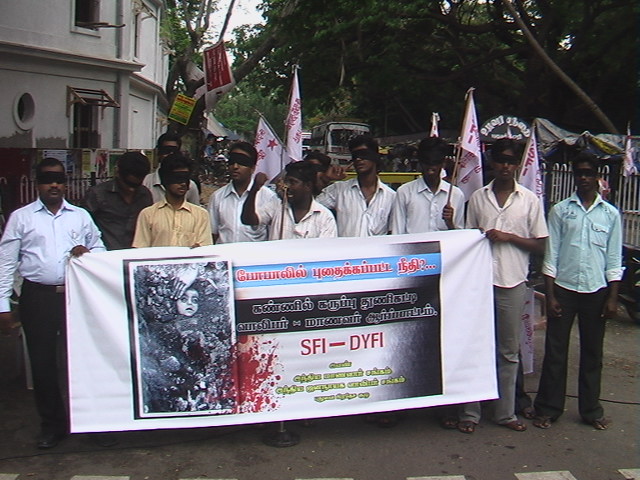
DYFI to conduct 1000 Peoples Court against Bhopal Tragedy Verdict


Democratic Youth Federation of India will conduct 1000 Peoples court across the country raising the issue of Bhopal Tragedy Verdict. DYFI demanded to inquire about the conspiracy behind the escape of main accused James Anderson and impeach the judges who have given the verdict letting the accused without much injuries. DYFI Central executive also decided to send 10 lakh email request to the Prime Minister regarding this issue. Peoples court which will be conducted in the first week of July will trial all the accused in the Bhopal Tragedy Case. Request E mail will be inaugurated on July 8 at Bhagath Sing Marg, New Delhi in the presence of Gas Tragedy Victims and their relatives. The Committee also decided to conduct vigorous campaign against the Maoist atrocities across the country. A National convention of the youth will be convened at New Delhi on August 20th.Study camp for leaders upto the district level will be conducted in 3 regions. Tamil Nadu, Tripura and Maharashtra will be venue for the study camps. The meeting also decided to celebrate the 150th Birth anniversary of Rabindra Nath Tagore. DYFI All India President Com. P Sreeramakrishnan presided over the meeting. General Secretary Tapas Sinha presented the Report. The meeting asked the Central Government to throw away the Nuclear liability bill which will create more Bhopals. 

DYFI Protest against Bhopal Tragedy Verdict

 Tiruppur
 
 Pondicherry
 
 Kozhikode

Saturday, June 19, 2010

33 Years of Left Front Government: Defend the Gains of the Working People

Prakash Karat

The completion of 33 years of the Left Front government in West Bengal is a historic landmark. No other state government led by other political parties have such a record both in terms of longevity and in the implementation of policies which have benefited the people. This unique record is sought to be overshadowed by the electoral reverses suffered by the CPI(M) and the Left Front in the past one year – from the Lok Sabha elections up to the 81 municipal corporation polls.

This situation is being utilized to negate all the achievements and work done by the Left Front government in the past three decades. A vitriolic propaganda is on to depict West Bengal as a state which has “suffocated” under “Red rule”; that West Bengal has been converted into a desert devoid of any worthwhile development. That such propaganda is being made by the ruling classes and the corporate media should not surprise one because the entire record of the Left Front government has been to push through policies which have been not in the interests of the bourgeois-landlord classes of our country.

No other state has implemented land reforms to the extent that West Bengal has. One-fifth of the total land distributed as surplus land in the country has been in West Bengal alone. No other state has ensured that agricultural development benefits the peasantry and not a narrow strata of landlords and rich peasants. The institutionalization of the panchayat system opened up the way for the rural toiling masses to have a say in their local affairs. The prolonged rule of the Left Front has created a stable secular atmosphere. The exercise of democratic rights by various sections of the working people is an inherent feature of the political system. There is no doubt that the three decades of Left Front government have transformed West Bengal for the better.

This does not mean that the Left Front government has had a smooth path of advance. Especially after the change in the phase of capitalist development at the all-India level marked by the introduction of neo-liberal policies in the 1990s, the difficulties in pursuing pro-people policies became evident. The limitations of the powers and resources of the state government posed obstacles to pursuing alternative policies. The CPI(M) and the Left Front, which have been the only consistent force against the neo-liberal policies and the growing collaboration with imperialism, were bound to come under attack.

For the ruling classes and imperialism, the continued existence of a Left Front government was disagreeable. The role of the CPI(M) and the Left after the 2004 Lok Sabha elections in national politics highlighted this aspect. Weakening of the CPI(M) and the Left required the isolation of the Left Front government.

Within West Bengal, the class struggle had not ever abated during the long tenure of the Left Front government. Under the impact of the new phase of capitalist development, there have been changes in class relations in the countryside and urban areas. New contradictions and problems emerged within the ambit of the impact of the policies pursued by the Left Front government. It is necessary to make a deeper analysis and understand the forces at play which have had its impact on the political situation in the state.

The nature of the opposition to the CPI(M) and the Left Front reveals certain political facts. The rightwing opposition forces are often adopting Left postures to cover-up their virulent anti-Communism. This arises from the people’s consciousness who will not mobilise around a rightwing/reactionary platform. We saw such a phenomenon in Kerala too decades earlier when the Congress-led anti-Communist alliance had to mouth radical slogans and rhetoric. Utilising some of the cracks which developed in the popular support for the CPI(M), the rightwing opposition has mounted an all out offensive by mobilizing all the anti-Communist and divisive forces.
The post-Lok Sabha election period has seen attacks on the CPI(M) cadres with more than 245 killed in the past one year. Thousands of people have been rendered homeless. There have been evictions of peasants and bargadars and forcible occupation of Party and mass organization offices and arson attacks on houses. Such attacks revealed the true nature of the political forces ranged against the Left Front. It portends a class attack which will take place against not only the CPI(M) and the Left but against the common people and the gains that they have achieved. The aim of the Trinamul-Congress combine of displacing the Left Front government to end the so-called “Red misrule” is actually meant to bring about a counter transformation. A `pariborthon’ which would lead to establishing the rule of the dominant classes and vested interests in the rural areas and under the cover of petty bourgeois radical demagogy, a free run for neo-liberal policies.

The crucial questions will be :

· Can such forces be allowed to rollback the relations in land which favour the poor peasants and the rural poor? Can the edifice built on land reforms be eroded?

· Can the opportunist bourgeois politics of instigating communal divisions and politicking based on that be allowed to come back in West Bengal? Already we saw how the Trinamul Congress leader had sought to stoke fears about communal violence erupting after the municipal polls. The lasting achievement of communal peace in West Bengal cannot be sacrificed for the narrow interest of anti-Communism.

What the anti-Communist combine seeks to usher in is a narrow form of identity politics which seeks to fan ethnic, religious and caste identities. Such politics is resorted to, to erode the solidarity of the working people and will have its regressive effects on society.

The CPI(M) is conscious that the long years of continuous Left Front government have, despite its enormous achievements, also engendered some negative features. It is a part of the basic understanding of the Party that running the state government is not the exercise of State power. The bureaucracy, the police and other institutions of the State have not been touched by any basic changes. Working in such a system, in government, has its effects on the Party and its organization. Though efforts were made continuously to limit the corrosive effects of this association.

The recent electoral results show that some sections of the people have been alienated. This cannot be attributed to the functioning of the Left Front government alone. The causes of such alienation lie in the political sphere and also in the organizational shortcomings and weaknesses of the Party. The steps that are being taken to overcome the shortcomings and reforge the links with the people are, therefore, to be taken up in the three spheres -governmental, political and organizational which are interlinked.

In the last year of its present tenure, the Left Front government will do everything possible to implement the pro-people measures spelt out in the state budget and continue to provide relief to the people who are suffering from price rise, the effects of the agrarian crisis and the policies of the Central government in various spheres.

Contrary to what is being depicted, the mass base of the CPI(M) and the Left is substantial and widespread. The forces which are ranged against the Left Front are not going to be united permanently. With the adoption of correct tactics and the single-minded resolve to go to the people, the situation can be turned around.


The entire Party, Left and democratic forces in the country stand with the CPI(M) and the Left Front in West Bengal in their difficult but necessary struggle to fend off the offensive of the reactionary forces and to reforge the links with the people. Defending the Left Front government means defending the gains and rights of the working people. We cannot ever forget that the Left Front government is a product of the prolonged struggles of the working people of West Bengal.

Lalsalam Com. Bidya Debbarma

1915 - 2010

Comrade Bidya Debbarma, one of the stalwarts of the Communist movement in Tripura, died in Agartala on Friday. He was 95. Debbarma, an iconic figure among over one million tribals in Tripura, had never lost any election and was elected to the state assembly six times till 1993.


He is survived by his two daughters and a son. His wife died many years back. A former Tripura minister, Debbarma was not keeping well for the past few years due to old age-related ailments.

"Since the middle of last century till now, Bidya Debbarma was strongly and aggressively involved in all the mass movements in the northeastern state," said Chief Minister Manik Sarkar in a condolence message. "Debbarma would be remembered in the past, present and future political history of Tripura. He was a leading soldier against the royal dynasty and a warrior to establish peace and ethnic harmony in the mixed-populated state" he added


Debbarma started his political career in 1950 with the undivided Communist Party of India (CPI) and later with CPI-M since 1964. He was one of the founding members of the Janashiksha Movement (mass literacy struggle) in 1945. He was also the founding leader of Tripura Rajya Upajati Ganamukti Parishad, frontal tribal organisation of the CPI-M.


The nonagenarian tribal leader along with former chief ministers Nripen Chakraborty and Dasaratha Deb played a prominent role in establishing the Left base in Tripura. Debbarma, a maverick and who led a spartan life, was jailed for about a decade and remained underground for 13 years. He was in prison during the India-China war in 1962 and during Emergency in 1975. The cremation was held Friday afternoon at his ancestral home at Asharambari in western Tripura. Tripura Governor DY Patil, Chief Minister Manik Sarkar and a large number of party leaders have condoled the death.

CALL FOR UNITED STRUGGLE

The city unit of the CPI (M) organised a memorial talk on ‘Communist movement-challenges' on the occasion of the 9th death anniversary of Moturi Hanumantha Rao here on Friday.
CPI State secretary B.V. Raghavulu dwelt on ebbs and tides of the communist movement in India and more particularly in Andhra Pradesh. Elucidating the challenges before the Communist movement, he said: “In view of developments, including capitalism, consumerism, money power and identity politics, we (the Left parties) are in a state of self defence.” The Left movement needs to tide over these challenges with renewed vigour and enthusiasm to prove that socialism was an alternative to capitalism, he said.
Major objective
“Many unanswered questions, such as when will the Communists come to power, are before us,” he said.

“The major objective is socialism and not just power.” “The identity politics like regionalism, casteism, and religion have reached the zenith. This apart, increasing election expenditure is questioning our chances of participating in parliamentary democracy as we never supported the identify politics. We need to find a solution to these challenges,” he said.

Stressing on the need for a united struggle to triumph over the capitalism and its challenges, Mr. Raghavulu said that nine Left parties were chalking out an action plan for united struggle to face these challenges and march towards socialism.

Earlier, he recollected the Communist movement spearheaded by Hanumantha Rao. CPI(M) district secretary V. Uma Maheswara Rao, city secretary R. Raghu, CPI(M) floor leader in VMC general body Ch. Babu Rao and others were present.

Friday, June 18, 2010

CITU Struggle against Anti-people policies in Rajastan


Protests was conducted by CITU and All India Kisan Sabha in front of  Shikar(Rajastan) collectorate against the anti-people policies of Congress led Rajastan government. The dharna and protest rally was led by CPIM central committee member and MLA Com. Amra Ram. CPIM MLA Com Prema Ram also participated in the protest. Speaking at the occassion Com.Prema Ram said " BJP and Congress are two sides of the same coin.". The tussle for power in the state between congress and bjp is creating problem and the real issues are been sidelined. Both these parties are involved in horsetrading to win rajya sabha seats' he added. Com Amraram spoke of the stand taken by congress in the Bhopal trajedy verdit issue and the deeds done by them to make enroute to the Bhopal trajedy main accused Anderson to escape from India. He also questioned the BJP stand regarding this issue. After the protest dharna CITU and AIKS leaders submitted a memorandum to the District Collector on various issues. Women in largenumbers participated in the struggle.

Left parties statewide Dharna on June 28 against ‘Andhra Pradesh Govt anti-people' policies


Leaders of nine Left parties  declared a “war” against the Rosaiah government against its “anti-people” policies, scrapping or restricting welfare programmes, inordinate delay in releasing funds, spiraling prices of essential commodities, irregularities in the Indiramma Housing programme, Pavala Vaddi loans, delay fee reimbursement funds, Excise policy and so on.

As a part of the struggle, the Left parties have decided to organise dharnas all over the State on June 28. The leaders have demanded that the government immediately release funds for the ongoing welfare schemes. They also demanded that the government refrain from rendering injustice to the genuine white ration cardholders on pretext of bogus ration cards.


Addressing the State-level meeting at the Sundaraiah Vignan Bhavan here, the Left leaders said that the Congress government, which poses as a welfare government, has been withholding funds for welfare schemes. They also alleged that the government was not showing interest towards the poor though it was receiving thousands of crores of rupees from liquor tenders. They also did not rule out the possibility of the liquor mafia running the government in the future. They further observed that the government itself has become a liquor mafia. They demanded that the government scrap the just-concluded liquor tenders in order to reduce liquor sales and take steps to save the poor from liquor consumption.


The meeting also demanded that the government order an inquiry into the allegations leveled by the ruling party leaders against the 'Jalayagnam' scheme. The left leaders asked the government to solve the problems of the displaced persons of various irrigation projects. Left parties criticised the skewed priorities of the government that were resulting in severe hardship to the common man.

Addressing the participants, CPI (M) State secretary B.V. Raghavulu alleged that over Rs. 10,000 crore had been misappropriated by the ruling party leaders in the Jalayagnam programme. Several ruling party leaders including MLAs secured contracts and sub-contracts relating to construction of irrigation projects, he said recalling that the government had sent legal notices to the CPI (M) when the party first pointed out that over Rs. 100 crore had been misappropriated.CPI State secretary K. Narayana expressed concern that ‘liquor mafia' was dictating terms to the State government.

Apart from CPI state secretary K Narayana and CPM state secretary  B V Raghavulu, Venkat Reddy from MCPI,  Gurram Vijay Kumar from CPI (ML), Murahari from SUCI, Mr K Venakt Reddy from ML Committee, Muralidhar Deshpande from Forward Block and Mr Janakiramulu from RSP also spoke.
(Courtesy : andhraheadlines, The hindu)

Lower school fees:CPI (M)

The Communist Party of India (Marxist) has asked the State government to lower the fees in schools for the benefit of poor students.

In a statement, CPM State secretary G. Ramakrishnan said the government should not wash its hands off by making the Justice Govindarajan Committee solely responsible for fixing school fees, as there was an apprehension that the committee could raise the fee after the opening of schools for this academic year following reports in the media.

Pointing out that the Madras High Court and the Supreme Court had rejected the demand of the schools to raise the fees; Mr. Ramakrishnan said people had taken to the streets in protest as many schools were collecting more than the fee prescribed by the committee.

The government should not succumb to the pressure exerted by private schools to reconsider the fee structure as lakhs of students would be affected, Mr. Ramakrishnan added.

CPIM observes fast to retain Government Land held by Justice Dinakaran


A 48 hour fast is being observed in Kaverirajapuram village, Thiruvalluvar district demanding the governement to retain the 200 acres of government barren land which the Karnataka Chief Justice Dinakaran has grabbed using force and forged documents. The dharna is being spearheaded by CPIM, All India Kisan Sabha, All India Agricultural Workers Union and various mass organisations. CPIM central committe member Com. U Vasuki is leading the protest. Around 500 peoples including women participated in the struggle. 80 comrades including 11 women and Com. U Vasuki were later arrested by the police. Tamil Nadu Agricultural Workers Union General Secretary Com. K Balakrishnan inaugurated the protest meet. While speeking at the occassion he camedown heavily on the authorities who have been acting as agents of Mr Dinakaran and are not taking any action to retain the government land. The Government is also taking a double stand in this issue he added.While asking for land to the landless poor and peasants the government is saying they have no land in their hands. But they are turning a blind eye on this land. He said " CPIM and its mass organisations will take up the struggle more vigourusly in the ocming days until the government land is retained"  

Thursday, June 17, 2010

State stifling trade unions : CITU AP State Conference


Concluding its four-day 12th AP State conference here on Wednesday, CITU has vowed to fight the anti-worker policies of the governments across all sectors and along with the other unions.

Addressing a press conference, State President S. Veeraiah and general secretary R. Sudhabhaskar said the government was stifling trade union rights and a grand resistance would be built to fight it. Doing away with the decade-old condition that seven workers could start a union, the government was making 100 workers or 10 per cent of the workforce a condition. The number of outsiders among office-bearers was also being reduced to 50 per cent for the organised sector.


The Central Indian Trade Unions (CITU ) is planning to spread its movements by not only holding protests and rallies, but also to take up cudgels and fight for the personal needs of members of the working class, said CITU Andhra Pradesh General secretary R Sudha Bhaskar.


He said the state government is creating a war like situation. ''It is trying to convert the state into a Union less land which is conducive to the private sector. The state government is going to get the SEZs under the Special Economic Manufacturing Zone (SEMZ) purview, which ignores the rights of the working class,'' he said.

Mr Bhaskar said the fate of the mid-day meal, Anganwadi and Aasha workers was very pathetic as the government was not paying them the wages due to them. They only earn a meagre amount of Rs 400 on completion of an assignment, he said.

The 1,50,000 mid day meal workers and the 70,000 Aasha workers were driven to a state of semi-employed state by the government, he alleged. He also claimed that the mid day meal workers were not paid even a single paisa since December. The CITU is planning to stage dharnas before the CDPO offices on the June 18, he announced.

According to the Dr Arjun Sengupta Committee report there are one crore unorganised workers in the state. CITU is going to build strong movements in the unorganised sector, he said. CITU is surging ahead by building trade union movements in the wake of the mass scale privatisation in the state. ''Our union is gearing itself to meet future challenges and to meet the needs of the unorganised sector, which is growing by the day. In the present conference, we are planning not only to improve our strength in numbers, but also our working pattern,'' he said.

The ongoing conference is discussing various aspects of functioning, categorising them into five broad operations terming them as Missions. The missions are presently mulling on the democratic work pattern, account systems, membership, working class unity at the ground level, building workers movements in municipal towns, he elaborated.

CITU membership has increased to 5,76,000 from 4,44,000 when the last conference took place, he said. CITU is also taking up the workers movements in the public sector by way of united struggles by tying up with the central unions. At present CITU is working with Nine central unions, he said.

Trade union activities were barred in the special investment zones proposed by the government in its draft new industrial policy, Mr. Sudhabhaskar said, adding that the State conference had decided to build movements strengthening CITU in all mandals and towns.

Deploring the attacks on trade unions, Mr. Veeraiah described it as the culmination of the policies of globalisation and privatisation launched in 1990s. He cited the instance of a circular being issued to identify persons ‘creating problems' in running the anganwadi centres.

Re-elected
Mr S.Veeraiah and Mr R. Sudhabhaskar have been re-elected president and general secretary of CITU at the 12 th AP State conference that concluded here on Wednesday. Md. Abbas will be the new treasurer. Besides 12 vice-presidents and 11 secretaries, 26 office-bearers, a council and committee comprising 188 members 110 members respectively were elected.

CITU is participating in a convention of working class at New Delhi along with all the central trade unions on July 15. In the present conference, CITU is also focusing on the fishermens movements, he said.
(Courtesy : The Hindu)