Tuesday, May 4, 2010

May Day in Greece: Workers’ class response to the capital

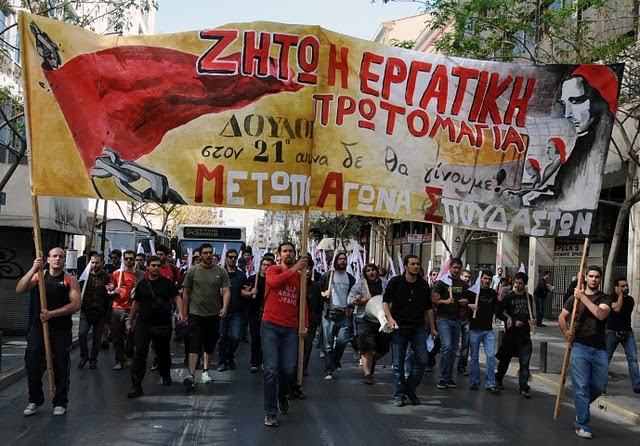
The strike mobilisations on the MayDay organised by the All Workers’ Militant Front (PAME) in 75 cities throughout Greece, were a watershed event in the mobilisations of the class movement during the last period. The participation exceeded all the previous as tens of thousands of workers, men and women, young people, pensioners and immigrants, self-employed demonstrated their determination to clash with the new anti-workers, anti-peoples’ measures decided by the social-democrat government together with imperialist unions and organisations such as the EU and the IMF and with the support of the conservative party of the ND and the nationalist LAOS.

Thousands of workers and especially young ones -to whom this year’s Labour Day was dedicated- have rallied once more and in a difficult and critical juncture with PAME, the main and authentic force that expresses the interests of the working class in the labour and trade union movement and in the struggles.

The participation of the workers proved that once again they turned their backs on the opportunist parties and on the compromised leaderships of the confederations of the trade unions in the private (GSEE) and public sector (ADEDY) that seek a variation within the EU supposedly in favour of the people, exonerating it in a provocative way in contrast with the IMF and sowing illusions for the possibility of the formation of a different, a “good” stability pact within the imperialist EU. Their rallies had not only scant participation but also prearranged provocative incidents took place aiming to make large masses of workers withdraw from the struggle and to be reproduced by the media in order to cover the slogans and the volume of the demonstrations of PAME that targeted against the aims of the plutocracy.

As noted by the main speaker of the rally of PAME in Athens “In the name of all the dead of our class and of the young generation, PAME calls upon the working class to lead the struggle to confront the brutal offensive against all peoples in Europe”.

The new measures announced by the government on Sunday, May 2 are literally a slaughter: they abolish the 13th and 14th wage in public sector and transform them to a gratuity; likewise the 13th and 14th pension (both in private and public sector); they freeze the wages in public and private sector for thee years; they promote the anti-social security measures for the increase of retirement ages; they impose drastic cuts on pensions; they increase the redundancy threshold from 2% to 4%. Moreover, they impose rise in VAT on public consumption goods from 21% (after the rises before two months) to 23%, the abolition of the collective labor agreements, drastic cuts of benefits and redundancy payments, mass dismissals in public sector and local administration.

But above all the measures include the most important element for the increase of the capitalist profits that is the complete overthrow of the labour relations while they grant new provocative benefits to the big capital. At the same time, they prepare the ground for the complete abolition of the 13th and 14th salary and pension both in private and public sector.

The class oriented forces of PAME are giving a militant response to this wave of anti-labor measures. They call on the people to be in alert and to go on a new general strike on Wednesday 5 May. With the slogan “the plutocracy to go bankrupt” they call the working people to participate even more determinately in the picket lines and the strike demonstrations of PAME throughout the country.

“No matter how many billions they lend to the Greek state this does not mean anything for the people. After all capital will continue exploiting the working people even harder and the decayed political system will continue treading down and intimidating them, it will continue to need workers without dignity”, stated Aleka Papariga, General Secretary of the Communist Party of Greece at the demonstration on May Day.

On behalf of Communist party of Greece she also rejected the ostensible meeting of political leaders which as she stated “it aims only at giving the impression that people consent”. In addition, KKE stated that “there is absolutely no need to meet with the representatives of the “troika” (EU, European Bank, IMF)” and therefore refused to participate in such a meeting as the yellow trade unions and the other bourgeois parties did.

The insanities of our era

Reflections of Fidel

THERE is no alternative but to call things by their name. Anyone with minimal commonsense can observe without much effort how little realism remains in the current world.

When United States President Barack Obama was awarded the Nobel Peace Prize, Michael Moore stated "Now please earn it!" That witty comment pleased a lot of people for its acuity, although the Norwegian committee’s decision was perceived by many as no more than demagogy and an exaltation of the apparently inoffensive politicking of the new president of the United States, an African American, a good speaker and an intelligent politician at the head of a powerful empire enveloped in profound economic crisis.

The Copenhagen world meeting was about to take place and Obama raised hopes of a binding agreement in which the United States would join a world consensus in order to avoid the ecological disaster that is threatening the human species. What occurred there was disappointing; international world public opinion had been the victim of a painful deception.

In the recent People’s World Conference on Climate Change and the Rights of Mother Earth, which took place in Bolivia, responses full of wisdom were put forward by the ancient indigenous nationalities, invaded and virtually destroyed by European conquistadores who, in their search for gold and easy riches, imposed over the centuries their egotistic cultures, incompatible with humanity’s most sacred interests.

Two news items that arrived yesterday express the philosophy of the empire in its attempt to make us believe in its "democratic", "pacific," "altruistic" and "honest" nature. Suffice it to read the text of those agency cables from the capital of the United States.

WASHINGTON , April 23, 2010—"The Obama administration is considering deploying a new group of intercontinental ballistic weapons that could deliver large conventional warheads, non-nuclear but capable of reaching targets anywhere in the world in approximately one hour and with a extremely powerful explosive capacity.

"While the new super-bomb, mounted on Minuteman missiles, will not have nuclear warheads, its destructive capacity will be equivalent, as confirmed by the fact that its deployment is anticipated in the recently signed START 2 agreement with Russia.

"The Moscow authorities demanded and succeeded in having inserted in the agreement, a provision demanding the United States decommission one nuclear missile for every missile it deploys.

"According to reports in The New York Times and on CBS News, the new weapon, baptized PGS (Prompt Global Strike), could carry out tasks like killing terrorist Osama bin Laden in a cave, destroying a North Korean missile as it is being transported to the launch pad, or demolishing an Iranian nuclear site - all without using nuclear bombs.

"The advantage of having a non-nuclear weapon with the same localized impact effects of a nuclear bomb is considered interesting by the Obama government.

"The project was initially proposed by Obama’s predecessor, Republican George W. Bush, but was blocked by Moscow’s protests. Bearing in mind that the Minuteman also transport nuclear warheads, the Moscow authorities said, it would be impossible to establish that the deployment of a PGS was not the beginning of a nuclear attack.

"But Obama’s government considers that it can give Russia or China the necessary guarantees to avoid misunderstandings. The launch facilities of the new weapon will be mounted in sites at a distance from nuclear warhead deposits and will be open to periodic inspection by Moscow or Beijing experts.

"The Prompt Global Strike warhead would be launched on Minuteman missiles armed with 1,000-lb. conventional warheads, designed to strike targets with incredible accuracy.

"Responsibility for the PGS project – which is estimated to cost $250 million just in the first year of experimentation – has been handed to General Kevin Chilton, chief of the U.S. nuclear arsenal. Chilton explained that the PGS will fill a gap in the Pentagon’s current range of options.

"‘Today, we can present some conventional options to the president to strike a target anywhere on the globe, but within a time span of at least four hours,’ said the general. ‘To act on a particular target faster than that, the only thing we have is a nuclear response.’"

"In the future, with the new missile, the United States could act rapidly and with conventional resources, both against a terrorist group or an enemy country, in a much shorter time period and without arousing international anger at the use of nuclear weapons.

"It is anticipated that the first tests will begin in 2014, and that by 2017 it would be available in the U.S. arsenal. Obama will no longer be in power, but the super-missile could be the non-nuclear legacy of this president, who has already won the Nobel Peace Prize."

"WASHINGTON, April 22, 2010—An unmanned Air Force space plane was launched this Thursday from Florida, in the midst of a veil of secrecy over its military mission.

"The rocket carrying the reusable X-37B Orbital Test Vehicle lifted off at 7:52 p.m. EDT (2352 GMT) from Cape Canaveral Air Force Station, according to a video distributed by the army.’

"‘The launch is imminent,’ Air Force Major Angie Blair told AFP.

"Resembling a small space shuttle, the aircraft is 8.9 meters in length and 4.5 in wingspan.

"The manufacture of the reusable space shuttle has taken years and the army has only offered vague explanations as to its objective or role in the military arsenal.

"The vehicle is designed to ‘provide the environment of a ‘laboratory in space’ to test new technologies and components before these technologies are assigned to satellite programs in operation,’ stated the Air Force in a recent communiqué.

"Officials have stated that the X-37B will land at the Air Force Vandenberg Base in California, but they did not say how long the inaugural mission will last. ‘

"‘To be honest, we don’t know when it’s going to come back,’ Gary Payton, second assistant secretary of Air Force space programs, told reporters this week.

"Payton stated that the shuttle could remain in space for up to nine months.

"The aircraft, manufactured by Boeing, began as a National Aeronautics and Space Administration (NASA) project in 1999 and was then transferred to the Air Force, which plans to launch a second X-37B in 2011."

Is anything more needed?

Today they have found themselves with a colossal obstacle: the now uncontainable climate change. The inevitable temperature increase of more than two degrees centigrade is being mentioned. Its consequences will be catastrophic. In just 40 years the world population will increase by two million, thus reaching a total of nine billion people; in that brief period: docks, hotels, seaside resorts, communications, industries and installations in the vicinity of ports will be submerged in less time than is required for the enjoyment of half of the existence of the generation of one developed and rich country, which is currently refusing to make the most minimum sacrifice to preserve the survival of the human species. Agricultural land and potable water will be considerably reduced. The seas will become polluted; many marine species will become impossible to consume and others will disappear. This is not affirmed by logic but by scientific investigations.

Via natural genetics and the transfer of varieties of species from one continent to another, human beings succeeded in increasing production per hectare of food and other products useful to humans which, for some time, alleviated the scarcity of foodstuffs like corn, potato, wheat, fibers and other necessary produce. Later, genetic manipulation and the use of chemical fertilizers similarly contributed to the solution of vital needs, but they are now reaching the limit of their possibilities for producing healthy food appropriate for consumption. On the other hand, in barely two centuries, hydrocarbon resources that nature took 400 million years to form are being exhausted. In the same way, vital non-renewable mineral resources that the world economy requires are being exhausted. At the same time, science created the capacity of self-destroying the planet several times in a matter of hours. The greatest contradiction in our era is, precisely, the capacity of the species to destroy itself and its incapacity to govern itself.

Human beings have succeeded in raising their possibilities of life to limits that exceed their own survival capacity. In that battle raw materials in their reach are being consumed at an accelerated rate. Science made it possible to convert matter into energy, as occurred with nuclear reaction, at the cost of enormous investments, but the viability of converting energy into matter is not even on the horizon. The infinite cost of investment in pertinent investigations is demonstrating the impossibility of achieving in a few dozen years what the universe took tens of billions of years to create. Is it necessary for the child prodigy Barack Obama to explain that to us? Science has grown extraordinarily, but ignorance and poverty are also growing. Can anyone demonstrate the contrary?


Saturday, May 1, 2010

CPI(M) Karnataka state Committee plans ‘mammoth' protest rally in September

MYSORE: The Communist Party of India (Marxist) will stage a mammoth rally in Bangalore in September to protest against the State Government's “administrative failure on all fronts and its inability to distribute ration cards to the poor”.

This was decided at the State Secretariat meeting of the party, which concluded here on Friday. CPI(M) State Secretary V.J.K. Nair told presspersons that the party would mobilise lakhs of people to participate in the rally, which would underline the growing resentment of the economically weaker section of society towards the Government. He said the Bangalore rally is part of the ongoing agitation against the Government's anti-people policies.

Mr. Nair said even though the Centre was responsible for the increase in prices of essential commodities, the State Government had failed to bail out the common man by way of subsidies, but had no compunction in releasing funds to maths. The BJP Government in the State had increased the prices of milk, water, bus fares and it was reluctant to reduce its cess on petrol and diesel to minimise the impact of hike in petroleum prices, Mr. Nair added.

He pointed out that the State Government had failed to make good its promises of distributing 35 kg of rice at Rs. 2 per kg and free power supply to farmers.

Corporate subsidies

The CPI(M) said subsidy to the poor could be garnered by reducing the subsidy to industries and the corporate world. About 1,500 companies had received subsidies of about Rs. 5 lakh crore, he said, adding that if this was cut down, it could help subsidise food for the poor.

Mr. Nair said farmers received a pittance as compensation in lieu of land from the Government.

Tax relief

Lampooning the Rs. 400 crore tax relief announced by the Union Finance Minister Pranab Mukherjee on Thursday, he said this only favoured the rich and the higher-middle class as most of the relief was for the aviation industry, construction, etc.

CITU May Day Pledge

The trend in the working class movement which confined itself to the immediate struggle only, which looked upon May Day as only for declaration and assertion of partial demands, diverted the working class movement from its revolutionary objectives, and ending of capitalist rule and establishing socialism and working class power” wrote Comrade BTR in Working Class on the eve of May Day, 1986 and today after 24 years when capitalism stands totally exposed world over after the so called global finance meltdown, these words should arm the working class with revolutionary arsenal to battle against capitalist exploitation in the neo-liberal form. The neo-liberal economic policy, driven as it is by the international finance capital, aims at quickest way of maximizing the profits. As a result May Day this year sees the workers locked in a grim combat against the attacks of rising prices, inflation, attacks on wages, indecent jobs and monstrous rise in unemployment. India is no exception, confronted with double digit inflation with 1/3rd of world‘s hungry population living in the country where 77% of the population can not spend more than Rupees 20 per day.
Working Class in India has been undergoing relentless onslaught of the neo-liberal policies since early nineties under the cover of a fanciful word coined for this purpose - Globalisation. The proponent and cheerleaders of this new brand of economic imperialism led by the ruling polity, the multinationals / domestic corporates and their captive media are trying to misinform and mislead the country that the IPL, Satyam, Illegal Iron Ore Mining by Reddy’s of Bellary and others, Share Scam of Nineties etc. etc. are only aberrations and not part and parcel of casino – capital driven neo-liberal economy. It is for the working class, whose rights and livelihoods are being jeopardized at every step, to expose the real face of present day capitalism and neo-liberal globalization which is a daylight (‘nightlight’ of IPL), loot and fraud on the economy and the people of the country. Neither Government enquiry nor JPC can even cosmetically treat the ugly face of the capitalism, in the bizarre scenario of ‘corporatisation of politics’, ‘Dinakaranisation of judiciary’, ‘pricing of news’, ‘Tharoorisation of Congress” or ‘Reddyisation of BJP’ and so and so forth
Establishment of Socialism and Working Class power is the only alternative as pointed out by Comrade BTR. Let us rededicate ourselves to this cause on this year’s May Day.

Tuesday, April 27, 2010

Successful Countrywide Hartal

Hyderabad - Andhra Pradesh

The call given by the thirteen parties for a countrywide hartal against price rise on April 27 has met with a big response in most parts of the country.

The thirteen parties call was joined by other parties in the states.

The success of the hartal shows the anger and discontent among the people at the failure of the Central Government to check price rise. There was a complete hartal in Bihar, Uttar Pradesh, West Bengal, Jharkhand, Assam, Orissa, Kerala and Tripura. In Andhra Pradesh, there was a successful bandh all over the state with the strike being partial in Hyderabad. In Tamilnadu too there was a hartal all over the state with Chennai having a partial strike.

In West Bengal, there was a total stoppage of work and movement of traffic. In Uttar Pradesh, in all cities and towns markets were closed and rail and road traffic were affected in many places. In Bihar there was a total hartal in all the districts. Rail and road traffic was disrupted due to rail and rasta roko. Markets, commercial establishments and educational institutions remained closed.

In Jharkhand, markets were closed and rail and road traffic came to a halt. Several state government offices remained closed.
In Orissa, all central government offices, central public sector undertakings, banks, railways were paralysed. State government offices in many districts were also closed. Road and railway traffic was paralysed.

In Kerala, all shops and commercial establishments remained closed. Road and rail traffic were paralysed. In major cities and towns LDF workers held demonstrations in support of the hartal.

In Tripura, there was a complete strike with all offices, markets and educational institutions being closed. All vehicular traffic also came to a halt.
In Maharashtra, all the districts observed rasta roko and rail roko for various periods. In Karnataka, more than 50,000 people protested against price rise in Bangaluru and the strike was a success in other districts. In Madhya Pradesh, there was hartal in Gwalior, Morena, Shivni, Bind, Rewa, Singroli and Indore.

In Himachal Pradesh, markets remained closed in Shimla and rasta roko was observed in various parts of the state.

In Chattisgarh, there was hartal in the state capital Raipur. Shops, commercial establishments, hotels and the main markets remained closed. In many parts of the state rasta roko and rail roko was also observed.

In Punjab, there was rasta roko in twenty places in the state. In Haryana, in all towns, there was hartal with markets remaining closed.

In Delhi, there was a strike in many industrial areas by the workers. There was rasta roko and picketing in 25 spots in the city, Ghaziabad, and Noida.

Calcutta - Westbengal

Ranchi - Chathisgarh

Danbad - Jharkand


Chennai Central Railway station

Chennai - Guindy Railway station

Belgaum - Karnataka

(Photos - Gavaskar @Theekathir, The Hindu)

Monday, April 26, 2010

Phone Tapping: Home Minister's Statement Unconvincing

The Polit Bureau of the Communist Party of India (Marxist) has issued the following statement:
The statement by the Home Minister denying that any interception/tapping of phone calls of political leaders has taken place, is unconvincing. The government would find it expedient to deny the use of intelligence and security agencies for such surveillance.
 
The CPI(M) demands an independent probe into the matter so that the truth can be uncovered.

Sunday, April 25, 2010

CPI(M) Submits Note On Telangana Issue

A delegation of CPI(M) Andhra Pradesh state committee met V K Fuggal, member secretary of Sri Krishna committee on April 13. The committee was formed by home ministry for consultations with regard to the present situation in Andhra Pradesh, in the back ground of separate Telangana movement. The CPI(M) delegation comprising V Srinivasa Rao, central secretariat member, Penumalli Madhu (MP), Central Committee member, S Veeraiah, state secretariat member submitted a note to the committee. The following is the full text of the note submitted by the delegation.

1. The Communist Party of India (Marxist) Andhra Pradesh committee opposes the division of Andhra Pradesh in any manner.

2. The formation of Andhra Pradesh was the result of a sustained movement for the creation of a unified linguistic state for all the Telugu-speaking people. The Vishalandhra movement was actually demanding the fulfillment of a promise made during the freedom struggle that the provinces of India would be reorganised on a linguistic basis. The Indian National Congress first accorded recognition to this principle by reorganising the Pradesh provincial committees of the Congress party on a linguistic basis as early as 1921 at the Nagpur session.

3. The creation of linguistic states undid the legacy of colonial rule which set up multi-lingual provinces purely for the administrative purposes of the British rulers. The States Re-organisation Committee explicitly recognised the linguistic principle for the formation of states. The formation of Andhra Pradesh in 1956 was followed by the setting up of states like Kerala, Karnataka, Maharashtra, Gujarat and so forth. Thus, one of the major steps for democratising the Indian State system was undertaken. Restructuring the states on linguistic lines was an essential step for expanding democracy since it enabled people to have an administration and educational set-up in their own language. Within such a state adequate safeguards for linguistic minorities was to be provided.

4. The formation of linguistic states provided the bedrock for the federal system in our country. The states thus formed have developed and contributed to the federal polity and the democratic political system. Dividing these states into smaller states will weaken the federal principle. Small states emerging out of the division of the linguistically homogenous states will be more dependent on the centre and this will militate against the federal principle. The CPI (M) has always held that we need both a strong centre and strong states to strengthen national unity.

5. Secularism is the foundation on which national integration and unity depends. Division of existing linguistic states and fragmentation of existing states into large number of smaller states will weaken the ability of the states to curb and control the disruptive forces of various hues including forces of communalism. Our country is a country of unity in diversity. Those who want to impose on India a religious identity would utilise weaker and smaller states to weaken communal harmony, thus endangering national integration.

6. Uneven development and regional backwardness within states have grown since independence. The nature of capitalist development is such where capital and resources flow into areas where infrastructure exists. This aggravates the problem of regional disparities. Such problems exist irrespective of the size of the states.

With the introduction of liberalisation policies in 1991, the situation further deteriorated. Disparities between states, between the regions and within the states further widened. Even within the same region, imbalances have grown between the districts and within the districts too. With regard to the development of the state, various studies carried out by experts at different periods have proved this. (Development of Andhra Pradesh 1956 – 2001, A study of Regional Disparities, edited by Y V Krishna Rao and S Subramanyam and two more studies on the regional and district level development and on development of various social and economic classes in Andhra Pradesh by ‘Sodhana’, Sundaraiah Vignana Kendram, Hyderabad.)

Withdrawal of the state from developmental activity, leaving the field to market forces as a part of the new economic policies is the primary reason for this state of affairs. Without addressing this fundamental policy problem, formation of a new state is not going to solve the problem of regional imbalances.

7. Telangana is a region which has been historically underdeveloped and backward since the days of the Nizam. Although the oppressive, regressive feudal régime of Nizam was over thrown in 1950s and Telangana became a part of united state, the feudal vestiges were not thoroughly destroyed to pave the way for modern democratic development at the grass root level. Out of 54 years of existence of Andhra Pradesh, Congress ruled the state for 40 years, Telugu Desam ruled for 14 years. Both these parties failed to implement the agreements and promises made by them to overcome the backwardness of the Telangana region. During the last five decades, lot of changes took place in the development of the state. The nature, extent and location of under development also changed. Inspite of many changes, the development of the Telangana region has lagged behind and the scope for employment opportunities have not been commensurate to the needs. The proportion of irrigated area to total sown area is less in Telangana and the Rayalaseema areas. Most of the educationally backward mandals are situated in Telangana and North Andhra. A large section of those who suffer due to the underdevelopment of the Telangana region are the tribals, dalits, artisan communities and minorities.

8. The division of the state of Andhra Pradesh is however, not the solution for the problems of backwardness. The arguments put forward by various proponents of division of the state are not based on scientific rational basis. It will be misleading to conclude that a separate state per se will ensure development. The problems of underdevelopment and socio-economic backwardness have to be tackled through specific measures.

i) Priority should be given to those irrigation projects which cater to the needs of Telangana and other backward areas of Andhra Pradesh.

ii) A comprehensive land distribution programme should be undertaken in the state with special focus on Telangana to break the grip of feudal forces.

iii) A crash programme has to be adopted to improve educational facilities in the identified backward mandals throughout the state.

iv) Special attention should be paid to the areas where health indicators are poor when compared to the state average.

v) Special measures must be adopted to improve the economic and social position of the dalits, girijans (tribal people) minorities and artisan communities. Many of the development indicators are poor in those mandals where the proportion of the dalit, tribal and minority population is large. This is true especially with relation to Telangana region. Development of these vulnerable sections is necessary to bridge the developmental gap between regions and sub regions.

vi) A comprehensive study of the imbalanced development among different regions, sub regions, districts and mandals is needed. A development index for each mandal should be developed. On this basis, comprehensive plans have to be prepared.

vii) There should be strict implementation of GO No 610 and rectification of past distortions. A constitutional amendment should be made to remove the exemption given to police department pertaining to Hyderabad in the presidential orders.

viii) Special funds have to be earmarked for the development of backward mandals in every budget and a separate mechanism to be created to oversee the implementation of the special plans for the backward areas.

ix) Special incentives should be given by the government to attract investments to the backward areas.

We urge the committee to consider all these aspects carefully. It should also keep in mind that the division of Andhra Pradesh which was the first major state to be formed on the linguistic basis will open up a plethora of demands for new states to be carved out from the existing linguistic states. Instead of tackling the root cause of regional imbalance, backwardness and underdevelopment, the demand for setting up of new states will be a diversion and open up a host of intra-state problems which can heighten differences and weaken the unity of the people of the country.

Forward to April 27 Nationwide Hartal

THE call for a nationwide hartal on April 27 given by four Left parties and nine other non-Congress secular opposition parties is gaining momentum with regional parties in various states coming forward to join this countrywide protest against the relentless rise in the prices of all essential commodities.

Simultaneously, it is very likely that on that very same day, April 27, a cut motion will be moved in the Lok Sabha on the budgetary demands for grants seeking the rollback in the hike in the prices of petrol, diesel and fertilisers. The anxiety in the ruling coalition is growing because if such a cut motion is adopted by the Lok Sabha, then the government has to go, according to our constitution. This has become a possibility because some parties that extended outside support to this UPA-2 coalition like the Samajwadi Party, Rashtriya Janata Dal and Janata Dal (Secular) have joined this protest action and are party to the joint hartal call.

Such an anxiety amongst the ruling coalition in its very first year in government is, indeed, unprecedented. In the last two decades of coalition governments at the centre, the party leading the coalition never had more than 200 seats in the Lok Sabha. This time around, the Congress party leading the present UPA coalition government has more than 200 seats. Yet, it is counting its numbers in the Lok Sabha today! It has nobody else to blame except itself. The audacious manner in which it has imposed extra economic burdens on the people and the continued shameless justification of it has led many a supporting party to join the ranks of the Left opposition.

The objective of this nationwide hartal is not the destabilisation of the central government. Its objective is very simple: force the government through public pressure mounted both outside and inside parliament to rollback the backbreaking hikes in the prices of petrol, diesel and fertilisers. If the UPA-2 government accedes to this very justifiable demand, then, of course, the question of its instability will never arise. However, if it chooses to do otherwise, then it alone shall have to bear the responsibility for any consequences.

People’s mounting anger at the economic hardships being imposed on them can be understood by the fact that the overall inflation rate based on the wholesale price index (WPI) was 9.89 per cent as of April 3, 2010. This is way ahead of the RBI’s revised target of 8.5 per cent. Worse is the fact that food inflation stood at 17.22 per cent implying that for months on end, the vast majority of the Indian people are seeing the continuous decline in their livelihood standards.

There is a new found euphoria regarding the so-called recovery of the Indian economy overcoming global recession. This is based on the fact that the index of industrial production (IIP) grew at 17.6 per cent in December 2009, 16.7 per cent in January 2010 and 15.1 per cent in February. Notwithstanding the low base of last year due to global recession, these may appear to be healthy rates of growth. There is, however, a very important fact hidden behind these aggregate figures. Within this high IIP growth rate is the fact that consumer durables (automobiles, fridges, TVs etc) grew by 29.9 per cent while consumer non-durables (mainly food and other articles of daily consumption) grew by a mere 2.3 per cent. This is for the month of February 2010. For the year 2009-10, the average growth of consumer non-durables was just 1.6 per cent compared to 25.75 per cent for consumer durables.

It is universally accepted that the consumption of non-durable items is driven by low and middle income consumers who spend a bulk of their money on food and not so much on consumer durables. There is a near unanimous view amongst all economists and experts that “inflation has affected the purchasing power of the lower income group especially food inflation and that is reflecting in the deceleration of growth in the consumer non-durables sector”. This clearly shows that the vast majority of Indian people continue to groan under mounting economic miseries due to this relentless rise in the prices of essential commodities.

Clearly, as argued in these columns in the past, the class nature of the stimulus packages and the tax concessions to the rich ostensibly to combat global recession have only made the rich richer and the poor poorer. The hiatus between the `shining’ and `suffering’ India continues to widen.

The Left parties had demanded, apart from the rollback of the price hikes announced in the budget, a complete ban on all forward/futures trading in all essential commodities and the release of surplus foodgrains held in central godowns through a universal public distribution system to control this relentless price rise. These have so far fallen on deaf ears.

The April 27 nationwide hartal and the moving of cut motions in the parliament are aimed at making this UPA-2 government hear the agonies of the people and rollback the budgetary hikes in the prices of petrol, diesel and fertilisers. It is only the strength of a powerful people’s mobilisation that will force this government to act in the interests of the people as against its current pre-occupation with bolstering super profits for the rich.
(Peoples Democracy)

On Phone Tapping

The Polit Bureau of the Communist Party of India (Marxist) has issued the following statement:
On Phone Tapping
The report published in the Outlook magazine about the interception of phone calls of four political leaders, including the General Secretary of the CPI(M), is a serious matter. The report shows that the government is using the intelligence and security agencies to serve its political purpose to spy upon opposition leaders and to keep track of even its own allies and party leaders.
Such acts subvert the democratic system and breeds an atmosphere of illegality in the higher echelons of the government. They cannot be tolerated.
The government must own up responsibility in the matter and take action against those who ordered the surveillance. Protecting the covert activities of the intelligence and security agencies cannot be made the pretext for a cover-up.
To ensure that such illegal acts do not recur, the government should place in Parliament a clear set of guidelines prohibiting the use of the intelligence and security agencies for any form of surveillance of political leaders and their activities. Instructions on tapping of phones and surveillance on grounds of national security or investigation of criminal activity must be codified. The intelligence and security agencies must be subject to parliamentary oversight.

Friday, April 23, 2010

SITARAM YECHURY’s speach in Rajya sabha on 15th April, 2010 on Maoism


Treasury Benches for fielding my learned friend, Keshava Rao, before I stand up to speak because it is indeed a double task that I have to do to come back to the topic, with all due respect.


We are discussing right now, Sir, the statement that the hon. Home Minister has made on the Dantewada massacre. We have t for that. But the point that I would like to highlight right now is that the Dantewada incident is not an incident in isolation. This is happening as a part of a policy, as a part of developments and activities that have intensified since the UPA-II Government has come. Since the General Elections in 2009, Sir, according to the figures of the Home Ministry itself, 993 lives have been lost due to Maoist violence, of which 340 are security personnel.(Only yesterday, in West Bengal, two more of my party's cadre were hacked to death by the Maoists, taking the total to 176 in the months since May last year.)

This is something which only demonstrates very, very eloquently, but chillingly, with murderous assaults and attacks, that the Maoist menace is mounting. Now, taking this as a general figure, looking at it in a general way, we entirely agree with the fact that this is not an issue or menace which can be tackled by apportioning blame. If you look at the States that are involved, apart from the Central Government, you have West Bengal, Orissa, Jharkhand, Chhattisgarh and Bihar, all these States where this current problem is persisting are States that are run by Governments led by different political parties. So, unless we have a unified approach on how to tackle this issue, we cannot succeed and that is something we must actually keep in mind and not be bothered about where the buck stops. The buck stops with India. The buck stops with the Government and the buck stops with all of us here in the Parliament. Are we going to break up the parliamentary democracy that we have built up so laboriously? Are we going to change it for the better for the people or not? That is where the buck should stop. Let us not pursue these bucks and let us actually try in right earnest to come down to how do we try and solve this problem.


The point that was made by the hon. Leader of the Opposition, a point that I have been making and we from the Left have been making in this House for the last nine months or so, is that there is a fundamental contradiction that is feeding the growth of such Maoist violence in our country and that contradiction lies within the Central Government and the Union Cabinet of Ministers itself. I have repeatedly stated that on three occasions, the hon. Prime Minister has drawn the attention of the country stating, 'Maoist violence represents the gravest threat to India's internal security.' Now, having said this, how can you have members in the Cabinet, the same Union Cabinet, who not only say things to the contrary but actually act to the opposite? How can you have Union Cabinet Ministers -- it has been read out by the hon. Leader of the Opposition and I do not wish to read out those statements again --demanding the arrest of the elected Chief Minister of a State under our Constitution?
Hon. Chairman, you would have to assure us; we are the Council of States. If this is the way in which members of the Union Cabinet deal with elected Chief Ministers of the States and ask for their resignation openly in the media, can the Government keep quiet? Is the Government not answerable to the country? How is it that on the one hand, the Prime Minister, the leader of the Cabinet, says that this is the gravest threat to India's internal security and on the other, you have members who not only say that it is not the gravest threat but also that they have no Maoists operating in Bengal at all.


They say there are no Maoists operating in Bengal at all and ask for the withdrawal of the Central forces. How can you co-exist with these contradictions? If you are co-existing with these contradictions, I am sorry to say that it is the height of political opportunism. Just for numbers in the LokSabha, if you are going to allow the country's internal security to be compromised, then this Government is doing a very big disservice to the country, just for the sake of its survival. Governments may come and Governments may go. But, what is of concern is the nation; what is of concern is the country; what is of concern is this institution called Parliament and parliamentary democracy. Don't play with it. Don't, for the sake of your political survival, allow such forces to feed and provide sustenance for this Maoist violence to spread. And that is my point. Why is it that 30 years after this Movement came into existence, the Maoist violence has reared its head in Bengal again.


That is the point this country must understand. You have the re-entry of Maoists into Bengal behind political flags and banners of legitimate political parties operating within parliamentary democracy. Maoists are being used in order to serve petty electoral purposes and petty electoral ambitions in a particular State. Can we allow such indiscriminate use, such despicable use of methods in order to somehow wrest power in a particular State?
Please remember, Naxalbari is a village that exists in Bengal today. It existed in Bengal always and the uprising that took place in Naxalbari in 1967 from there the term 'Naxalites' has arisen. After that uprising there in 1967, there was a big debate within the Indian Communist rule. I need to refer to this because sometimes there have been references saying that we, CPI(M), are after all cousins of Maoists or, at one point of time, we had allegedly supported them and this only can come from those people who have not really understood our history. The Communist Party of India (Marxists) was divided in 1967 by a small group of people who had argued that Naxalbari uprising was the way for revolution and emancipation of India. We had disagreed with them. We had told them that it was only through the combination of parliamentary means and extra parliamentary means that we could achieve social transformation. But in an erroneous understanding that the Indian ruling classes are comprador in the sense that they do not have their own social basis and all that is required is to arm the people, they armed the people and, therefore, by arming the people the slogan of People's War emerged. The slogan of People's War was 'Arm the people' so that they can capture power. It was all easy because the ruling classes do not have a social base. That was the wrong ideological understanding and that understanding had to be combated and that was combined with the policy of individual annihilation, individual annihilation of originally class enemies and now, as it is being pointed out, individual annihilation of all those who are opposed to them. It is the combination of this which is ideological and ideological strain which we think is completely wrong both in terms of understanding Indian reality and in the methods employed to achieve a social transformation in our country and it is an ideological battle that we, CPI, have been in the forefront for the last forty years.


We have lost thousands of our people in this ideological battle and it is because of this ideological battle that we succeeded in isolating them in West Bengal. So, today if we think of combating Maoism without an ideological battle, it can never succeed. The question of ideological battle rests on the basic fact that social transformation in India is necessary, but what are the means that you will apply and adopt for achieving such a social transformation and what is the concrete analysis of the concrete conditions that you are living in? This ideological battle is as important as re-establishing the writ of civic administration in these areas and re-establishing of the writ of civic administration is not negotiable. On that, there is no dispute among all of us. But it has to be combined with a political battle or political offensive against this, particularly the ideology which we think is undermining the foundations of modern India. That is why whenever such problems have occurred in West Bengal, in order to resolve these problems, we have repeatedly adopted the approach where an All-Party Meeting is called in these affected areas. Twenty-eight All-Party Meetings have been called since the last General Election to tackle these Maoists' violence in these areas, but not one of them was attended by the ally of the Congress Party who is now sitting in their Cabinet. The reason for not attending is not to legitimize this process but to allow or use the Maoists in order to create terror in a particular area and use the terror to browbeat people into politically supporting them.


So, this is a tactic of terror. This is politics that is being operated through terror. And it is this politics of terror that needs to be fought today. I think what is required is a combination of measures required by law and order and ideological political struggle against the Maoists and Maoism itself. Unless this combination is adopted, I don't think we can actually succeed. Therefore, I would sincerely urge the Government at the Centre and I sincerely urge the Prime Minister, the Leader of the House, to please come here and explain to us how he has Members in his own Cabinet who think completely opposite of what he has been telling the nation as far as Maoists violence is concerned and do not compromise the interest of our country for the sake of continuation of your Government.


You may be happy, like once Winston Churchill famously remarked during the Second World War, "Let the Communists and Fascists kill each other and then we shall enter.", and he delayed the second front. If that is the thinking of the Congress Party today, I am sorry, it will only lead to a sort of devastation that the world had seen during that time. If they think that let the Maoists and the Marxists fight each other out and let them deplete themselves, and then, they will enter in order to restore the peace in that region, then they will destroy the very basis and the foundations of the parliamentary democracy in our country. So, they have to be extremely clear. In this, what is required by the Central Government, as I mentioned earlier, in these five States that you are talking about right now with five different Governments, but unless you take on board all the political parties-- and that requires a complete non-partisan approach -- and the Central Government co-ordinates these activities, you cannot really solve this problem.
Mr. Deputy Chairman, Sir, you come from a State that was also infamous for having bandits like the Veerappan. For two decades, you could not catch him because whenever Karnataka Police moved, he would move into Tamil Nadu; whenever Tamil Nadu moved, he would come back into Karnataka, or go into Kerala. And, in this way, between the three States, he managed for two decades. You require a co-ordinated approach between all these States if you want to solve this problem. And, that requires a strong political will. That requires a strong political will only if you are able to coordinate between all these State Governments. That is required, and my appeal would be to all other political parties also who are running Governments in the States that this is not something on the basis of which, we should calculate our electoral fortunes for the future. This is a threat that needs to be met squarely. Otherwise, you will have series of actions that will continuously undermine the foundations of a modern parliamentary democracy in India.

And, that is why, Sir, when my learned friend, Dr. Keshava Rao, was talking about the method employed in Andhra Pradesh and he was talking about negotiations or talks as the way in which the problem was solved, please remember, the biggest thing that was undertaken by the Andhra Government then was Operation Grey Hounds.
Therefore, it is a combination that will have to be done. In fact, we have to learn from our own States which have actually tackled extremism in a very successful way, and one of those States from which we have to learn is the tiny State in the North-East called Tripura. In Tripura, they have tackled it by a combination of a political approach, a political will using the law and order measures and addressing the most important issue of development. And, addressing that issue of development can only be with a combination of this that you could actually control the growth of these extremists activities. And, the development issue is the third arm of this tripod. You require a tripod approach, and in that tripod approach, one leg is the law and order; the second leg is the political will and the political battle; and the third leg is to address the developmental concerns. Look at the area where all these activities are taking place. This is one of the richest areas in terms of mineral resources in our country. You have, through the year, successively in the Government, privatized the mining. And, all of us know what havoc private mines have been playing in other parts of the country. But, here, privatization of mining activities in the areas which are predominantly inhabited by tribal people has only added to the woes of the people there. The private mafias that come with the private mines and their activities, had only caused further miseries to the tribal population there who already could not have the benefits of development reach them.


Therefore, what is required is to also look into the policies, re-look into the policies, and, at least, try and understand why we oppose the privatization of these mines. You are creating situations of over-exploitation and extra burden being imposed on the people there. That is also adding to the backwardness of the people there apart from the traditional backwardness of the tribal areas. Therefore, what is required if you really, sincerely want to tackle this problem is a combination of these tripods. You will have to address all the three - law and order, a political will and a political battle against them, and address the developmental issues of the concerned population there. Unless this holistic approach is undertaken, we cannot really tackle this problem. The Home Minister, in his statement, said that there are two pillars of the policies that the Central Government has adopted. One is that of calibrated police action, and the other is that of development.


And, then, he goes on to say, the State Governments, therefore, have a primary responsibility. Sir, I find it completely contradictory. Now, you are saying that the State Governments have a primary responsibility. Yes; law and order is a State subject, and, the State Governments have a primary responsibility. There is no doubt about it. But when a law and order problem spreads beyond the borders of a particular State and goes into the borders of other States, then, of course, the concerned State Governments have that responsibility, but the task of the Centre in coordinating these actions of the State Governments become important.


I hope that instead of the Central Governing standing ready and willing to assist the State Governments, and, to coordinate the inter-State operations-- I am quoting it from the statement of the Home Minister -- this coordination of inter-State operations and willingness to assist the State Governments, should come in right earnest. There is no political scoring of points. The Home Minister is not here; perhaps he has gone to the other House. It is very,very ironic that he said to the Chief Minister of West Bengal, "the buck stops with you", and, then, within 48 hours, he had to say to the country, "the buck stops with me", after the Dantewada incident took place. Today, you may try and score a political point saying that the buck stops with you. Tomorrow, the development will tell you that the buck stops with you. Finally, as was said in the beginning, the buck stops with the country, buck stops with the nation, and the buck stops with the Government, which, at the moment, is given the responsibility to run the country.


Sir, I would also want to just touch upon one point, which, in this ideological battle against these forces, we also have to understand. We have made one appeal to the naxalites since they started and formed their party in 1969. They started work in 1967; splintered into various groups; got regrouped, and, in 2004, they came together and formed this party, the Communist Party of India (Maoists), and, since then, there is this growth in violence. Since then, we have always been saying, if you have a difference of opinion, come forward and put that difference before the people; let the people decide whether we are right or you are right. That is the approach, which we will have to adopt even now; and, in that ideological battle, we have to say it very clearly.


Unfortunately, Sir, -- I wish; I don't believe in such things -- but if there is a grave and if there is a Mao, then he would be turning upside down in his grave because his name is being grossly misused by these forces, I mean,when they call themselves as Maoists. Poor Mao was the man who said, no communist can survive unless he mingles with the people like a fish takes to water. It was Mao, who said, let a hundred flower bloom, let a thousand thoughts contend, and, it is only then that you know what truth is. You have to  seek the truth from the facts, and, that is what Mao taught us. They misused the name of ours; anyway, that is their democratic right, and, we can take on them ideologically. But, Sir, we have to realize that in this battle, we will have to be united in taking on them, on the basis of this tripod understanding. Finally, Sir, I would like to recollect, with some degree of anguish, the warning that Dr. Ambedkar gave to all of us and the country when he presented the final draft of the Indian Constitution to the Constituent Assembly for consideration and adoption. Yesterday was his 120th birth anniversary.


When he commended the Constituent Assembly to accept it, in his speech, he said, 'but this Constitution that we so laboriously have constructed, and, this structure that we so laboriously want to build, is beset with contradictions." And, he defined the contradictions, I think, very, very well. I can't find a better way of defining it. It is that the Constitution provides one man with one vote, and, one vote with one value. But our social conditions have not created one man with one value, and, as long as you have this contradiction that one man does not have one value, but you have one man having one vote, and, a vote having the same value. (Interruptions) We have created a system where you have given one man one vote, and, each vote has same value -- one vote, one value -- but one man does not have the same value.


So, unless you create a society where all men are equal, he warned that, Sir, and I quote, "What we have so labouriously built will be blown asunder by the very people who are suffering from this contradiction". And, if you really want to tackle the problem of extremism, the problem of anarchy, you will have to have a very serious re-look on the trajectory of this neo-liberal economic reforms that we are adopting because that is generating this sort of a situation where it is easy for an unemployed, insecured youth to take to arms and take to militancy because that is the only security it offers. Therefore, Sir, finally in conclusion, while waiting for the inquiry report on this specific Dantewada massacre, we will urge upon the Government to immediately inform us what is their decision with the people within their Union Cabinet who are providing both protection and patronage to the Maoists. Unless you take a firm, decisive step in that direction, we cannot succeed in combating this menace.
Thank you, Sir.